
Why you need BAS and autonomous pentesting together
Most security teams know the drill:
A new autonomous penetration testing tool gets deployed, and the first run is genuinely impressive. The dashboard surfaces critical findings, maps lateral movement paths nobody had documented before, and exposes a legacy service account that has been sitting idle for years.
Great. The red team feels like it’s found a force multiplier. The CISO feels like the “human element” of validation has finally been automated away.
Then, troublingly, by the fourth or fifth run, the new findings stop coming.
The tool keeps reporting the same stale issues, and the dashboard turns into another source of noise to add to your alert cacophony. What looked like a continuous validation capability has quietly become a periodic re-run of the same handful of well-trodden paths.
This isn’t a tuning problem, and it’s anecdotal. It’s a repeatable proof of the validation gap, the widening distance between what organizations are validating and what they’re reporting as validated. As autonomous pentesting moves from a niche capability to a default line item in most teams’ security budgets, this gap is becoming harder to ignore, and treating the tool as a complete validation strategy is becoming an increasingly risky bet.
Six surfaces, and where coverage breaks down
Marketing materials tend to promise “comprehensive” coverage, but a closer look at what autonomous pentesting does tells a different story.
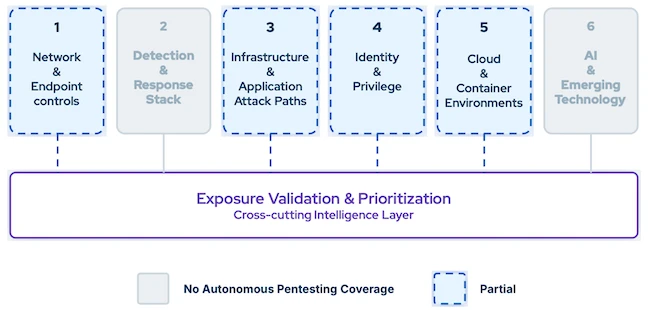
Six layers of attack surface
The modern attack surface can be broken down into six layers, and an autonomous pentesting tool, used alone, fails to fully validate any of them:
- Network and endpoint controls (partial). Investigates whether firewalls, WAF, IPS, DLP, and EDR block what they’re configured to block or not. Because “configured” isn’t the same as “effective.”
- Detection and response (none). Tests whether SIEM rules and EDR logic fire when they should. Autonomous pentesting runs as the attacker, so it can’t observe the defender. Detection is assumed, not measured.
- Infrastructure and application paths (partial). While infrastructure coverage is decent on the first run, application-layer chains often stay open once the PoC cliff hits.
- Identity and privilege (partial). IAM, Active Directory, and privilege boundaries get tested only where an attack path happens to traverse them, not systematically.
- Cloud and containers (partial). Cloud and Kubernetes posture is assumed to be secure based on initial configuration and is rarely re-validated even as configurations drift over time.
- AI and emerging tech (none). Guardrails on internal LLMs against jailbreaks, prompt injection, and adversarial manipulation go almost entirely unvalidated today.
Cutting across these is an intelligence layer: exposure validation and prioritization.
Matching theoretical CVEs against live control performance can take the 60%+ flagged “high or critical” down to the roughly 10% that are genuinely exploitable, cutting false urgency by more than 80%.
However, this only works if the underlying validation reaches all six surfaces. Otherwise, the prioritization engine is sorting noise.
The PoC cliff: a structural ceiling, not an operational one
Practitioners have started calling this diminishing-returns pattern the proof-of-concept (PoC) cliff: the sharp drop in new findings once an autonomous pentesting tool exhausts the fixed scope of attack paths it knows how to chain together.
By design, this is what autonomous pentesting does well. It produces its strongest results on the first run, when there’s still plenty of unexplored terrain. Within a few cycles, however, exploitable paths within the tool’s scope inevitably get patched or blocked, and the tool runs out of new things to discover. This doesn’t mean your environment is now secure. It simply means the tool has reached the edge of what it can see.
The reason is architectural.
Why? Autonomous Pentesting chains its steps: Step B depends on step A, step C depends on step B. Once a defender patches the specific path the tool prefers, the chain breaks. The tool may have twenty lateral movement techniques in its catalog, but if it gets caught at step A, the other nineteen never execute. Teams walk away with a falsely comforting “mission accomplished” feeling while large parts of their attack surface remain unprobed.
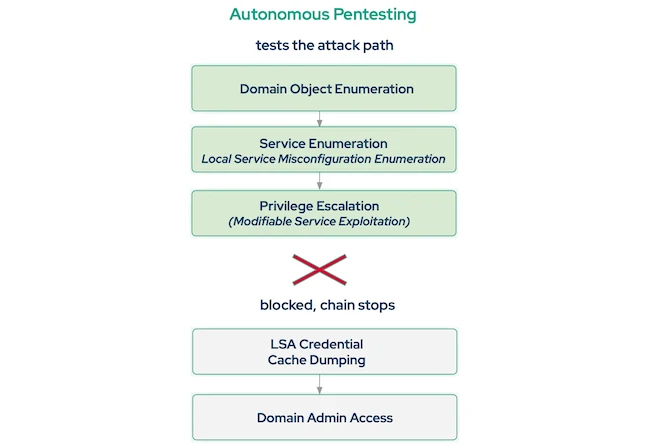
Autonomous penetration testing runs directionally
Breach and attack simulation (BAS) operates on a different principle.
It doesn’t chain. It runs thousands of independent, atomic simulations, each with its own clean execution context. A blocked exfiltration test over DNS doesn’t prevent the next exfiltration test over HTTPS. A failed lateral movement technique does not stop the platform from running the other nineteen.
One approach tests the path. The other tests the shield.
BAS and autonomous pentesting are complementary, not interchangeable
A growing point of market confusion is the idea that autonomous pentesting can simply replace BAS.
On the surface, the consolidation pitch sounds rather reasonable. In practice, however, the two technologies answer fundamentally different questions, and swapping one for the other is a coverage regression dressed up as a simplification.
BAS asks: Are my firewalls, EDR, WAF, SIEM, and DLP doing their jobs across the MITRE ATT&CK framework? Here, the unit of measurement is the effectiveness of a defensive control against a known adversarial behavior. Each test stands on its own.
Autonomous pentesting asks: Can an attacker get from point A to point B using known exploits? Here, the unit of measurement is the success of a specific attack path, chained end to end. Automatic pentesting excels at exposing scenarios like Kerberoasting in Active Directory or privilege escalation toward a Domain Admin account.
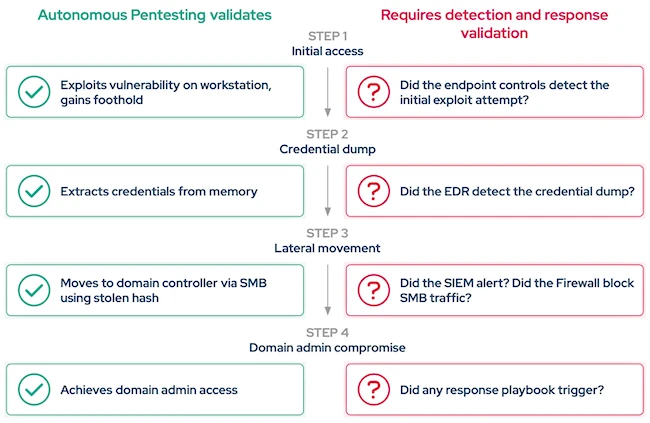
Attack chain scenario: Pass-the-hash to domain admin
Again, these tools are complementary not substitutable.
- One tells you how strong your individual defenses are.
- The other tells you how far an attacker can travel despite them.
If you replace BAS with autonomous pentesting, you stop validating prevention and detection coverage altogether. You might know that a specific exploit can’t reach the database, but you have no visibility into whether your EDR would even register a different, non-exploitative technique aimed at the same asset.
The market direction reflects this.
Recently, Gartner merged BAS, automated pentesting, and red-teaming into a single category, Adversarial Exposure Validation (AEV). In its March 2025 Market Guide for AEV, Gartner projected that 40% of organizations will adopt formal exposure validation initiatives by 2027.
The point of that category consolidation wasn’t that one capability replaces another. It was quite the opposite: these are distinct technologies that need to operate together under a shared framework. Treating them as interchangeable misreads both the market and the tools’ architecture.
Three questions to bring to every vendor conversation
Closing the validation gap starts with holding tools to a structural standard rather than a marketing one.
Three diagnostic questions cut through most of the noise. They each work because they are specific, evidence-based, and difficult to answer with fancy slideware:
1. Which of the six validation surfaces does your tool cover, and at what scope within each? A vendor that can’t map their coverage to all six layers has just shown you where your blind spots will continue to be.
2. How does your platform distinguish exploitable vulnerabilities from theoretical ones, using my live security control performance data? A static CVSS score is not an answer. The question is whether the tool can correlate vulnerability data with the actual behavior of your controls.
3. How does your platform normalize findings from my other tools into a single, deduplicated, prioritized view and action list? Validation that adds another dashboard to an already saturated stack is not helping. It’s just adding overhead.
The difference between “we purposefully chose not to validate this surface” and “we didn’t realize it wasn’t being validated” is the difference between deliberate risk management and silent exposure.
Any tool that can answer these three questions with specificity deserves serious evaluation. Any tool that can’t has just lost the case for itself.
The bottom line
Your attack surface doesn’t care which vendor’s logo is on what tool.
It only cares whether it’s been tested. If your current automated pentesting deployment is leaving critical surfaces in the dark, it’s time to remap your strategy.
Our latest practitioner’s guide, The Validation Gap: What Automated Pentesting Alone Cannot See, provides the complete diagnostic framework you’ll need to audit your own coverage, diagnose where that coverage is hitting a plateau, and actually build a working, unified validation architecture.

Start with the six surfaces. Score your own coverage. Knowing where your tools stop is how you decide what to do next.
