
Snyk unveils continuous AI pentesting and agent red teaming
Snyk has announced the general availability of Evo Continuous Offensive Security (COS), enabling security teams to continuously test applications with autonomous, AI-powered pentesting and AI agent red teaming while providing validated proof of what attackers could actually exploit.
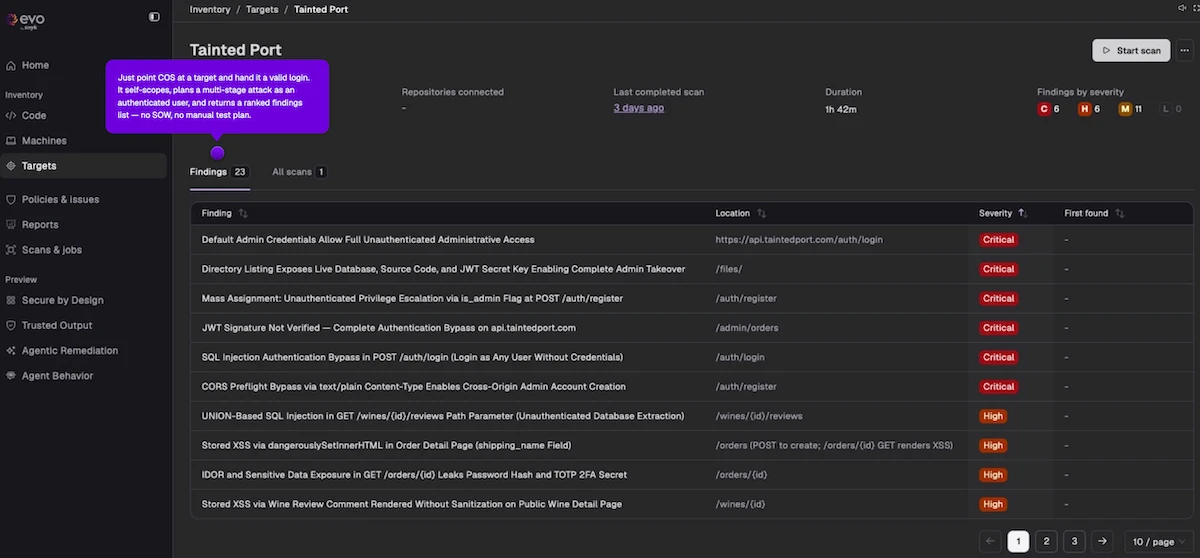
AI is accelerating software release cycles while rapidly expanding the exposed attack surface, which now spans architectural flaws only reasoning-capable systems can find, credentials leaking out of AI-generated code and the models and agents now embedded directly in the development lifecycle. Attackers are now going after every layer at once: low-priority legacy bugs that were never fixed, new code being written and the applications agents run in production.
Snyk’s latest research into enterprise AI adoption shows agentic development accelerating faster than security programs can track it. The Five Eyes alliance warned in June that AI will bypass cybersecurity in months, not years, with adversary breakout time now measured in seconds, and Gartner forecasts the window to exploitation will be halved by 2027.
Closing that gap requires four key actions: discovering the full attack surface, remediating the backlog, validating what’s actually exploitable, and preventing what comes next. The Snyk AI Security Platform expansion delivers on all four:
- Discover: the full software and AI attack surface — models, agents, MCP servers, skills, tools and what each can reach, with an upgraded AI-SPM
- Remediate: the inherited backlog before autonomous attackers work through it faster than people can respond, with a first look at Snyk’s Agentic App Sec
- Validate: continuously confirm that fixes hold and surface the architectural and business-logic flaws no scanner reaches, with the general availability of Evo Continuous Offensive Security
- Prevent: secrets, malicious packages and new vulnerabilities from rebuilding the backlog as humans and agents write software, with Snyk Secrets, prevention gates and malicious code defense
Validate: proving what is actually exploitable with Evo Continuous Offensive Security
Scanners find bugs. Pentesters find flaws. That distinction held for 20 years, and the flaws have always been the more expensive part of the process. Flaws are architectural: to exploit one, you have to understand what the application was designed to do.
Manual pentesting has always been the go-to means of uncovering these flaws, but a typical engagement runs 15 days and costs $20,000 to $100,000. What about the other 350 days? Development doesn’t stop, and neither do attackers.
Evo COS closes that gap: an AI-powered pentesting capability built on an enterprise-grade AI harness that reasons about application intent to uncover the architectural flaws and business-logic vulnerabilities traditional scanners miss. It receives its context from existing Snyk Code, Snyk Open Source and Snyk API & Web findings, so AI Pentesting and Dynamic Testing (DAST), the components that autonomously uncover exploitable vulnerabilities at scale and exhaustively test every endpoint for commodity flaws like XSS and SQLi, direct their effort at what those tools can’t catch.
Organizations can now see how many AI components they’re running, models, agents and the tools they call, but they can’t see how an attacker could use those components. Those risks are behavioral and non-deterministic; no signature-based scanner or annual pentest can account for them. That’s the gap Agent Red Teaming closes: simulating prompt injection, tool and agent abuse and data exfiltration against running AI agents and LLM-integrated applications, testing continuously as the footprint changes.
Other COS solutions have saturated leading benchmarks with a 100% pass rate using pure blackbox, non-SOTA models. Snyk is now building the next generation of AI pentesting benchmarks, modeled on real design partner environments instead of synthetic tests.
Discover, remediate, and prevent
Discover: AI Security Posture Management, featuring major enhancements: Upgrades to the AI-SPM model risk taxonomy and scoring engine, plus new skills and MCP server risk analysis surfaced inside the AI-BOM. This provides visibility into what agents are actually touching, and converts raw attack results into a prioritized risk score.
Remediate: Evo Agentic AppSec, a first look at what’s next: Snyk’s vision for autonomous application security, anchored by the public preview of the remediation agent via command line interface (CLI) or agentic development environment (ADE), which fixes vulnerabilities automatically, plus a first look at a new malicious code defense solution, which protects against supply chain attacks.
Prevent: Snyk Secrets, now in general availability: A secrets detection and prevention product built for the agentic development lifecycle (ADLC), using a proprietary ML detection engine that reads context around a candidate secret to cut false positives, with prevention gates across AI coding agents, IDEs, PRs and CI/CD.
What security teams are already seeing
“Security teams are looking for solutions that help them prioritize real risk, not just manage more alerts. Snyk’s Continuous Offensive Security gives teams clearer visibility into exploitable vulnerabilities and how they chain together, enabling them to move faster, reduce exposure and support innovation with confidence,” said Colleen Carroll, Senior Director, Information Security Officer, Emburse.
“The volume and pace of AI-generated code has fundamentally outpaced the pentesting model most of us have been running for years. We can’t schedule our way out of a continuous risk surface. What we need is offensive testing that keeps up with how we actually build software today — with enough context to focus on what’s genuinely exploitable, not just what’s theoretically possible,” said Gabriel Brolo, Staff Security Engineer at Yalo.
“Nearly every CISO conversation starts with the same question: how do I prepare for the post-Mythos era, when autonomous AI attacks move from a research breakthrough to a mainstream operating model for attackers? You cannot answer that with another disconnected security tool. Working with some of the world’s largest enterprises, we designed Evo as a connected set of defense loops: see the exposure, remediate the backlog, continuously prove what is still exploitable and prevent AI-driven development from rebuilding that backlog faster than teams can reduce it. Continuous Offensive Security is the adversarial proving layer at the center of that system,” said Manoj Nair, Chief Technology & Innovation Officer, Snyk.
