
Dataiku Agent Management reveals unmonitored AI agents
Dataiku has announced the launch of Agent Management, a standalone product that finds every AI agent an enterprise is running, regardless of which platform built it, measures the business and technical performance, and flags agents that pose the greatest risk.
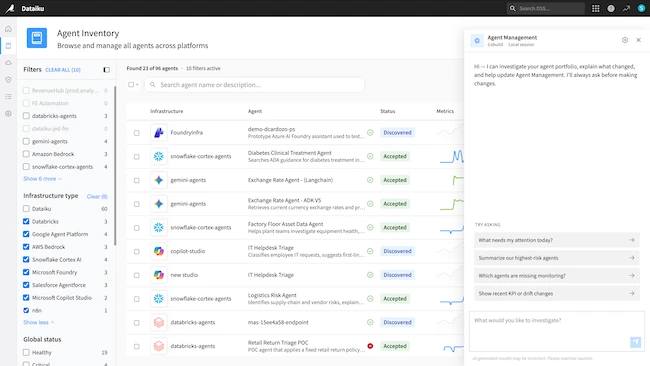
The launch addresses a disconnect between how fast agents are being created and adopted and organizations’ ability to observe and manage them. Every large company already keeps an account of the software it runs: who owns it, what it costs, and when it renews.
Almost none can say the same about the AI agents. In fact, fewer than one in five organizations maintain a complete, current inventory of their AI systems, according to IBM’s “AI in Motion” research. The reason is that most agent platforms can only see the agents built on them, leaving the bulk of a company’s agent estate without clear ownership, purpose, risk, or business outcome.
“Ask a bank how many servers it runs, and you get an answer to the decimal. Ask how many AI agents it’s running, and you get a shrug or a guess,” said Florian Douetteau, CEO of Dataiku. “Nobody set out to build it this way. Teams built agents faster than anyone could count them. Agent Management tells you what’s actually out there, and what it’s actually worth.”
Agent Management connects to the platforms that enterprise teams already use to run agents, including AWS Bedrock, Databricks Agents, Google Vertex, Microsoft Copilot Studio and Azure Foundry, Salesforce Agentforce, Snowflake Cortex, Dataiku itself, with OpenTelemetry support for custom environments, and scans them into a single inventory. It automatically identifies each agent’s structure, including the tools and models it relies on, giving supervisors full transparency into how an agent actually works, not just that it exists.
For the highest-risk agents, the ones handling customers, sensitive data, or live transactions, it keeps a standing record of certification status, named risks, and tests that rerun on a schedule, so the evidence trail already exists when a manager, auditor, or regulator asks for it.
Unlike traditional agent monitoring capabilities, which are in a single vendor’s stack and designed to favor that vendor’s own agents, Agent Management is deliberately agnostic. It sits above the stack, which lets it answer questions no single platform can, which agents are unmonitored, where risk is concentrated, and which ones earn their cost. Teams ask those questions in plain language and get an answer covering the whole portfolio.
