
Aikido Infinite introduces continuous, self-remediating AI penetration testing
Aikido Security has unveiled Aikido Infinite, a continuous AI penetration testing solution that autonomously validates and remediates vulnerabilities. Infinite reduces risk with every release by testing software changes as they move through deployment, confirming exploitability, and fixing vulnerabilities within the same workflow.
Penetration testing often relies on manual or point-in-time assessments, frequently delivered weeks after software has already shipped. In a recent survey of 500 security and engineering leaders conducted by Aikido, 76% reported deploying significant production changes weekly or faster, yet only 21% validate security on every release. Meanwhile, 85% report that security findings are outdated by the time final reports are delivered.
While newer tools have introduced faster, AI-driven testing, these solutions are often riddled with false positives, do not truly operate autonomously, and stop short of remediation. Aikido Infinite closes this gap. Security teams can expand their capacity with elite hacking agents dedicated to finding security holes in every single piece of code that is pushed, 24/7.
“For years, organizations have been working around the limitations of traditional testing and DAST because there was nothing better available,” said Willem Delbare, CEO of Aikido. “Software delivery is now continuous, but security testing isn’t. Infinite completely changes that. This is the beginning of self-securing software.”
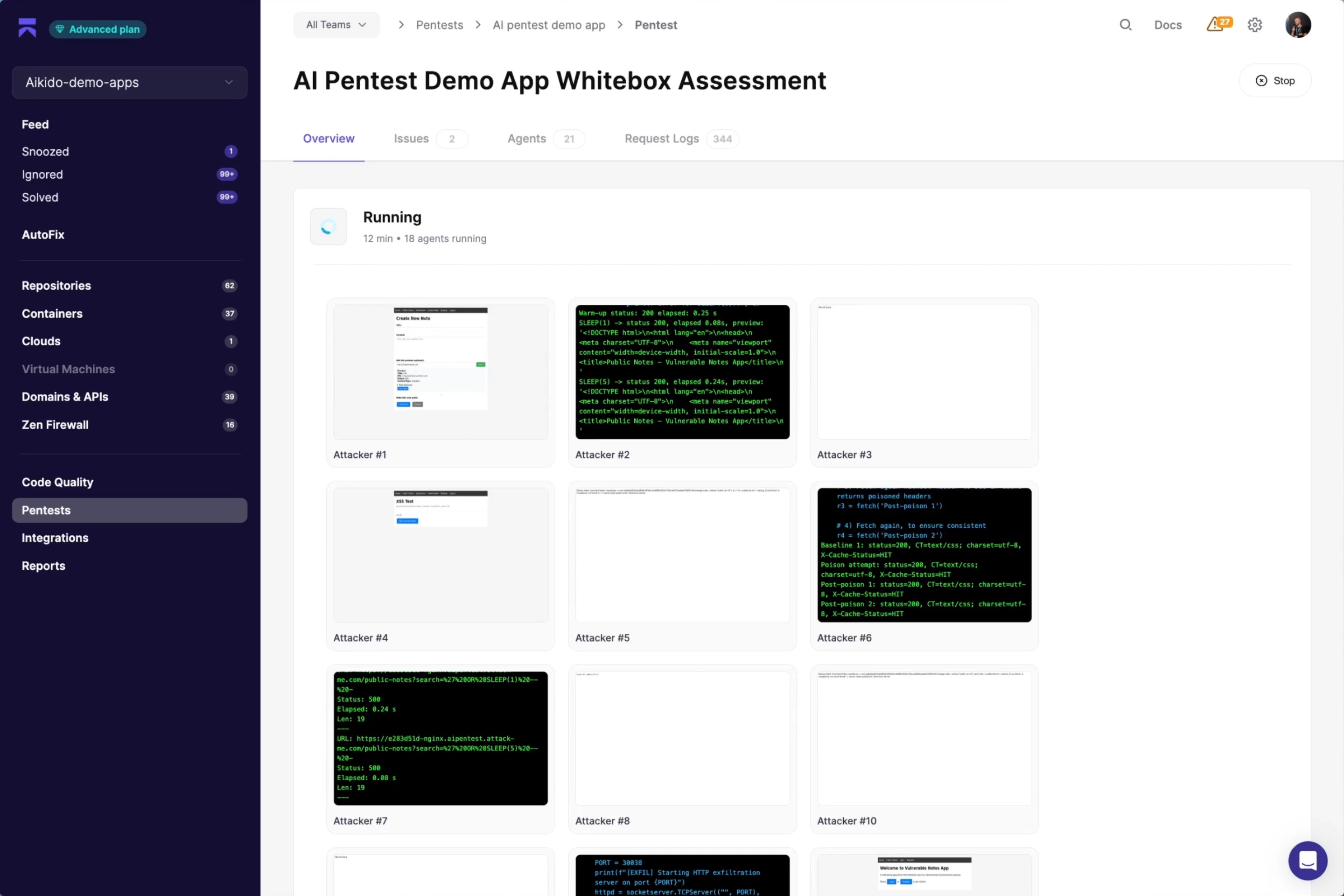
Each software change triggers agentic pentesting agents that discover risk, validate exploitability, apply remediation where safe, and retest to confirm risk reduction. Instead of relying on periodic engagements, teams gain a continuous feedback loop that operates alongside deployment, not after it. This level of exhaustiveness would be difficult to replicate even with the largest in-house security teams, whose resources do not scale in proportion to the expanding attack surface and pace of change.
“As software delivery cycles shorten and change becomes constant, point-in-time security models no longer reflect how modern systems operate,” said Katie Norton, Research Manager, DevSecOps and Software Supply Chain Security at IDC. “We are beginning to see early signs of a more autonomous security approach, where exploitability validation and remediation are embedded directly into the software lifecycle. Aikido Infinite reflects this shift by combining continuous testing with remediation capabilities inside a unified platform.”
Infinite utilizes two main resources for its attack. First, Aikido’s code-to-runtime platform gives it deep context from the organization’s source code, application architecture, and internal logic flows. Then, agents autonomously pursue every possible route of attack across the application’s total surface area, identifying undocumented endpoints, hidden logic paths, complex multi-step edge cases, and architectural anomalies that are often unknown by testers or too time-consuming for manual testers to address. Aikido Infinite learns from every finding on each deployment, providing a continuous feedback loop that developers can then use to improve code security even before commit.
Built on Aikido’s model-agnostic architecture, Infinite combines advanced AI with proprietary exploit validation and controlled runtime execution. Aikido Infinite is the company’s flagship product and the realization of the company’s vision for building self-securing software, shifting security from a reactive process to an embedded, continuous loop. Infinite builds on Aikido Attack, the company’s on-demand AI penetration testing offering that deploys hundreds of specialized agents to hunt vulnerabilities like hackers, validate exploitability, and provide built-in remediation.
Aikido’s AI pentesting capability is already uncovering complex vulnerabilities in apps and frameworks that had previously gone undetected by experts. When combined with in-house expertise, teams achieve a previously unattainable improvement in security posture.
