
Astelia extends reachability analysis with agentic AI for vulnerability management
Astelia has added agentic capabilities to its reachability analysis platform as organizations face shrinking exploit windows and the growing challenge of managing vulnerabilities.
At the core of the platform is Astelia’s reachability analysis, which determines whether a vulnerability can be reached and exploited within a specific environment. By correlating network topology with the technical requirements needed to exploit a given vulnerability, Astelia identifies that less than 1% of findings present real exposure, eliminating the noise that consumes security and business resources. In one enterprise deployment, Astelia reduced approximately 40 million identified vulnerabilities to fewer than 2,000 that were actually reachable.
Once a reachable vulnerability is identified, Astelia identifies the fastest evidence-based path to eliminating that exposure. Depending on the environment, that may be a targeted configuration change, network segmentation, a compensating control, or a software patch. This enables organizations to eliminate reachable exposure without relying solely on software patches.
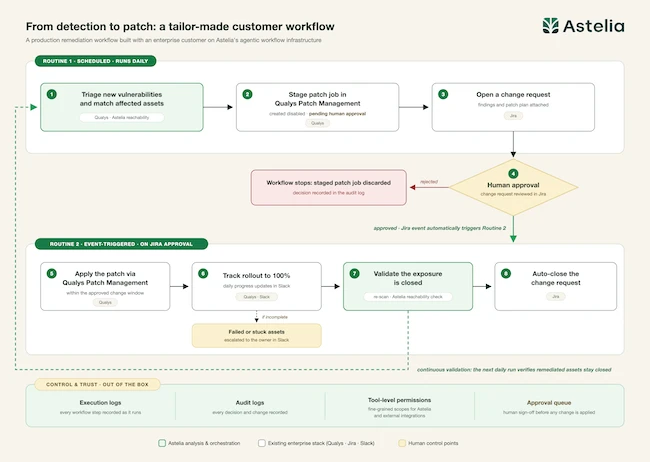
The new agentic capabilities extend Astelia’s reachability analysis and remediation workflow across the vulnerability lifecycle. As AI accelerates both vulnerability discovery and exploitation, security teams are being asked to investigate and remediate more vulnerabilities in less time. Astelia’s agentic capabilities are designed to meet that challenge, evaluating newly disclosed vulnerabilities and their reachability, assessing operational impact, coordinating remediation across security and IT teams, and helping drive each issue toward resolution.
Human approval remains built into key decision points, with every action logged and auditable. The platform also integrates with more than 100 MCP-enabled systems and is designed to incorporate additional threat intelligence capabilities over time.
“The release of Claude Mythos marked a turning point for vulnerability management,” said Alon Noy, CEO of Astelia. “It showed that vulnerability discovery and exploitation could happen at machine speed. Organizations can no longer afford to treat every vulnerability the same. Understanding which ones are actually reachable is what allows security teams to respond before exposure becomes an incident.”
While the volume of exploitable vulnerabilities continues to grow, the teams responsible for managing them often remain the same size. Astelia’s agentic workflow is designed to give those teams greater operational scale by automating repetitive analysis and coordination tasks while preserving human oversight where security decisions matter most.
“Reachability gives security teams the evidence they need to act more precisely,” said Nadav Ostrovsky, CTO of Astelia. “The same network intelligence that tells us a vulnerability is reachable also tells us how to make it unreachable. We’re seeing strong traction with Fortune 100 enterprises because that approach helps security teams keep pace with the growing volume of newly disclosed vulnerabilities and exploits. The new agentic layer builds on that foundation while keeping security teams in control.”
“Astelia got our security team out from under millions of CVE alerts we were never going to work through, and pointed us at the fraction of vulnerabilities attackers could actually reach. Each exposure comes with evidence and mitigation options, which cut our triage time by over 80%,” said the CISO of Fortune 100 Financial enterprise.
As AI continues to reshape vulnerability management, Astelia is extending its platform to help security teams focus on the vulnerabilities attackers can actually reach. By combining reachability analysis, evidence-based remediation, and agentic orchestration, the platform helps organizations respond at the speed required by today’s evolving threat landscape.
