VMware vCenter zero-day exploited for months before patch (CVE-2026-123890)
A suspected China-nexus espionage group tracked as Armory Castle (formerly UNC5221) has been exploiting a VMware vCenter zero-day since at least early September, more than two months before Broadcom released a fix, Google Threat Intelligence Group (GTIG) revealed.
The vulnerability (CVE-2026-123890) carries a CVSS score of 9.8 and allows a remote, unauthenticated attacker to obtain an administrator session on vCenter Server, which organizations use to manage their VMware servers and virtual machines.
Broadcom fixed it on November 19 in security advisory VMSA-2026-0009, along with four other vulnerabilities affecting VMware SDDC Manager and VMware Tools for Windows.
The company said there are no workarounds, and the advisory makes no mention of the in-the-wild exploitation uncovered by Google’s researchers.
“You are affected if you are running any version of VMware vCenter, SDDC Manager, or VMware Tools for Windows prior to the versions listed as ‘fixed’ in the VMSA. This includes vCenter and SDDC Manager deployed standalone and as part of VMware Cloud Foundation, VMware vSphere Foundation, VMware Telco Cloud Platform, and VMware Telco Cloud Infrastructure, as well as VMware Tools installed in Windows virtual machines,” the company explained.
Mandiant, which Broadcom credits with discovering the flaw, and GTIG “have investigated multiple incidents” in which the group exploited it, Mandiant CTO Charles Carmakal said in a LinkedIn post. “Organizations should both apply the patches and examine their systems for evidence of compromise,” he advised.
From BeyondTrust to vCenter
GTIG and Mandiant have tracked Armory Castle exploiting zero-days and n-days in edge and security appliances to gain initial access since 2023. In the intrusion detailed in their report, the group got in through CVE-2026-102764, a zero-day in BeyondTrust Remote Support.
From there, the attackers moved to internal Linux appliances that had no endpoint detection and response (EDR) tools and turned to BONESAW, an exploit tool written in Go and built for the vCenter flaw. With it, they created an SSO administrator account and copied vCenter’s directory database, which holds the key used to sign login tokens.
A second tool, SAWSNAKE, can pull signing keys from that database and use them to forge SAML login tokens. “This allows the threat actor to forge authentication tokens, bypass MFA, and impersonate any user,” the researchers wrote.
The next stop was an ESXi host, one of the servers that run the virtual machines, where the group pulled the Active Directory database and registry hives off a Windows VM’s disk. The archived files were moved to the BeyondTrust appliance, from which Armory Castle “likely exfiltrated the data,” GTIG said.
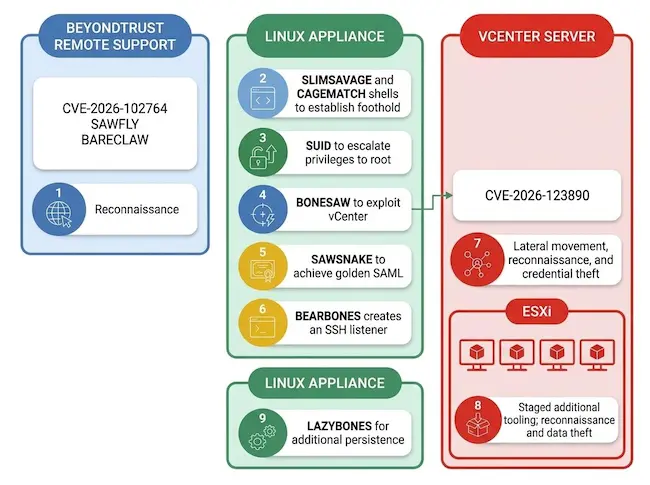
ARMORY CASTLE lateral movement and vCenter compromise sequence of events (Source: Google)
An exploit ready in July
Mandiant has evidence that the group knew about CVE-2026-123890 before July 29, when CVE-2026-59309, another vCenter authentication bypass, was disclosed. Both bugs let an attacker obtain a session key without knowing a password, but Broadcom stresses that “CVE-2026-123890 is a new and distinct issue.”
The BONESAW binary carries a build timestamp of July 13, though the report notes that Go build metadata “can be modified prior to compilation.” Logs show the group ran the tool in early September against a server already patched for the older flaw. Since BONESAW was built more than a month before it was used in this intrusion, Google believes it “was likely developed for broader operations.”
Five of the malware families and utilities found in the victim’s environment had not been seen before. “The use of three separate specialized sets of malware and two zero-days in the course of a single campaign indicates that there are significant resources supporting ARMORY CASTLE operations,” the analysts added.
Patching is only the first step
Google wants admins to go beyond installing updates. “Because vCenter serves as the centralized control plane for the virtualized data center, relying solely on reactive patching is insufficient to protect it,” the team wrote.
The appliance’s built-in firewall can be switched off by anyone who gains access to its management interface, and Armory Castle gained that access in this attack. Mandiant recommends its VCSA Hardening & Logging Tool, which blocks network access by default, filters outbound traffic and sends logs to a SIEM. The report also includes indicators of compromise and YARA rules for threat hunting.
“In the unprecedented flood of agentic intrusion activity that we’re currently seeing, it’s exponentially harder to identify these quiet and discreet espionage incidents,” Carmakal warned.
“We will continue to see espionage-focused adversaries exploiting zero-day vulnerabilities and deploying malware on systems that don’t support EDR solutions,” he concluded.