
Axonius updates Asset Cloud with AI, exposure management, and asset trust standard
Axonius has expanded its Asset Cloud with AI-powered remediation in Axonius Exposures, added support for IoT and OT environments via Axonius Cyber-Physical Assets, and introduced a new data trust standard with Axonius Verified Assets.
“Security environments have grown more distributed, more dynamic, and more complex, and when teams can’t fully understand their environment, they simply cannot act,” said Joe Diamond, president and interim CEO of Axonius.
“Findings pile up because the data isn’t trusted, ownership isn’t clear, and entire asset classes aren’t even in the picture. Today we’re closing all three gaps – with Axonius AI that drives remediation in Axonius Exposures, built on a platform that now covers cyber-physical environments. This delivers the single-source verified asset data that enables strategic security decisions – human and agentic – to be built and actioned on trusted data,” Diamond added.
Axonius Exposures + Axonius AI: From finding risk to fixing it
Axonius Exposures is purpose-built to eliminate the operational drag between identifying a risk and fixing it, the data gaps, decision bottlenecks and coordination breakdowns that stall remediation even when teams have the proper tools and best intent. Bolstered with Axonius AI, security findings now arrive with the right context, a designated owner, and a path to resolution, delivering zero-drag exposure management.
Key Axonius Exposures enhancements include:
- Axonius AI recommended actions surface specific remediation and mitigation steps for each finding, ranked by expected impact, with attack-path analysis that prioritizes containment based on real exploitability – not isolated severity scores.
- Security finding rules extend exposure management beyond Common Vulnerabilities and Exposures-based (CVE) vulnerabilities to the security-relevant conditions, identity hygiene gaps, SaaS misconfigurations, certificate issues, policy violations, and custom risk conditions, across all 1,400+ Axonius adapters and 45 asset types, on premises and in the cloud.
- Research-backed risk scoring and axonius threat intelligence enhance prioritization with the new Axonius Vulnerability Score (AVS), asset criticality, and Axonius Threat Intelligence with active exploitation signals, lowering costs and eliminating complexities of third-party threat intelligence feeds.
- Automated remediation ownership assigns the appropriate owner to each finding using asset, business, and organizational context from systems already connected to the Axonius Asset Cloud, reducing mean-time-to-ownership to near zero.
“The exposure management market has moved past the point where finding vulnerabilities is the hard part. The real challenge is closing the gap between detection and remediation at scale,” said Francis Odum, founder and head analyst at Software Analyst Cyber Research (SACR).
“What makes Axonius distinctive is that they’re building from the asset intelligence layer up – they already have the trusted data foundation and the integration breadth. Now, with AI-driven recommended actions, automated ownership assignment, and exposure management that extends beyond CVEs to any security-relevant condition, they’re addressing the remediation workflow problem in a way that reflects where this market needs to go. When you combine reliable asset context with AI that can reason about what to fix and who should fix it, you start to see exposure management shift from a dashboard exercise to an operational discipline,” Odum continued.
Axonius Cyber-Physical Assets: Unifying OT, IoT, and IT security
When Axonius acquired Cynerio in 2025, the acquisition brought OT and IoT device discovery and protection expertise to the platform. The launch of Axonius Cyber-Physical Assets extends that expertise across industries where securing cyber-physical environments is mission-critical, including manufacturing, utilities, energy, and critical infrastructure.
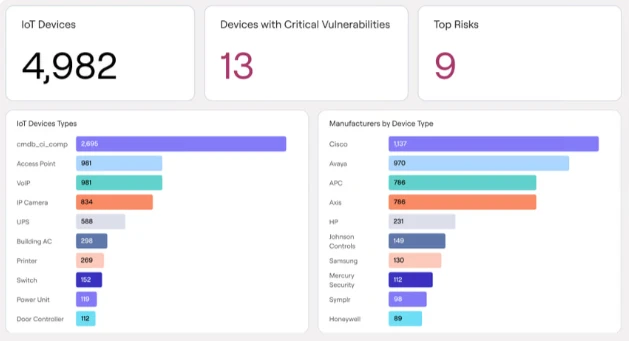
Axonius identifies and fingerprints cyber-physical assets, enriches each device with deep contextual attributes, and correlates them into the Axonius Asset Cloud alongside IT assets, delivering unified visibility across IT, IoT, and OT in a single model built on 1,400+ integrations. Organizations can prioritize cyber-physical risk based on operational impact and business criticality, not just technical severity, incorporating behavioral insight, device dependencies, and enriched risk context.
Axonius Verified Assets: Foundation for AI and automation
Every downstream security workflow, from risk prioritization to automated remediation, depends on decision-grade asset data: trustworthy enough to act on without re-verification. AI agents compound “bad data” problems, they don’t question their inputs, they amplify them.
Axonius Verified Assets establishes the trust standard these workflows and AI agents require. Each asset is continuously reconciled and evaluated against multiple trust signals, distinguishing verified records from duplicates, ghost assets, and stale or transient data to produce a provably accurate, audit-ready inventory.
Assets that fail verification are surfaced with specific failure analysis, enabling teams to investigate and close data gaps rather than operating on unverified assumptions. The result is the decision-grade data layer that downstream automation, AI-assisted prioritization, and board-level risk reporting require to operate safely and accurately.
Feature availability
Updates to Axonius Exposures are being delivered in a phased rollout. Core capabilities, including predefined risk scoring, security finding rules, and status management, are generally available today. Threat intelligence enrichment, attack path analysis, remediation ownership, and AI-driven remediations are generally available with additional updates releasing through May 2026. AI-driven recommended remediations are available in early access today, with general availability expected by July 2026.
