
Aptori expands its platform with autonomous offensive testing to reduce security bottlenecks
Aptori has expanded its Runtime-Driven Validation Platform with autonomous offensive testing capabilities to address the growing gap between code output and security team capacity.
By moving beyond passive scanning to active validation, the platform helps organizations identify, validate, and fix vulnerabilities at the pace of development.
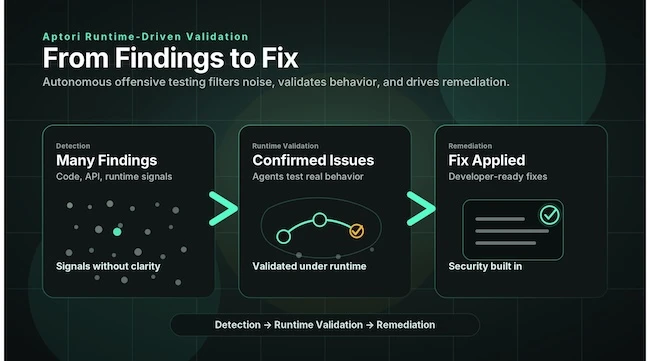
As AI-assisted coding increases development velocity, traditional point-in-time security assessments have become a bottleneck. Most security tools produce large volumes of findings that require manual triage, slowing teams down and obscuring what actually needs to be fixed.
Aptori’s offensive testing approach addresses this by simulating real-world attacks against running systems. It validates which vulnerabilities are real, allowing teams to focus on what matters and resolve issues quickly.
“Runtime validation is critical in modern applications,” said Sumeet Singh, CEO of Aptori. “Security issues don’t exist in isolation, they emerge through real execution paths across APIs, logic, and authorization. We built Aptori to test those paths at runtime and make sure issues are fixed before release.”
Early deployments show a significant reduction in remediation backlog and time spent on manual triage.
Automated penetration testing at scale
Aptori replaces the manual, time-intensive process of human-led penetration testing with a system that operates continuously and at scale.
- Logic-aware exploration: The system navigates application logic and stateful interactions, uncovering business logic flaws and authorization gaps that traditional automated tools often miss.
- Active validation: Rather than flagging potential issues, Aptori’s AI agents safely exercise vulnerabilities in a runtime environment to confirm which ones are real.
- Continuous context: The platform runs within development workflows, ensuring that new endpoints and application changes are tested as they are introduced.
A unified system for detection, validation, and remediation
Aptori brings detection, security data, and remediation into a single system:
- Modernized detection: AI-powered code analysis is combined with dynamic and API testing to provide visibility into how applications behave in runtime.
- Unified security data layer: Findings from code, dependencies, APIs, and runtime environments are normalized into a single data model, eliminating fragmentation.
- AI-driven remediation: Once a vulnerability is validated, Aptori’s AI agents generate actionable fixes that developers can review and apply within their existing workflows.
Building secure-by-design software
Aptori enables teams to validate security controls during the build phase, not after deployment.
By testing applications in runtime before release, teams can verify that authentication, authorization, and business logic controls behave as intended. Issues are identified and resolved early, reducing the likelihood of vulnerabilities reaching production.
Security becomes part of how software is built, not something applied after the fact.
Organizations can explore Aptori’s AI Security Center for securing agentic workflows, LLM integrations, and AI-powered applications.
Designed for enterprise environments
Aptori is built for enterprise and regulated environments, supporting:
- Integration with commercial and open source AI models
- On-premises and fully air-gapped deployments
- No requirement to transmit sensitive data outside controlled infrastructure
