Product showcase: Trust Chain TPRM turns vendor compliance evidence into verified assurance
Trust Chain is an AI-native third-party risk management (TPRM) solution by Strike Graph that replaces the security questionnaire model with validated evidence of compliance. Rather than asking vendors to self-report their security posture, Trust Chain requires vendors to submit evidence, which is then evaluated using Strike Graph’s patent-pending Verify AI technology. The evaluation tests each submission against the requesting organization’s specific requirements. The result is verified assurance rather than vendor attestation, delivered in a fraction of the time and at a fraction of the cost of other TPRM tools.
Trust Chain is built directly into the Strike Graph GRC platform, putting vendor risk data alongside an organization’s compliance frameworks, internal controls, and audit evidence in a single environment rather than a separate tool.
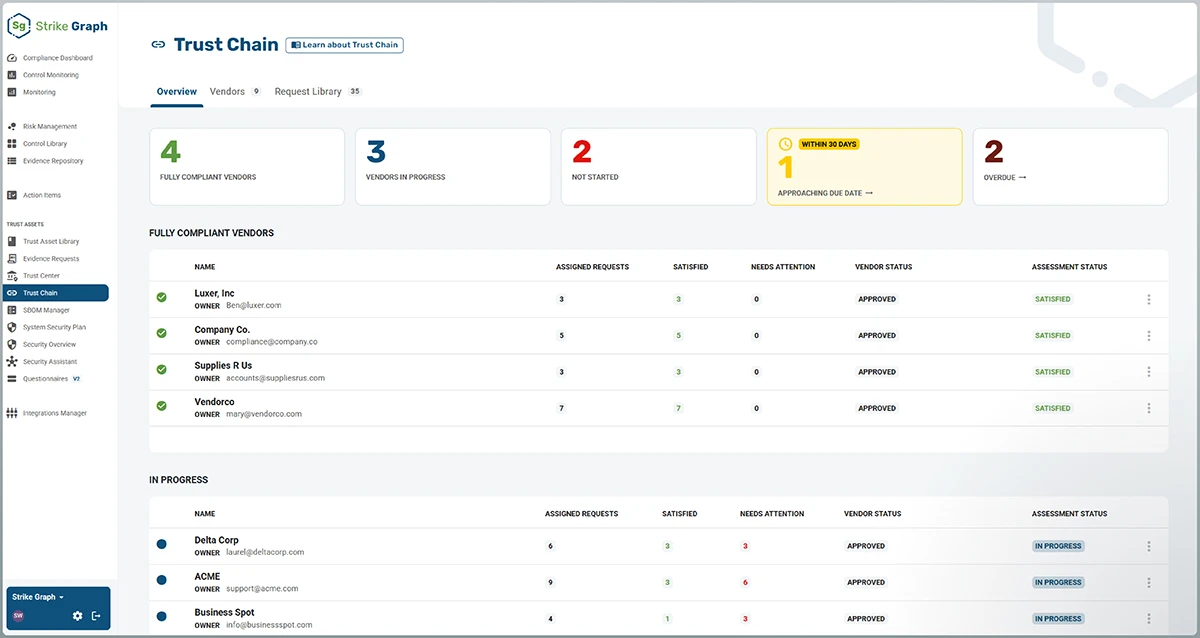
Validate vendor compliance with evidence-based AI-validation
Verify AI: The engine that tests evidence, not just collects it
The core capability that separates Trust Chain from every other TPRM tool on the market is Verify AI, Strike Graph’s patent-pending AI validation engine for compliance evidence. When a vendor submits a compliance document, Verify AI tests the evidence against the specific requirement it was submitted to satisfy, determining whether the evidence demonstrates the control in question and surfacing gaps, discrepancies, and missing scope automatically.
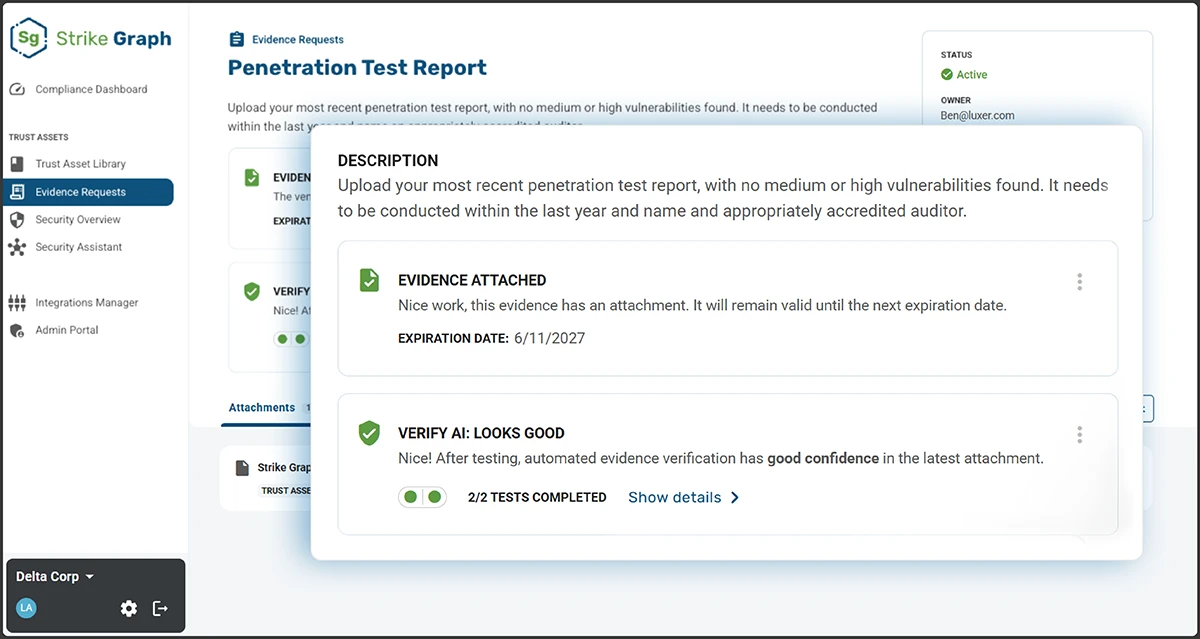
[Vendor view] Verify AI runs tests to validate the vendor’s attached evidence to ensure it satisfies the requirements listed by the customer’s description.
A vendor submitting a penetration test that covers a narrower scope than required by the requesting company, or a policy document that addresses only a subset of the relevant controls, will have those deficiencies surfaced automatically rather than accepted as complete. Verify AI catches what manual review misses and what questionnaire tools never even attempt to verify.
Flagged items route to the compliance team for human review, dramatically reducing the scope of manual work. Trust Chain reduces the time compliance teams spend on TPRM by 92%, from an industry average of more than 40 hours per vendor to approximately 3.5 hours, by handling the initial evidence testing automatically.
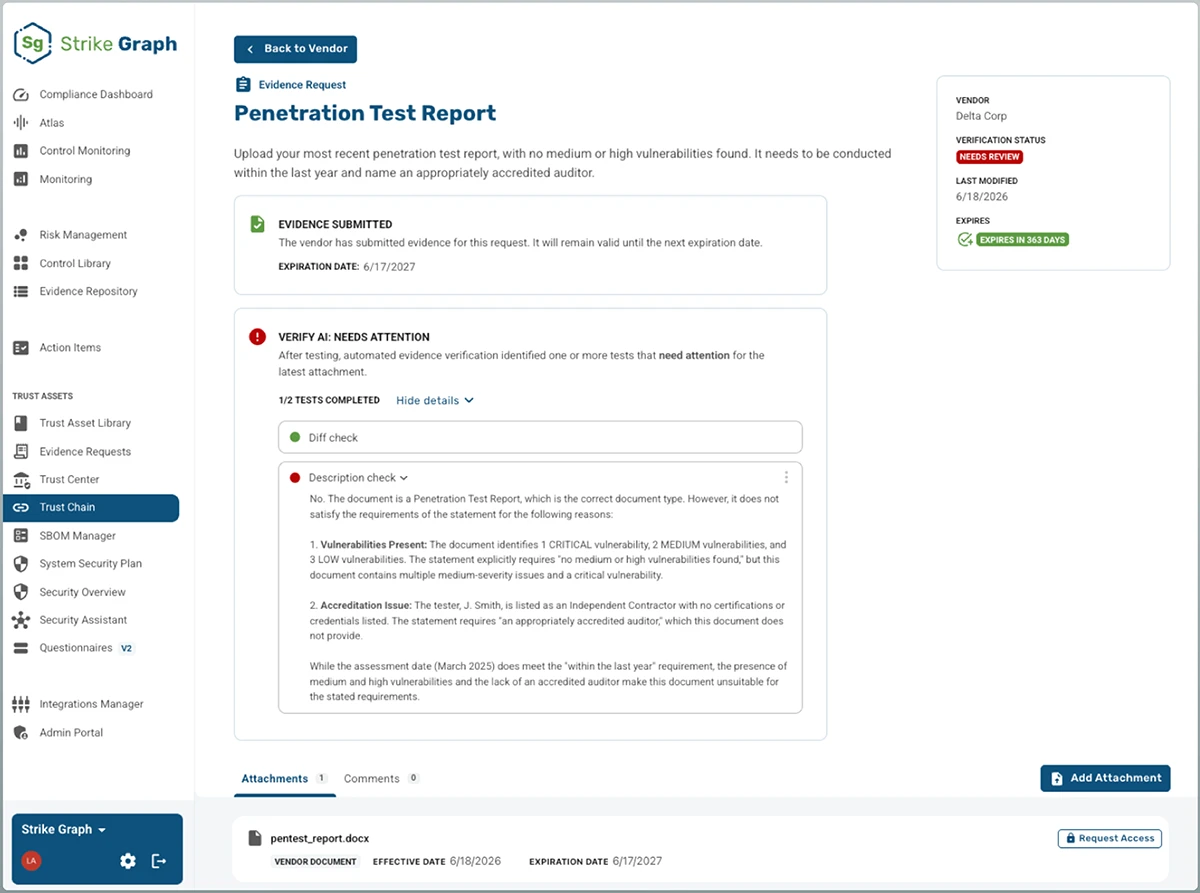
Verify AI flags evidence that does not fully satisfy the requirements with written explanation, prompting human intervention for review.
When compliance teams review flagged items, they can review the failed test reasons, leave comments, and override the results, saving their notes to the record.
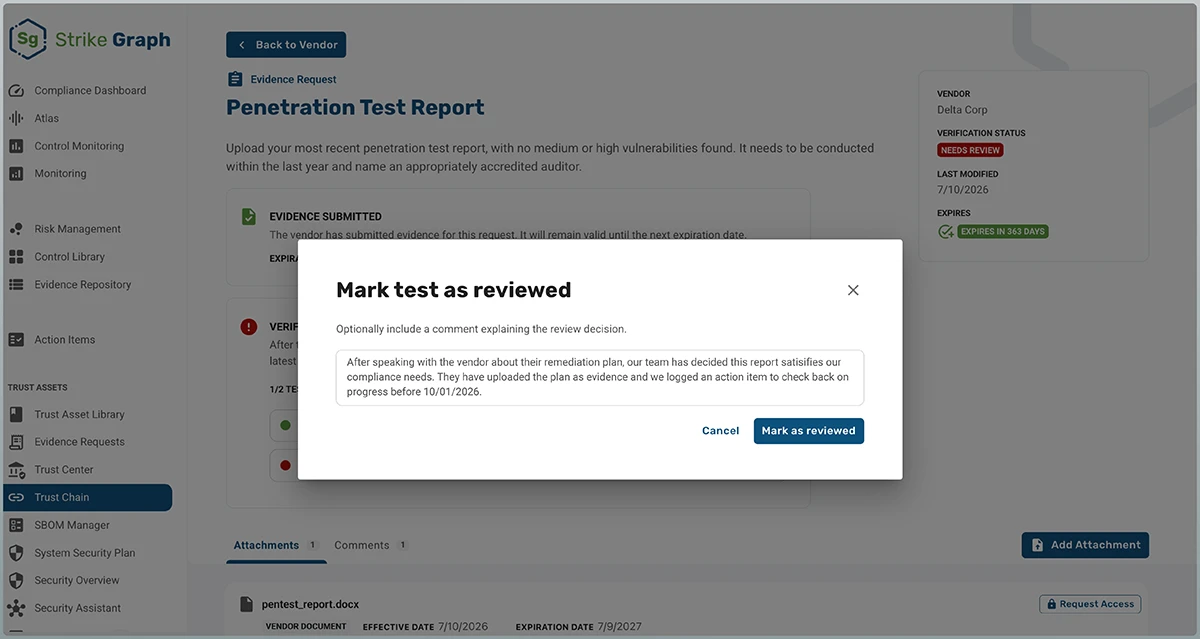
Leave internal comments during manual review of vendor evidence requests
“Organizations have been measuring compliance claims for decades and calling it third-party risk management,” said Chris Steffen, VP of Research at Enterprise Management Associates. “What Strike Graph has built with Trust Chain is architecturally different: rather than asking vendors what their controls look like, it validates whether the evidence they submit demonstrates those controls. That’s the shift the market needs, and it’s the right direction for TPRM to move.”
Continuous monitoring: Risk visibility that does not lapse between assessments
Most TPRM programs assess vendors once a year and treat the completed questionnaire as evidence of ongoing compliance. Certifications lapse, audit scopes change, and security programs evolve in the months that follow, and the compliance team has no visibility into any of it until the next assessment cycle begins.
Trust Chain replaces the point-in-time model with automated supply chain monitoring. Compliance teams define exactly what vendors need to prove through Trust Chain’s Evidence Request Libraries, starting from a standard set of evidence types or converted directly from an existing questionnaire. Requirements can be assigned uniformly across the vendor portfolio or tailored per vendor relationship to reflect differences in risk tier, data access, or regulatory exposure.
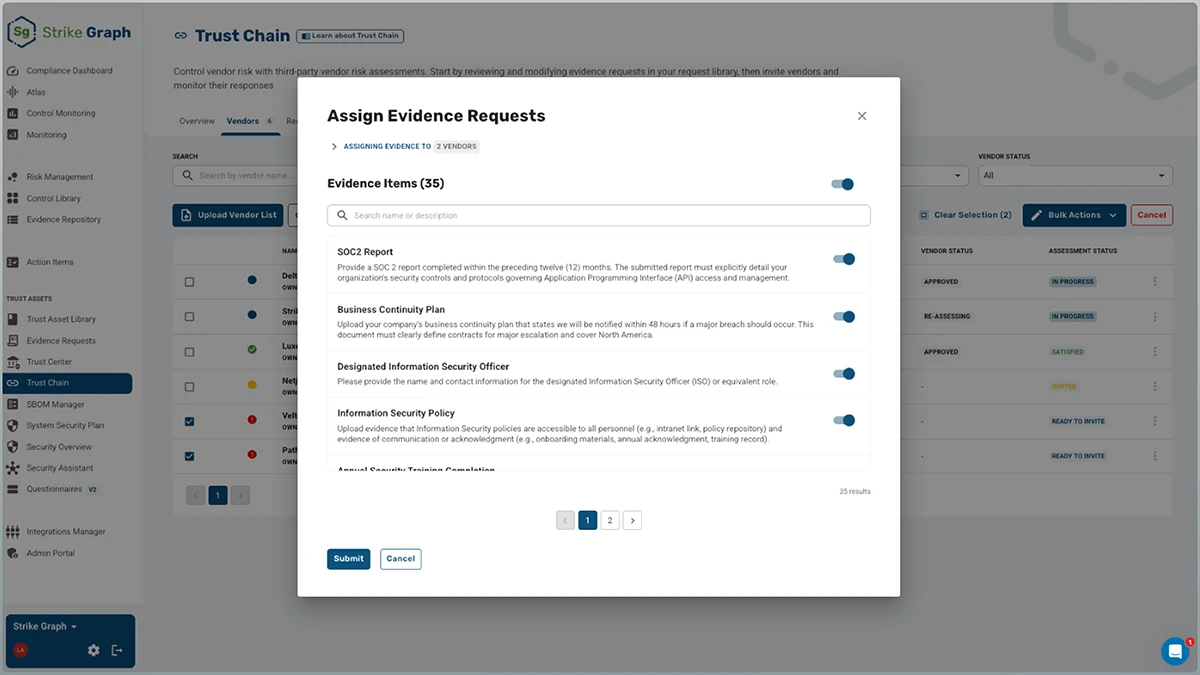
Assign evidence from the pre-loaded Evidence Request Library across all vendors or add tailored requests based on individual vendor risk level
Compliance teams also configure evidence expiration schedules for each requirement, specifying how long a document (i.e. SOC 2 report, penetration test, or policy) remains valid before a recollection is required. When evidence approaches its expiration date, Trust Chain automatically sends vendors a new submission request without any intervention from the compliance team. Risk visibility becomes continuous rather than annual.
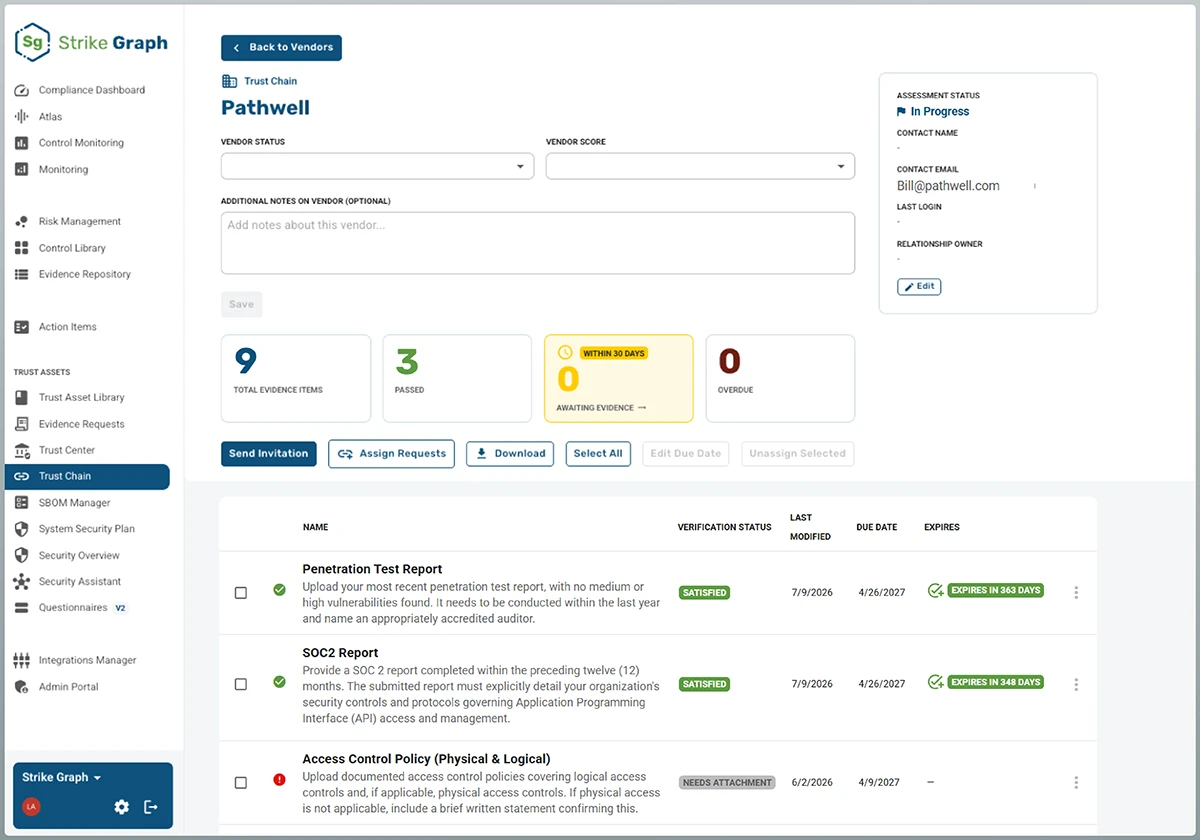
View real-time assessment status and progress by vendor for each evidence request
Real-time dashboards surface which vendors are fully verified, which have pending submissions, and which have active gaps without manual tracking of renewal dates or follow-up email chains. Compliance teams can also enrich each vendor record with internal context that remains within the platform: a manual vendor score, a status designation, and notes that reflect business decisions beyond what the evidence alone shows. If Verify AI flags an item as a known and approved risk, teams can override the flag directly, keeping the audit trail intact without creating false remediation work. For items requiring vendor action, reviewers can leave specific comments tied to the submission, giving vendors direction on what to resubmit rather than routingfeedback through email.
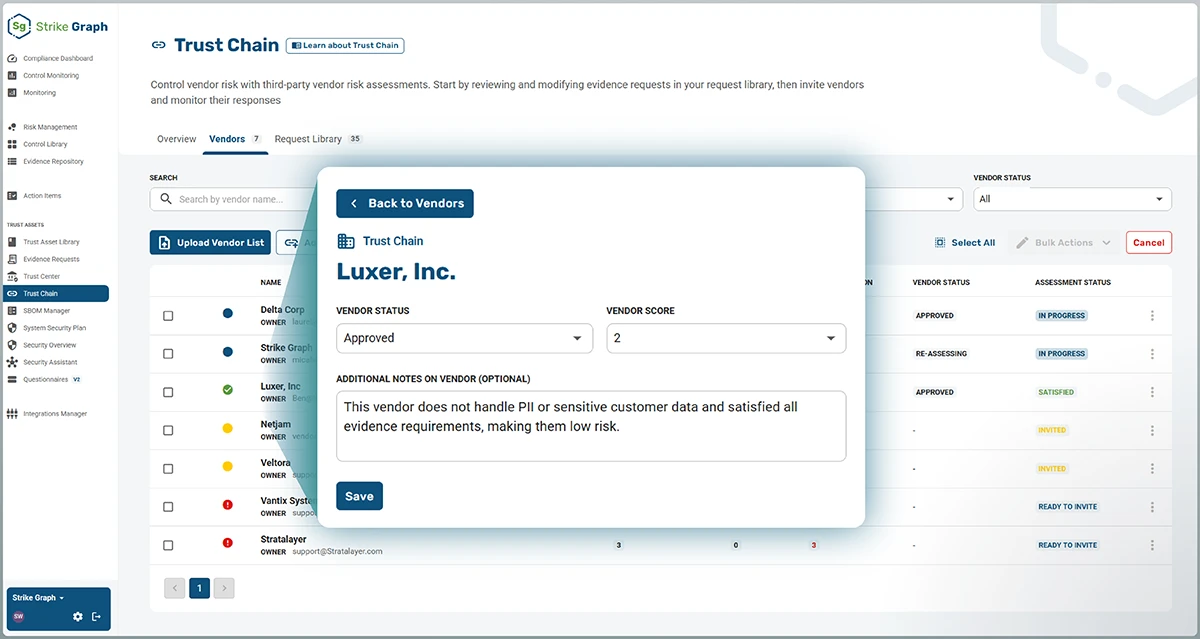
Approve and score vendors for internal team visibility with optional notes
The vendor experience: Submission replaces redundant questionnaires
Rather than completing custom questionnaires for every customer relationship, Trust Chain gives vendors a centralized platform to store and submit compliance evidence — from access control policies, incident response plans, and business continuity documentation, to penetration test results, audit reports, and certifications — in order to meet their customer’s specific requirements.
Verify AI validates each submission and shares the results with the requesting organization rather than the underlying documents themselves, so vendors retain control over their compliance documentation unless they choose to share it directly. When a submission falls short, vendors receive the customer’s comments alongside a specific request to resubmit, giving them direction without routing the back-and-forth through email.
Vendors working across multiple customer relationships can easily use Trust Chain to prove compliance without duplicating the redundant work that makes questionnaire-based TPRM so costly for vendors to participate in.
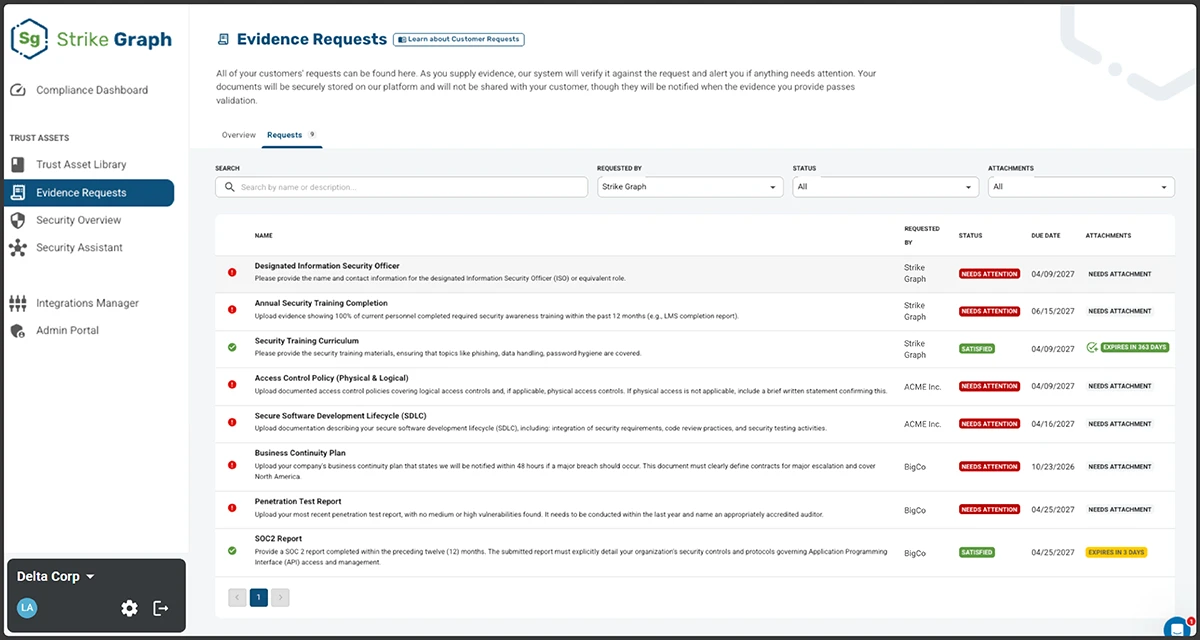
The Vendor Portal shows all evidence requests and submissions with status, due dates, and requester
The friction reduction for vendors is measurable. Trust Chain achieves an 84% vendor response rate compared to an industry average of roughly 67%, a direct result of replacing the questionnaire burden with a submission model that respects vendors’ time.
Why questionnaires cannot meet today’s compliance obligations
The case against questionnaire-based TPRM is not just operational, it is increasingly legal. Under CMMC Level 2, a named Affirming Official is personally responsible for annual compliance affirmations covering an organization’s vendor and supply chain security. The CMMC assessment methodology requires that each security control be evaluated against three criteria: correct implementation, operational effectiveness, and desired outcome. A completed vendor questionnaire satisfies none of them. A completed questionnaire captures only what a vendor chooses to say about their own controls, which is precisely what CMMC’s assessment methodology is designed to move beyond.
As Justin Beals, CEO and Co-Founder of Strike Graph, writes in his article “Affirming Official’s dilemma: Why security questionnaires fail under CMMC Level 2”, an Affirming Official who relies on questionnaires to attest to vendor compliance faces potential False Claims Act exposure under deliberate ignorance or reckless disregard standards. The regulatory framework itself makes it clear that self-reported assertions are not evidence of the implementation of controls.
The same principle applies beyond CMMC. Michael Rasmussen, founder of GRC 20/20 Research and widely recognized as the father of GRC, draws a sharp distinction between evidence collection and evidence assurance in his analysis of AI in GRC. A completed questionnaire does not mean the answer is accurate; a document attached to a control record does not mean the control is operating effectively; and AI that only accelerates evidence collection may simply produce more artifacts and greater false confidence. Verify AI is built to close that gap, moving from collecting evidence to validating whether it demonstrates what it claims.
