
Product showcase: Material unifies Google Workspace email, file & OAuth defense
Here’s an uncomfortable truth: the attack that gets you won’t look like an attack. It’ll look like a normal login, a normal file share, a normal permission request you clicked past without reading. You don’t have a phishing problem, a DLP problem, or an OAuth problem. You have one problem wearing three masks, and most security stacks aren’t built to address this.
Material Security designed its platform from a fresh point of view: stop defending Gmail, Drive, identities, and third-party apps like they’re separate surfaces. They’re all part of one surface: the cloud workspace.
What is it?
IBM’s Cost of a Data Breach Report puts the average time to identify and contain a breach at 241 days. That’s eight months of an attacker running the place while your tools each quietly do their job and never compare notes.
Phishing got worse the moment generative AI made impersonation cheap. Material’s own research on customer mailboxes found that 100% of inboxes reviewed contained sensitive information, adding up to years of sensitive data sitting at rest, unreviewed, waiting for credentials to get popped. The problem gets worse when attackers use the inbox to reset passwords and move laterally to other systems. The email that got through was never the whole story; it was just the opening move to gain persistence in company systems.
A secure email gateway has no idea a “legitimate” login just triggered a mass export from Drive. A DLP tool has no idea that the account was compromised through a phished OAuth screen an hour earlier. Each tool does its job perfectly and misses the crime completely. The features are there, but the architecture isn’t.
How it works
Email is your front door, so treat it like one. Material catches the phishing, business email compromise, and impersonation attempts that slip past Google’s native protections and legacy gateways. These tools were built for commodity spam, not a well-researched attempt to impersonate your CFO. It also triages every “this looks phishy” report your employees send in, so your team stops burning hours confirming what a machine could flag in seconds.
Material doesn’t stop at email security, because breaches don’t stop there either. An email login is a gateway into Google Drive, a treasure trove of sensitive information that’s also built for sharing. Material hunts down PHI, PII, and anything sensitive shared wider than intended, and fixes it in bulk: pull back the link, revoke access, done. No blanket lockdown that has employees filing angry tickets or worse, going rogue with unsanctioned file-sharing solutions.
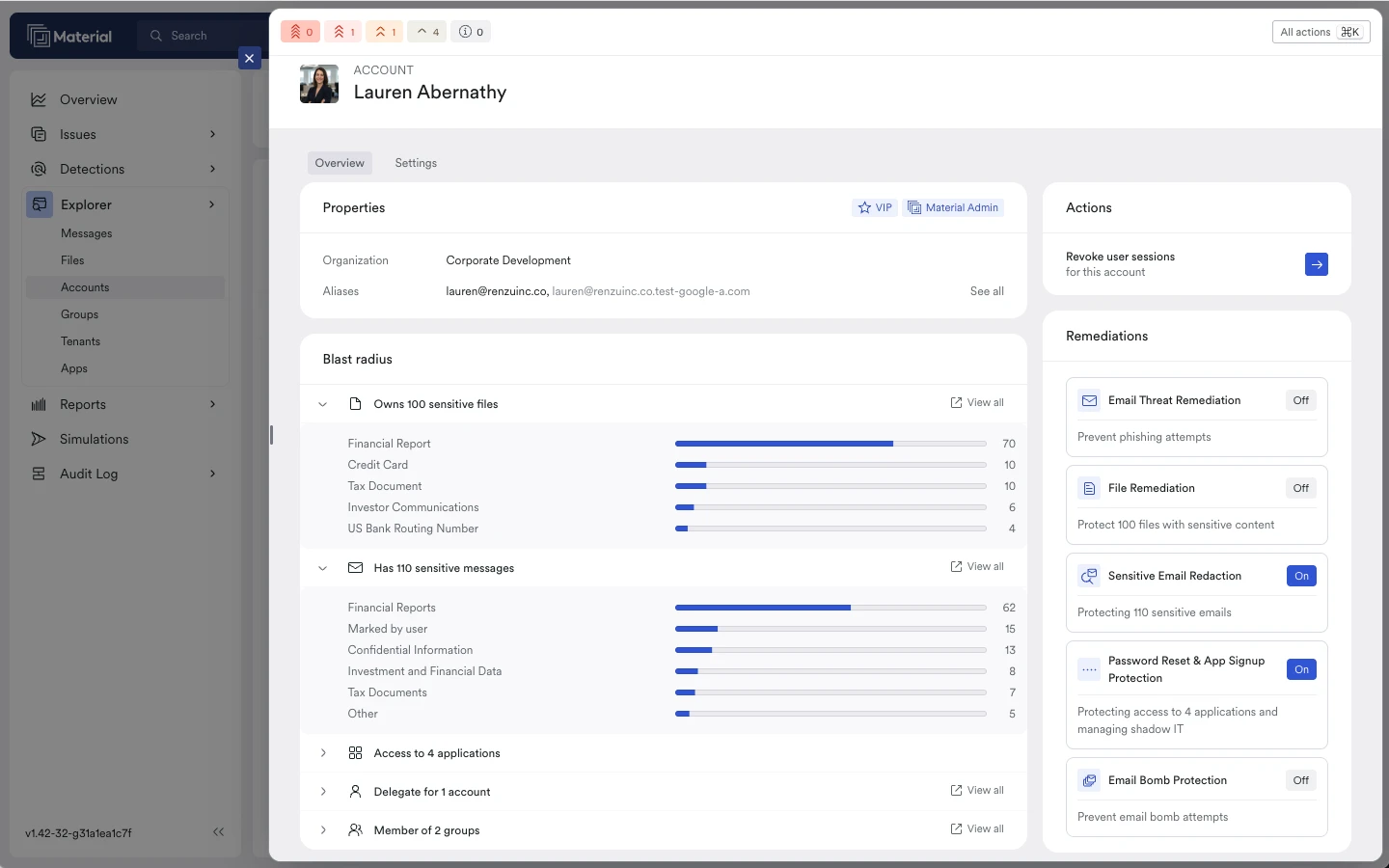
Assume an attacker breaches a mailbox. Material’s access controls sit at the message level, so a stolen password won’t automatically give an attacker access to sensitive emails, let them grab a magic link, or trigger a reset that cascades into other systems. When something goes wrong, you get a real-time trail of what the intruder touched, not a forensic guessing game several weeks later.
Then there’s OAuth, the backdoor MFA was never built to guard. When’s the last time you reviewed every third-party app with access to your workspace? A valid token doesn’t care that you reset your password or turned on MFA. It just keeps working until somebody revokes it. Material’s OAuth Remediation Agent watches every connection, sizes it up by scope, behavior, and vendor trust, and pulls the plug the moment something looks wrong, no ticket, no waiting for next quarter’s review.
What security teams see
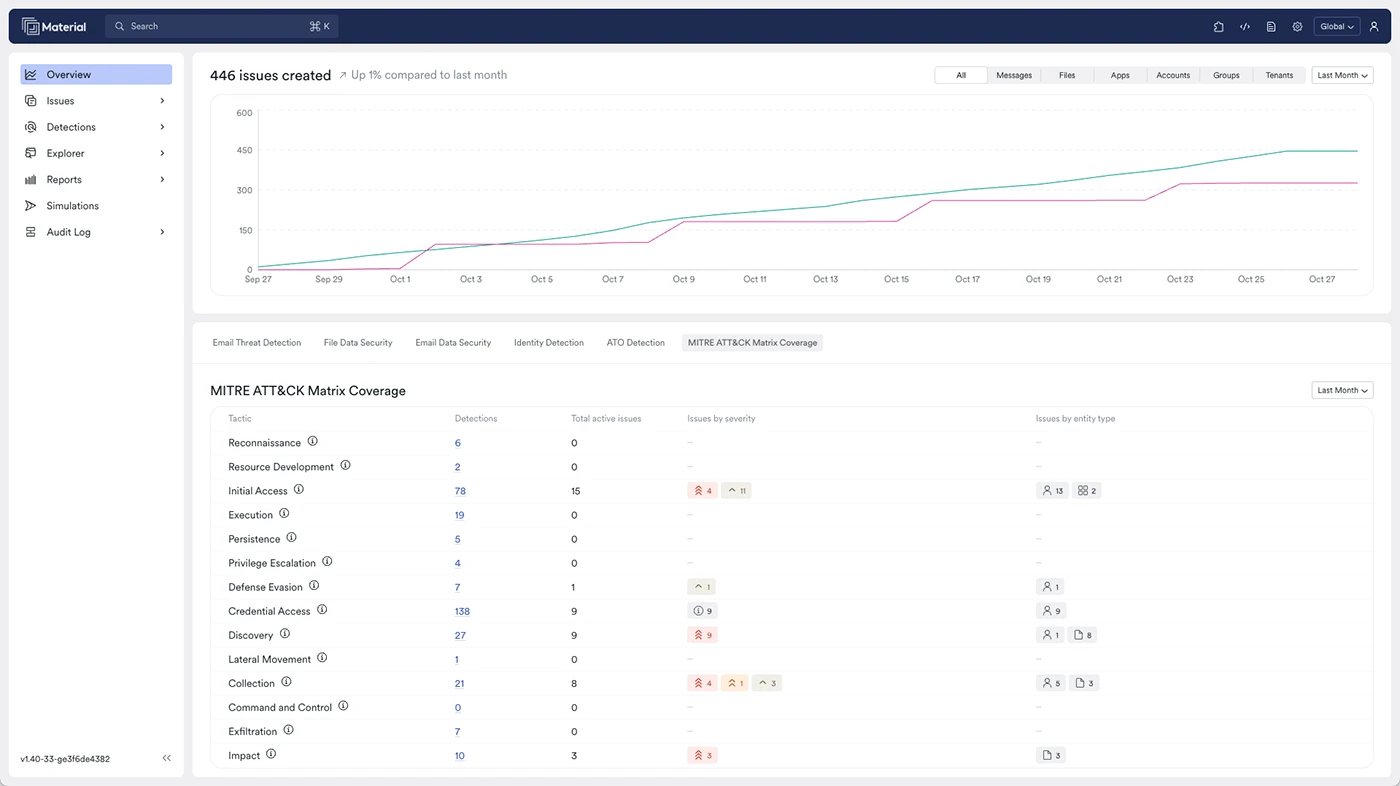
Run all four jobs on one platform and your alerts stop showing up alone. A risky OAuth grant doesn’t land in a vacuum; it shows up next to that account’s recent logins and the files it has access to, so whoever’s looking already has the whole picture instead of hunting for it across a patchwork of consoles. Fixing it works the same way: revoke a token, quarantine a message, lock down a sharing link, same system, same click, not a relay race between tools that don’t talk. None of it requires ripping out your mail routing. Material connects through the API, and you’re live in minutes.
Who is it for?
Material is for security and IT teams running Google Workspace who’ve hit the ceiling on what native tools and legacy gateways can catch, and who are done accepting that as the cost of doing business:
- You’ve outgrown what Google’s built-in controls and legacy gateways can catch on their own
- You’re tired of stitching together separate tools for email, DLP, and identity, and paying for the seams
- You handle regulated data and need an answer, not a guess, when someone asks who could access what and when
- You’re adopting AI agents faster than anyone can manually review an OAuth request
Final thoughts
Attackers don’t respect your org chart. They rely on the fact that email security lives in one tool, DLP in another, and nobody owns an OAuth review. They look for the seams.
Material’s bet is that several of your security challenges can be addressed faster and more effectively in one surface. One suspicious login. One overshared file. One app nobody remembers approving. Read alone, they’re noisy. Read together, they’re the whole story, and that story is exactly what most stacks can’t tell.
If you’re tired of stitching that story together by hand, Material’s cloud workspace security platform puts email, files, accounts, and OAuth governance under one roof, with details on the OAuth Remediation Agent, file security, and account takeover containment on Material’s site.
