
AI is making fraud harder to spot and identity harder to prove
Online fraud has become a routine concern for consumers and businesses that rely on digital accounts, payments and customer service. Experian’s 2026 U.S. Identity & Fraud Report describes a market where scams extend across messages, websites, documents, voices, images and account activity.
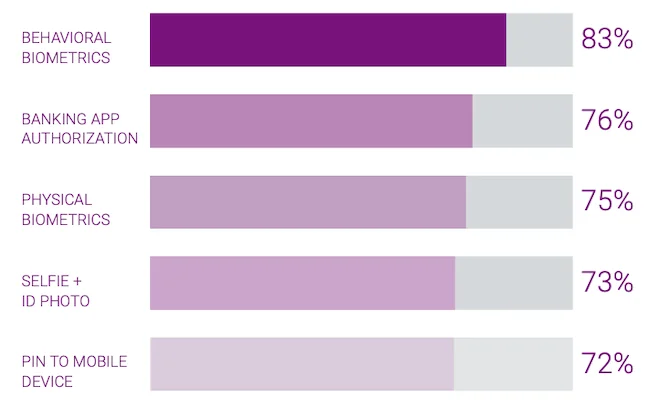
Security measures that make consumers feel most secure (Source: Experian)
Deception spreads across digital channels
Fraud used to be treated as an isolated event, such as a forged check, stolen credit card or false invoice. It has become a regular part of digital activity, appearing through phishing emails, scam texts, delivery notices, misleading ads and account alerts.
The growth of online banking, shopping, payments and customer support has created more opportunities for fraud. For consumers, that can mean financial losses and declining trust. For businesses, it raises costs and puts pressure on security systems and customer relationships.
AI makes fraud harder to recognize
AI makes digital scams easier to create and harder to identify. Criminals can imitate emails, messages, websites, documents, voices and customer support interactions. These scams can appear legitimate enough to persuade people to share information, send money or provide account access.
Around 60% of consumers have heard of scams using AI-generated images or videos, 53% are aware of AI-generated phishing messages and 47% know about deepfake voice impersonation. Nearly half feel more like a target for fraud than a year ago.
A fraudulent payment or account change may be the final step in a longer chain of deception. AI-generated phishing is a leading concern for businesses, alongside document forgery, automated bot attacks and synthetic identities.
Identity becomes central to digital trust
The rise of convincing digital scams makes identity verification more important. Seventy-one percent of consumers say accurate online recognition is important.
Behavioral biometrics make 83% of consumers feel secure, while banking app authentication, physical biometrics, ID verification and passwordless login also rank highly. Businesses use multiple identity and authentication signals to assess risk.
Verification is important when opening an account, where companies need to detect stolen credentials, synthetic identities and manipulated documents. Strong identity systems can adjust authentication according to risk, allowing routine activity to require fewer checks than sensitive requests.
Security should match the risk
Consumers expect digital services to be secure without making routine tasks difficult. Eighty-four percent say they will accept additional verification when it helps prevent fraud.
Extra checks may be appropriate when opening an account, recovering access or making a high-value transaction, while routine activity from a familiar device may require fewer steps.
Adaptive authentication can help reduce unnecessary friction. Businesses can also measure fraud losses alongside false declines, abandonment, conversion and customer satisfaction to understand how security affects the customer experience.
Data control builds digital trust
Fraud prevention, identity verification and AI rely on personal data, but consumers want more control over how companies use and protect it.
Only 23% feel they have complete control over how their personal data is used online, while 56% want that level of control. Consumers remain willing to share information when they understand the benefit. Security and privacy are the main reasons they are comfortable doing so.
Businesses share those priorities, making careful data governance an important part of digital trust.
AI plays a growing role in fraud management
AI is becoming a common tool for consumers, businesses and fraudsters. Twenty-seven percent of consumer-reported account openings were for AI chatbot accounts, up from 16% in 2025.
Eighty percent of U.S. businesses already use machine learning or generative AI in fraud management. The technology can help identify unusual behavior, detect manipulated documents and reduce manual review, while fraudsters use it for phishing, forged documents, automated attacks and deepfakes.
Greater use of AI requires oversight. Businesses need reliable data, model monitoring and human review to support accurate decisions and maintain customer trust.
“AI is transforming digital interactions in ways that are creating both exciting opportunities and new risks,” said Kathleen Peters, Chief Innovation Officer at Experian.
“As we move toward a human-not-present era where consumers increasingly rely on AI to help make decisions on their behalf, the organizations that will succeed will be the ones that make trust visible. Establishing identity and trust, whether for a person or an AI agent, is essential to every digital interaction.”
AI agents introduce new identity risks
AI tools are becoming part of online shopping and booking. Thirty-one percent of consumers have used AI for these activities, and 23% would consider doing so, although comfort falls for higher-stakes decisions.
Businesses may need to verify the customer, the agent, their relationship and the permissions granted when AI agents begin acting on customers’ behalf.
Fraudsters may impersonate legitimate agents, compromise authorized ones or exploit weak permissions. Businesses are beginning to explore Know Your Agent as an emerging authentication and fraud-control capability.
