
Fake Gemini installer delivers Vidar infostealer via Google Colab lure
A malicious executable masquerading as a Google Gemini installer was used to deliver the Vidar infostealer on a company network in the EMEA region, according to Darktrace researchers who investigated the incident.
“During the initial analysis, it was noted that the top search result for the suspicious filename associated pointed to a file hosted on Google Colab, a cloud-based Jupyter notebook platform, commonly used by developers, researchers, and data scientists to run code and machine learning workloads through a web browser,” Darktrace wrote.
“By leveraging another trusted Google platform, the attacker increased the likelihood that users would perceive the download as legitimate, making the lure more convincing to those searching for Gemini-related software,” they added.
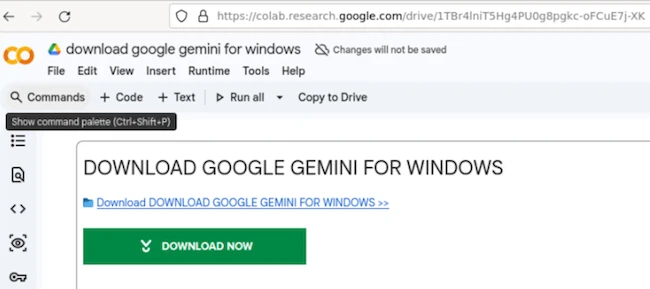
The Google Colab page containing a download prompt for the fake Google Gemini installer (Source: Darktrace)
From there, the page redirected to a second site posing as a “Windows Software Hub,” where the file Download_Google_Gemini_For_Windows.exe was waiting to be downloaded.
Darktrace saw SSL connections to Google Colab right before the malicious file ran, timing that suggests the user hit the Colab page before being redirected to the site hosting the download.
Vidar infostealer targets browser credentials
The ZIP archive offered through the campaign appeared to contain a README file instructing victims to run the executable with administrator privileges and add it to their antivirus exception list.
Researchers identified the malware as a newer Go-compiled Vidar variant that communicated with Telegram-based infrastructure, using dtm[.]kijangturbo88[.]top as its command-and-control endpoint.
“While the malware itself was not novel, the lure and delivery mechanism was,” researchers noted.
A separate detection through the customer’s endpoint protection integration later reinforced what the network activity had already suggested. The activity was consistent with the theft of browser credentials and other sensitive data from the infected machine.
Following detection, Darktrace’s Autonomous Response system blocked communication with the malicious infrastructure and quarantined the infected device. Despite the campaign’s use of a trusted platform and the appearance of a routine software download, the attack was caught because the device’s behavior deviated from its normal pattern.
“As AI adoption continues to accelerate across enterprise environments, organizations should remain alert to campaigns that exploit this interest through fake applications, malicious websites, manipulated search results, the misuse of trusted platforms, and AI-themed social engineering,” researchers concluded.
