
Researchers built a $7 gadget for anyone paranoid about hidden cameras in hotel rooms
Most of us, staying in a hotel room or a vacation rental, have wondered at least once whether we’re safe there, whether someone might be watching or recording us without our knowledge. The thought alone leaves a bitter taste in the mouth.
A team from the Korea Advanced Institute of Science and Technology (KAIST), working with the National University of Singapore and Singapore Management University, has built a small LED accessory that tries to answer that question in under five seconds.
The system is called SweepLED. It clips onto a smartphone’s camera, and its case-mounted LEDs sweep light onto an object from several angles while the phone films the reflections.
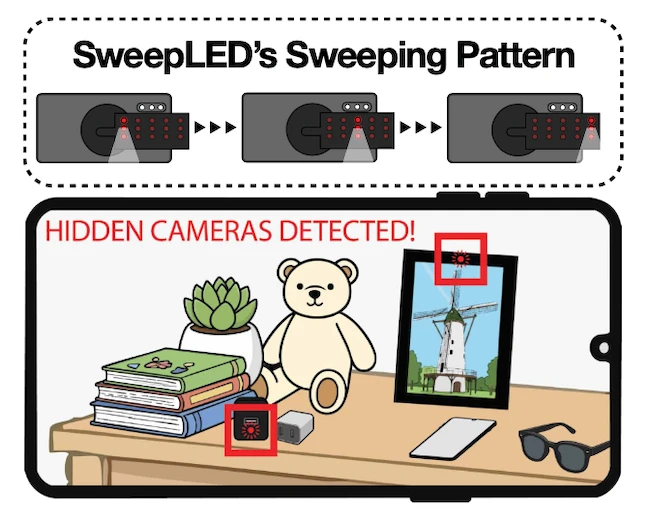
Illustration of SweepLED in use (Source: Research paper)
Handheld camera detectors already exist. Point one at a suspicious object, and it lights up whatever bounces light back. The trouble is that almost anything glossy does that, so the person holding the device still has to guess which glint belongs to a lens and which belongs to a bookshelf or a picture frame.
“Hidden cameras pose a serious threat to personal safety and privacy in everyday spaces,” said Professor Jun Han of KAIST, who led the research. He described the project as an attempt to pair low-cost smartphone hardware with AI analysis so that people without technical training could use it themselves, rather than needing specialized equipment or a professional inspection.
The user points the phone at a suspicious object and holds it still at three angles while the LEDs sweep across multiple positions. “SweepLED analyzes the captured reflection sequences to determine whether a hidden camera is present,” the researchers explained.
The software then compares “LED-on” frames against “LED-off” frames to isolate the reflections the sweep itself caused, filtering out camera shake and ambient light. It flags any spot that looks lens-like, then tracks how each candidate behaves as the light angle shifts.
A curved or recessed shiny surface changes differently than a lens does, and that difference, tracked frame by frame, is what a spatio-temporal AI model uses to make the final call, checked against all three viewpoints before it decides.
SweepLED was tested on 30 objects, a mix of 12 items with a hidden camera built in and 18 ordinary reflective items without one.
“SweepLED achieves an overall accuracy of 93.9% and 95.1% under handheld and static settings, respectively, demonstrating robust performance across diverse reflective conditions. Moreover, SweepLED maintains high accuracy in handheld scenarios, highlighting its practicality in real-world use,” researchers noted.
The hardware itself is inexpensive. The prototype uses 15 LEDs, attaches to the back of a phone with a cable, and the researchers estimate the core components cost less than $7 to build.
“This demonstrates its potential as a practical and accessible tool for enhancing guest privacy in hotels and Airbnb-style short-term rentals,” they concluded.
