
GNOME 51 adds passkey logins, offline maps and drawn PDF signatures
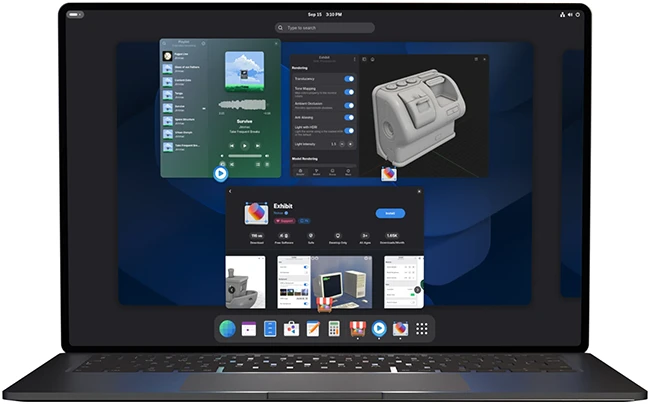
GNOME 51, the new version of the Linux desktop, came out on September 16 under the codename A Coruña. The release adds offline maps and live transit information to Maps, new login options at the login screen, hand-drawn signatures in the Papers document viewer, and smoother animations when the system is under load. Fedora 45 and Ubuntu 26.10 will ship it.
The update also takes something away. Owners of older NVIDIA graphics cards, such as a GeForce GTX 780, lose support for NVIDIA’s proprietary driver on the GNOME desktop and fall back to Nouveau, the open-source NVIDIA driver, which runs those cards in a basic mode. UbuntuHandbook, which followed the change from the alpha onward, lists the GeForce 700 series and older as affected, except the GTX 750 Ti, GTX 750 and GTX 745.
Maps works without a signal
The largest user-facing addition is in Maps, which GNOME’s release notes call the app’s “most exciting release in years.” Users can download a region and use it with no network connection, and downloaded areas sit in a list. Transit directions gain live departures at stops, real-time delays in journey instructions, platform hints, and walking times between a destination and the nearest stop.
Other apps got smaller upgrades. Image Viewer now shows camera and color information, Calendar received a round of performance and accessibility work, and the Web browser can generate passwords.
New ways to log in, and a signature that proves nothing
GDM, the login screen, adds smart card, passkey and QR code login. Remote Desktop gains smartcard passthrough and Kerberos login, useful to organizations whose sign-in already runs through Kerberos. Fingerprint enrollment in Settings has a new interface, and Remote Login now supports SSH socket servers.
Papers, GNOME’s document viewer, now lets users add a visual signature by drawing with a mouse or touchscreen or by importing an image, with the background removed automatically. The result is an image placed on the page. Nothing in it identifies the signer or detects a later edit, and anyone holding the PDF can draw one.
Smoother screens and smaller fixes
Mutter, GNOME’s compositor, the program that assembles windows into what appears on screen, now schedules frames so animations hold steady under load. Screen recording runs faster after redundant buffer copies were cut. GNOME remembers monitor brightness across reboots and HDR toggles, and laptops with hybrid graphics gain cross-GPU buffer scanout.
Settings adds Auto Rotate for devices with an accelerometer, an orientation lock, and an option to turn off the touchpad when a mouse is plugged in. Accessibility work includes wider support for Reduced Motion, keyboard-only screenshot area selection, and a setting to remove the focus-ring timeout. Files, also called Nautilus, shows a count badge while dragging, no longer clears a selection when you click empty space, and stays responsive during slow operations. The file previewer Sushi and the Disks utility now run on GTK 4 and libadwaita.
Three apps joined GNOME Circle, the project’s collection of endorsed third-party apps. Bobby is a SQLite browser, Tally is a counter app, and Bazaar is an app store for Flatpak sources with a curated section distributions can customize.
What older NVIDIA cards lose
Jonas Ådahl, a Mutter developer, removed the code behind the NVIDIA change during the GNOME 51 cycle. Mutter had carried two NVIDIA-specific paths: EGLStreams, which applications used to draw on Wayland, and EGLDevice paired with EGLStream, which Mutter used to drive screen updates. NVIDIA built EGLStreams as its own route to Wayland, and no other GPU vendor adopted it. NVIDIA later added support for GBM, the buffer-allocation method Intel and AMD drivers use, and the old path ended up serving only legacy drivers.
In the commit removing it, Ådahl wrote that the old approach had long been “replaced with the standard DMA buffer passing protocol in Wayland.” That is true for current NVIDIA hardware. The owner of an older GeForce card is not running current NVIDIA hardware.
If you run GNOME on an older NVIDIA card with the proprietary driver, check what your distribution installs before moving to Fedora 45 or Ubuntu 26.10. Newer cards on NVIDIA’s current drivers already use GBM and should see no change. The coverage does not list which driver branches are cut off, so the card model is the test.
The Network panel in Settings also dropped WEP, a legacy Wi-Fi encryption standard. The coverage does not say whether GNOME’s lower-level networking tools still connect to WEP networks, so anyone with an old access point should test before upgrading.
When you get it
GTK 4.24, the toolkit release paired with GNOME 51, shipped September 12. Beta releases of Fedora 45 and Ubuntu 26.10 are the quickest way to try the new desktop, and the final Fedora 45 is targeted for October 20, with October 27 as the fallback date. Developers can use the GNOME 51 Flatpak SDK on Flathub, and GNOME OS Nightly images run in a virtual machine or on bare metal. GNOME 52 is planned for March 2027, a year after GNOME 50 shipped on March 18.
Fedora’s October 20 target leaves owners of older GeForce cards 34 days to choose between Nouveau, a newer card, or putting off the upgrade.
