
Most open critical and high flaws are over 90 days old
Detectify analyzed exposure data from 1,293 of its customers in the US, the UK and the Nordics and found that most serious flaws still open on their internet-facing systems are months old. Of the critical and high-severity vulnerabilities open at the time of the snapshot, 97% in the Nordics had been exposed for more than 90 days, along with 92% in the UK and 86% in the US.
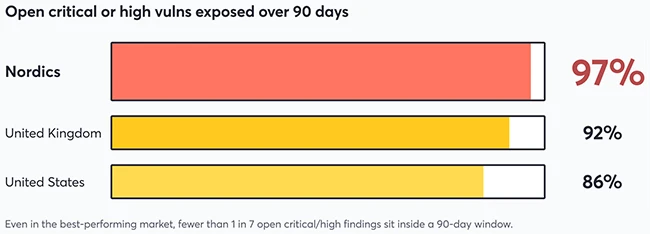
Source: Detectify
The organizations already know about these flaws. Detectify says it confirms findings with payload-based testing, which sends a working attack request and checks the response, so the backlog consists of issues its scanner judged exploitable. In the best-performing market, fewer than one in seven open critical or high findings is less than three months old.
The 90-day number describes the backlog on a single day. It does not measure how fast teams usually patch, since a few long-lived legacy problems can dominate a snapshot even where most findings close quickly. Researchers also allows that a flaw rated critical may sit on a low-value asset, behind other protections, or on a system due for retirement, and leaving it open may be deliberate. If you run a vulnerability program, the useful question about each old item is whether someone chose to accept it. Detectify calls the alternative risk tolerance drift, where flaws left open long enough get treated as accepted by default.
Public bodies fix the least
Public-sector organizations resolved 8.3% of their critical and high-severity findings, the lowest of the five sectors measured. Consumer packaged goods and brand companies resolved 46.2%, followed by technology at 37.4%, financial and banking at 30.6% and manufacturing at 23.9%, each counted within 90 days of first detection. The consumer brands posted the worst overall hygiene score of any sector, 56.2, largely because of their large backlogs. Across all severities, public bodies formally resolved 4.3% of their vulnerabilities in the Nordics and 2.3% in the US.
“There is unlikely to be one explanation, but public-sector environments often combine several conditions that make remediation difficult: large amounts of legacy infrastructure, fragmented ownership, long procurement and change-management processes, limited specialist capacity, and systems that cannot easily be taken offline,” Rickard Carlsson, Detectify’s CEO, told Help Net Security.
“A security team may know exactly what needs to change, but the affected system could be owned by another department, depend on an old vendor, require a procurement process, or support a service where downtime carries real consequences,” he said. “Public bodies need clearer ownership of exposed assets, better prioritization based on which exposed assets matter most, and faster routes to address the small number of vulnerabilities that create the greatest risk.”
The UK watches more and fixes less
UK organizations actively monitor 72.4% of their verified internet-facing domains, against 31.9% in the Nordics and 28.9% in the US. Over the lifetime of their accounts, though, UK customers have closed 18.6% of all critical and high findings ever raised, the lowest of the three markets. The US sits at 20.7%. The Nordics lead at 31.9% while also holding the stalest backlog, suggesting Nordic teams close more overall and leave a stubborn remainder to age.
The US has the largest measured attack surface, meaning the systems an outsider can reach, and monitors the smallest share of it. Among customers using Detectify for at least a year, US verified domains grew about 20% in 12 months, adding more than 100,000. UK domains grew 14% and Nordic domains 3.4%.
Exposed AI tools come with slower fixes
Researchers are finding more publicly exposed AI platforms on customer estates, including Lovable and Base44. Its early numbers point to organizations with exposed AI tooling resolving critical and high-severity flaws at less than half the rate of the wider customer base. Detectify gave no exact rate or count of organizations behind that comparison.
“At this stage, we’d be cautious about calling shadow AI the cause,” Carlsson said. “What we can measure is publicly exposed AI tooling, which isn’t necessarily shadow AI: much of it may be known and approved. The data shows an association, and one plausible explanation is that both reflect the same gap in asset visibility and governance, but that’s something we’re continuing to investigate.”
“Tools such as Open WebUI or LibreChat can be deployed quickly by individual teams, sometimes without going through the same inventory, ownership and security review processes as more established systems,” he said.
“The organizations we surveyed in the report are likely aware of the AI tooling that they are exposing, so it’s not necessarily a sign of neglect,” Carlsson said. “However, there is a need for organizations to make AI infrastructure visible and governable: know what is running, who owns it, what data and credentials it can access, and make sure it falls under the same vulnerability management and remediation processes as every other internet-facing asset. The danger is not experimentation itself; it is experimentation becoming invisible infrastructure.”

Download eBook: Identity-First Threat Intelligence
