
You don’t have to choose between BAS or automated pentesting, you shouldn’t
There’s a debate making the rounds in security circles that sounds reasonable on the surface but falls apart under operational scrutiny: Which is better, breach and attack simulation (BAS) or automated penetration testing (APT)?
Security vendors have stoked this debate for obvious reasons, with some even explicitly arguing that automated pentesting should replace BAS entirely. But for practitioners responsible for defending an organization, this framing is the problem. It represents a coverage regression disguised as simplification. Asking whether either BAS or automated pentesting is “enough” like asking whether a smoke detector or a sprinkler system makes a building safer. They both perform fundamentally different functions, and neither, alone, is a silver bullet.
Below, we cut through the three well-known myths about these two technologies and explain why a comprehensive strategy requires both offensive depth and defensive breadth.
First, what are we talking about?
Breach and Attack Simulation (BAS) continuously and safely simulates and emulates adversarial techniques, including ransomware payloads, lateral movement, and data exfiltration, to verify whether your specific security controls will stop what they’re supposed to. Though BAS can run CVE-based exploitation attacks, it doesn’t necessarily perform chained vulnerability exploitation. Instead, it tests whether your security controls, firewalls, EDR, SIEM, WAF, and email gateways, are blocking, if not, alerting on known threat behaviors.
Ultimately, BAS assessments ask your defenses: “Is this configured control effective?”
Automated Penetration Testing, on the other hand, takes a different, adversarial approach. It goes further by chaining vulnerabilities and misconfigurations together the way real attackers do. It excels at exposing and exploiting complex attack paths that include Kerberoasting in Active Directory or privilege escalation through mismanaged identity systems.
Automated pentesting asks a fundamentally different question: “How far could an attacker get?”
While these two technologies share the same broad goal of validation, they use different methods to answer different questions, and they each have their own blind spots.
Think of BAS as a series of independent measurements: does this control hold? Does that gateway block, if not, detect, and alert? Each test stands alone. Automated penetration testing is directional: it starts somewhere in your environment and moves, chaining whatever it finds into a path toward your most critical assets. One tells you how strong your controls are. The other tells you how far an attacker can get despite them.
Myth #1: We run automated pentesting, so we know where we stand
There’s a pattern most practitioners who’ve run automated pentesting recognize: the first run surfaces genuinely new findings. By run three or four, new discoveries have nearly stopped. This is often read as a sign that the environment is hardened, that the tool has done its job. Spoiler alert: It hasn’t. It’s worked through its fixed scope from a fixed starting point. Point it at a different network segment or initial access machine, and new attack paths open up again. In a 10,000+ person organization, three or four runs from the same entry point haven’t exhausted your attack surface, they’ve mapped one narrow slice of it. The findings decline isn’t coverage. It’s the illusion of it, leading to a dangerous and false sense of confidence and control.
The scope of entry point is only half the problem. The other half is what automated pentesting doesn’t touch regardless of where you start it.
When automated pentesting vendors talk about coverage, they typically mean infrastructure and network attack paths. What they generally don’t cover: SIEM detection rules, your cloud misconfigurations, your identity controls, or your AI/LLM guardrails.
The tools designed to catch attacks as they happen remain entirely unvalidated.
Consider the practical consequences: your automated pentesting tool maps an attack path from an unprivileged endpoint to a domain controller. Your team patches the vulnerability and closes the path.
- But would your SIEM have alerted you to the lateral movement technique used along the way?
- Would your EDR have flagged the credential dumping attempt?
Automated pentesting doesn’t tell you. Yes, it’s found the path. But it doesn’t tell you whether your detection stack would have caught the attacker walking it.
Note that some vendors take this further and market a clean run with zero findings, as proof of protection. It isn’t. It means no exploitable path was found from that entry point, within that scope, at that moment. Your firewall, your SIEM rules, your EDR logic all remain unvalidated. A no-finding pentest isn’t a green light. It’s a gap in visibility dressed up as confidence.
Myth #2: We run BAS, so we’re covered
BAS is exceptionally strong in breadth: validating control effectiveness across a wide range of known tactics, catching configuration drift, and providing continuous, measurable validation across your defensive stack. That’s its real value, and it’s a lot.
What BAS doesn’t do is chain real vulnerabilities together to demonstrate a proven attack path. BAS can simulate CVE exploitation to test whether your controls detect and block it, that’s part of its value. But it doesn’t determine whether an attacker could chain a misconfigured permission, a weak credential, and an unpatched service together to achieve domain-level compromise in your specific environment.
That’s the job of automated penetration testing.
See where this is heading?
BAS runs continuously and at breadth. Automated pentesting conducts deeper, scheduled assessments that surface complex, multi-step attack paths that BAS isn’t designed to find.
A team running a BAS tool alone has solid visibility into whether controls are tuned, but limited insight into the attack paths that exist regardless of how well those controls are configured.
A sophisticated adversary doesn’t just test controls. They route around them.
Myth #3: One of these tools will replace the other
Some vendors make the bold claim that autonomous pentesting is ready to replace BAS entirely. The argument goes that if you can validate actual exploit paths, why simulate theoretical attack behaviors?
On the surface, this sounds reasonable enough. However, it disingenuously ignores a basic structural reality. BAS and automated pentesting answer fundamentally different security questions.
- BAS asks: “Are my controls working as intended against known threats?”
- Automated pentesting asks: “What can an attacker do in my environment?”
Replacing BAS with automated pentesting would mean trading away continuous detection validation, control drift monitoring, and the ability to continuously test your entire defensive stack in exchange for deeper but periodic attack path insight.
In this scenario, you’d gain adversarial depth but lose defensive visibility.
An organization running automated pentesting and no BAS equivalent knows what paths attackers can take. It doesn’t know whether its defenses would catch the attacker taking those paths. That’s not a comprehensive security posture. That’s half of a validation program.
What the numbers say
The theoretical debate between BAS and Automated Pentesting fades when you look at actual production data. Real-world numbers illustrate why you need both: they reveal completely different halves of the same coin. Or crisis.
The context: Attackers are getting quieter
According to the Picus Red Report 2026, encryption-based attacks have declined by 38% year-over-year. In their place, adversaries are pivoting to, and increasingly relying on, stealth: exfiltrating data through trusted application layer protocols, like cloud services and legitimate APIs designed to look like normal traffic. Attackers are avoiding your controls by blending in.
The BAS perspective: Defenses are failing… quietly
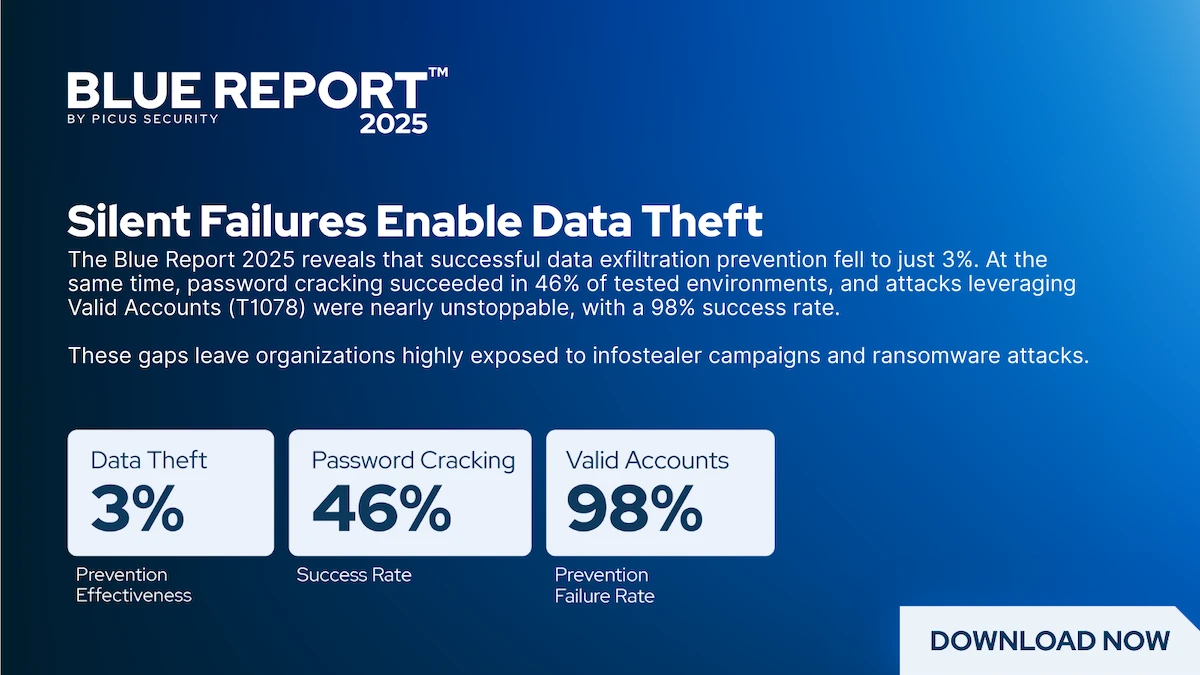
Customers’ anonymized and aggregated BAS assessment data shows exactly how poorly security stacks are keeping pace with this stealthy shift. According to the Blue Report 2025, organizations might assume their deployed controls are working, but continuous simulation reveals the gaps:
- Only 14% of logged adversarial activity generates an alert.
- Data exfiltration prevention succeeds just 3% of the time; precisely the layer adversaries are now targeting as they blend theft into trusted application traffic.
- Credential-based access succeeds in 98% of tested environments.
Controls are deployed, but too often, they’re not working the way you assumed they would. This is what BAS surfaces: the configuration reality of your defensive stack, not its hypothetical strength.
The automated pentesting perspective: open doors
While BAS highlights the gaps in the fence, automated pentesting shows how easily an attacker can walk through them to your proverbial vault. With credential access succeeding 98% of the time, what is the actual consequence? According to Automated Pentesting data: 22% of organizations have an open, unvalidated attack path straight to Domain Admin.
The combined reality
Two different tools. Two different approaches. Two distinct pictures of the same risk. BAS shows you why the attacker isn’t being caught; automated pentesting shows you where they’ll inevitably end up once they slip past your controls. As you can see, neither picture is complete without the other.
You deployed BAS + automated pentesting, mission accomplished? Not so fast
So, you deploy both BAS and automated pentesting. You now have offensive depth and defensive breadth. Excellent. But, is the job done?
Not quite. By running both, you’ve now introduced a new challenge: the normalization gap.
Now you’ve got a digital tsunami of disconnected finding streams flooding your team, including:
- Dozens of validated exploits from your Automated Penetration Testing solution
- Control gaps from your BAS solution
- Tens of thousands of theoretical vulnerabilities from your scanners
Without an additional layer to merge, deduplicate, and prioritize these outputs, your remediation queue quickly becomes operationally unmanageable.
A “Critical” vulnerability on paper is a much lower priority if your BAS platform has already proven that your WAF or EDR successfully blocks its exploitation.
This is exactly where the Picus Security Validation Platform bridges the gap. Built for practitioners who have hit the operational ceiling of disconnected tools, the Picus Security Validation Platform provides you a unifying intelligence layer.
It automatically ingests findings from external automated pentesting tools and vulnerability scanners alongside its own continuous validation products. It then runs that combined dataset directly against your live security control performance data. By unifying these dimensions, Picus Platform eliminates CVSS-based guesswork, transforming 50,000 theoretical findings into a single, deduplicated, and ranked action queue based on confirmed real-world exploitability.
The right questions to ask
If you’re evaluating your validation coverage, or challenging a vendor’s “silver bullet” claims, ask these three questions to cut through the noise:
1. Which of my attack surfaces does your product validate, and at what scope? If the answer doesn’t address your detection stack, cloud environment, identity controls, and AI tools, those surfaces are being assumed to be safe rather than proven to be.
2. How does your platform distinguish exploitable vulnerabilities from theoretical ones? If the answer is CVSS scores, you’re prioritizing against a list that doesn’t reflect your actual environment’s live, real-world security controls.
3. How does your platform normalize findings from my other tools? If the answer involves manual cross-referencing or exporting CSVs, run, don’t walk. This is where your risk gets lost and your backlogs grow.
There’s an answer to whether BAS or automated pentesting alone is sufficient: neither is. Both sides of the question need answers. And the data shows what happens when you don’t get them.
Relying on just one tool leaves you with half a validation program. Relying on both without a coordinating platform leads to a different level of chaos and confusion.
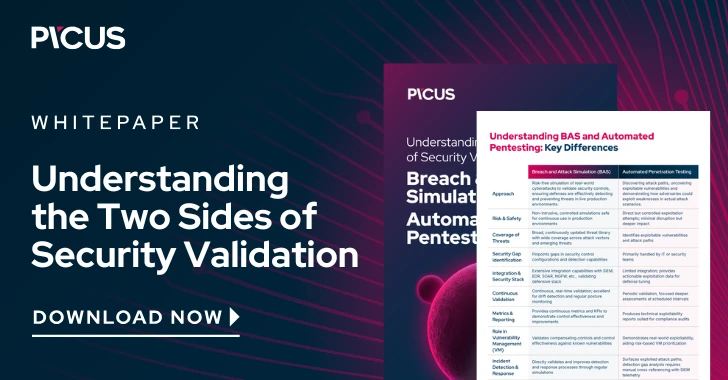
Ready to build a complete validation strategy? Download our whitepaper, Understanding the Two Sides of Security Validation: BAS vs Automated Pentesting, to learn how to unify your offensive and defensive tooling without drowning in disconnected alerts.
