
The AI oversight paradox: Is the investment worth the cost of watching it?
Unlike in 2025, when AI adoption and testing drove business strategies, organizations in 2026 want proven ROI before committing budgets, according to a report by Globalization Partners.
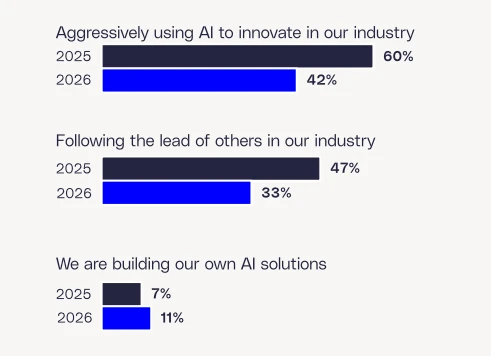
How global executives characterize their organization’s approach to AI adoption (Source: Globalization Partners)
62% of business leaders said they felt pressure from their organizations to use AI, while only 38% found AI tools personally beneficial. Companies also began building in-house solutions to address security and compliance requirements.
“A sophisticated strategy identifies high-impact AI use cases and builds the necessary organizational foundation before the plan is written. That’s the difference between a perpetual proof of concept and a successful, transformative deployment,” said Nat Natarajan, COO of G-P.
Most global firms are ready to reduce AI spending if profit goals for 2026 are not met. This shows disappointment with last year’s ROI results.
Globally, business leaders remain divided on AI’s long-term trajectory, with 69% of U.S. HR executives view AI as a lasting transformation tied to the future of work.
The growing oversight burden
AI helps employees work faster, but many decision-makers still do not trust the results. Only 23% of global executives said they have total confidence in the accuracy of AI output. Companies are increasing human oversight to prevent speed from affecting quality, turning workers into reviewers who check and revise AI-generated content.
Managers are also concerned about workers using AI tools without approval or oversight.
Some say they are uncomfortable using AI for sensitive documents because they are uncertain whether the information is legally accurate.
Firms are becoming more comfortable allowing AI to handle tasks such as risk management, financial budgeting, and talent management.
AI is also increasing review work for employees. Most workers report spending more time checking, editing, and updating AI-assisted work, while only a small percentage say they spend less time on oversight.
AI is changing how companies value work
Decision-makers admit they increasingly view employees as secondary assets because advanced AI systems have reduced the value they place on human labor. They also worry that they use AI to “perform productivity” instead of creating measurable business value.
Only 12% of executives strongly agree that sacrificing employee privacy for AI monitoring is worth it to achieve business goals.
AI is reducing the perceived value of parts of the workforce while increasing competition for specialized talent. To secure top AI talent, leaders say they are willing to hire in countries where they do not already employ workers. They also say AI improves access to talent but introduces risks they are not prepared to manage.
Leaders say organizations need a borderless workforce strategy to turn global talent access into a competitive advantage.
