
GPT-5.6-Cyber refuses security researchers’ requests far less often
GPT-5.6-Cyber is a new OpenAI model built on GPT-5.6 Sol, trained to find zero-day vulnerabilities and build exploit chains, with fewer refusals on higher-risk, dual-use work.
Model is available only through Daybreak Red, the higher tier of OpenAI’s vetted access program for cybersecurity professionals.
“The GPT‑5.6‑Cyber model is trained to improve performance on certain cybersecurity workflows involving exploit development and advanced security research,“ the company said.
OpenAI built an internal benchmark to track how often each model agrees to handle requests involving exploit chains, authentication bypass, and privilege escalation. GPT-5.6-Cyber completed 95% of these requests. The standard, guardrail-enabled version of GPT-5.6 completed 1.5%.
“On ExploitGym, which evaluates whether agents can turn known vulnerabilities into working exploits that achieve arbitrary code execution in controlled environments, GPT‑5.6‑Cyber outperforms both GPT‑5.6 Sol and GPT‑5.5 Cyber,” it added.
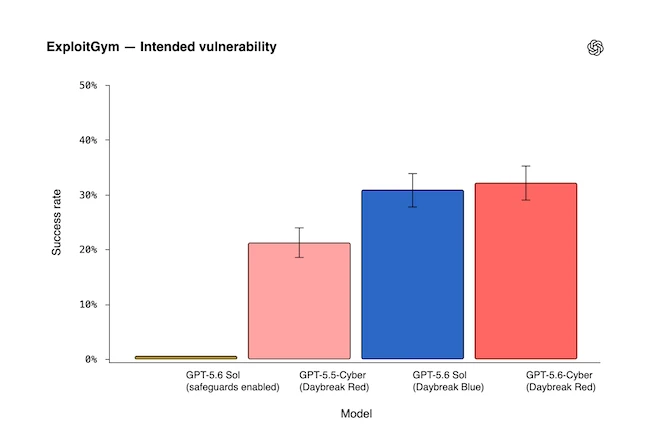
(Source: OpenAI)
GPT-5.6-Cyber uncovered zero-day flaws in Chrome’s V8 engine
OpenAI says its own researchers used GPT-5.6-Cyber to find bugs no one had documented before, including two flaws in V8, the JavaScript engine behind Chrome, that could be chained to corrupt memory and escape the browser’s sandbox. Google fixed the issue and assigned it CVE-2026-15903.
The company also identified high-severity vulnerabilities affecting a popular mobile operating system, a widely used database, and an operating system kernel. OpenAI did not publicly identify the affected projects, saying it is working with partners and the open-source community to disclose and remediate the vulnerabilities.
“Under our Preparedness Framework, the GPT‑5.6 Sol model was assessed as High for cybersecurity capability and below the Critical threshold. Before launching GPT‑5.6‑Cyber, we also evaluated its frontier cyber capabilities and determined that it similarly reaches the High threshold but not the Critical threshold,” OpenAI noted.
This new model comes just days after OpenAI said it was holding back its upcoming model, Astra, after preliminary testing raised the chance it could reach the top tier of hacking capability under the company’s own risk framework.
