Scammers have figured out the best time to text you
The suspicious calls, texts, and DMs you got recently aren’t a coincidence, according to Malwarebytes. Scammers have worked out which platform gets them the best results for each type of con, and they stick to that formula.
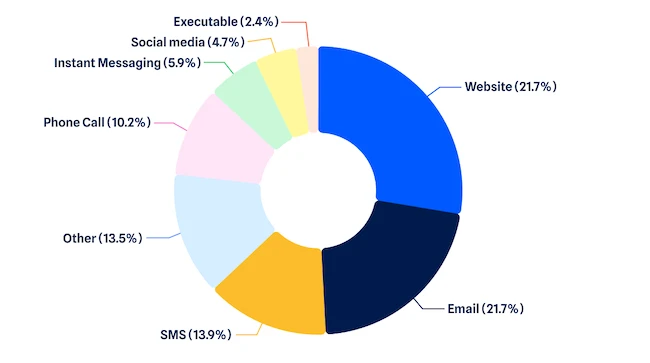
(Source: Malwarebytes)
The company looked at its own threat data collected between April 15 and July 14, 2026, and tracked more than 20 scam categories, from tech support cons to sextortion. “Intuitively, the platforms favored often match the content of a scam,” researhers noted.
“Job scams mostly arrive through typical work channels like email, romance scams mostly arrive through social media where meeting strangers is least questioned, and tech support scams mostly arrive through the phone,” they added.
The web remains the top delivery method for scams, ahead of email and SMS. “No surprise that the web is the most popular doorway,” Malwarebytes wrote. The company claim it blocks around 500,000 phishing sites a day.
Jimmy Donaldson, known online as MrBeast, is the most impersonated person in Malwarebytes’ data, ahead of Elon Musk and Donald Trump. His likeness turns up in about 30% of impersonation scams, ranging from crypto giveaways to transfer-fee schemes, the data shows.
“Familiar faces lower the public’s guard and make scam messages feel more credible, which is why they work so well.”
Friday is prime time for scammers
Scam texts peak at 12:00 pm ET, a volume that’s about 874% higher than the quietest hour, 1:00 am ET.
The rate of scam texts also builds through the week. Volume is lowest on Sunday and rises steadily until it peaks on Friday, when people get about 50% more fraudulent texts than at the start of the week. This suggests scammers time their campaigns rather than send messages at random.
According to reports from Malwarebytes users, the five most impersonated brands are Google, Microsoft, Apple, Roblox, and Amazon. Google’s name was abused at least twice as often as Amazon’s.
Gaming communities are also drawing more attention from scammers. Roblox, Steam, Discord, and Minecraft were the most impersonated gaming platforms. Roblox scam activity rose 15% between mid-June and mid-July, and Steam saw a 19% jump over the same period.
“The data points to a scam economy that’s becoming more specialized. Rather than relying on one-size-fits-all campaigns, criminals are tailoring scams to the platforms we use every day, from email and text messages to gaming communities and social media. The tactics may change, but the goal stays the same: to earn your trust long enough to steal your money or your information,” Malwarebytes concluded.