
How AI can fix cybersecurity compliance: From dashboards to continuous execution
Most compliance work goes into proving security, not improving it.
That isn’t because the rules are unreasonable. Regulators, customers, and cyber insurers are right to expect organizations to implement hundreds of technical and administrative controls, monitor their environments, respond to incidents, and prove that all of it works. The problem is the cost of delivering it. The Pentagon’s own estimate puts a small contractor’s CMMC level 2 compliance at roughly $105,000 over three years. That figure covers only assessing and attesting to compliance, not implementing a single control. In our experience working with small and midsize businesses, the full first-year cost of a compliance program runs from $50,000 to well over $300,000, depending on the framework, the organization’s starting maturity, and how much outside consulting it needs.
The strain is showing. In July, the Department of War suspended Phase 2 of CMMC (Cybersecurity Maturity Model Certification), which would have required third-party assessments for contractors handling controlled unclassified information. It launched a 60-day review with an eye toward easing the burden on small and midsize businesses. Yet the underlying obligations didn’t go away. Contractors working with DoW must still meet compliance standards and submit self-assessment scores. The same burden applies across SOC 2, ISO 27001, HIPAA, HITRUST, FINRA, and NYDFS: implement the controls, keep them running, and prove it.
An assembly line that never stops
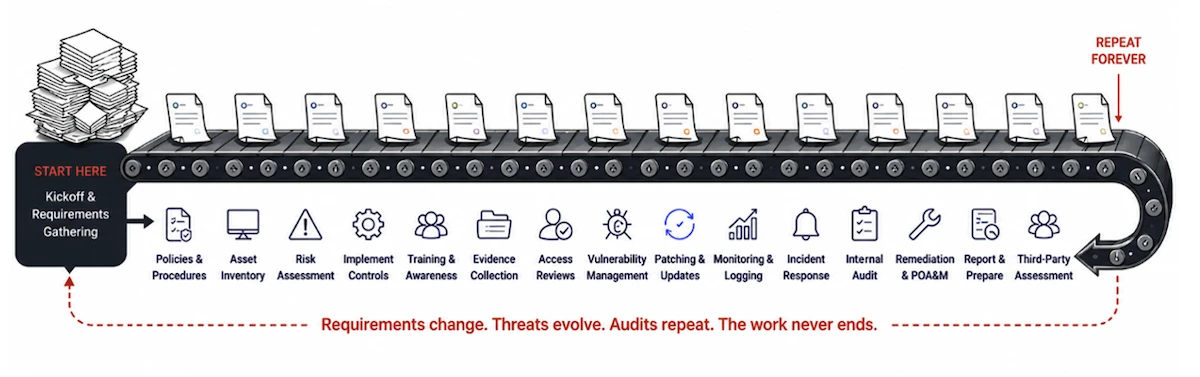
Compliance isn’t a checklist. It’s an assembly line.
It starts with policies, asset inventories, and risk assessments. Next come control implementation and employee training. Then the daily grind: monitoring, patching, vulnerability management, incident response, and remediation. Every step must be documented and every control backed by evidence, while systems, users, and regulations keep changing. The day one audit closes, prep for the next one begins.
To keep that line moving, a typical organization stitches together more than 20 tools. These span identity management and MFA, endpoint protection (EDR), device management (MDM), firewalls, SIEM, backup, encryption or CMMC enclaves, vulnerability scanning, and many more. On top of the tools come an MSP, a SOC provider, consultants, auditors, and someone to coordinate it all. Controls get applied unevenly, and documentation goes stale. Weeks before the audit, everyone scrambles to reconstruct evidence for controls that may have been working all year.
The irony is that most of this effort doesn’t make anyone more secure. It goes into proving security that already exists.
Traditional compliance software didn’t fix it
The first generation of GRC platforms replaced spreadsheets with dashboards. They centralized policies, mapped controls to frameworks, assigned tasks, and sometimes pulled evidence automatically from cloud services. That was real progress.
But it left the hardest part untouched. Somebody still has to deploy endpoint protection, configure MFA, patch systems, encrypt devices, triage alerts, and fix what’s broken.
A dashboard can tell you a control exists. It can’t enforce it.
Attackers already run at machine speed
There’s a second reason manual compliance can’t keep up: the adversary has automated.
A CISO I know recently walked me through a breach at his company. The attackers got in and left with the data in seven minutes. No ticket queue, on-call rotation, or morning triage meeting moves that fast.
Seven minutes sounds extreme, but the numbers are heading the same way. CrowdStrike reports that the average time for a criminal intruder to move from initial access to other systems fell to 29 minutes in 2025, and the fastest took 27 seconds. Operations by AI-enabled adversaries rose 89 percent. AI is also putting these capabilities in the hands of amateurs. Earlier this year, Amazon’s threat intelligence team found that a single, modestly skilled criminal had used commercial AI tools to break into more than 600 firewalls across 55 countries in about five weeks.
Now compare that with how most compliance programs operate: a quarterly access review, a monthly patch window, an alert that sits in a queue over the weekend. A control checked once a quarter won’t stop an attacker who needs seven minutes. When offense runs at machine speed, defense has to as well. That means catching drift the moment it appears, closing the gap automatically, and bringing in a human for the calls that need judgment.
The Amazon case holds the most important lesson. The attacker didn’t use a single zero-day. They got in through exposed management ports and passwords without MFA, the same basics every compliance framework already requires. When they ran into hardened environments, they simply moved on to easier targets.
Controls that are actually enforced, every day, are what make an organization the harder target. The automation that satisfies the auditor is the same automation that sends attackers looking elsewhere.
From compliance dashboards to continuous execution
AI-native compliance platforms flip that model. Instead of telling teams what to do, they do the work.
Take a control like “ensure unauthorized applications are not used.” A dashboard displays it as a task. An operational platform scans endpoints, detects unapproved software, prioritizes the risk, and removes or quarantines the software according to policy. It logs each action as audit evidence along the way.
The same approach applies across the whole lifecycle. The platform drafts policies tailored to the environment and maps one set of controls to CMMC, SOC 2, ISO 27001, and HIPAA at once. It watches endpoints, identities, cloud services, and networks for drift. It investigates alerts around the clock and opens remediation tickets.
As a result, evidence becomes a byproduct of daily operations rather than a separate project. Audit prep shrinks dramatically. Instead of a snapshot once a year, organizations can see their real security posture every day.
People still make the calls
None of this removes the need for security professionals. It changes where they spend their time. AI handles the repetitive work: monitoring, evidence collection, documentation, and routine remediation. Humans own architecture, governance, serious incidents, and decisions about which risks to accept. And a human remains accountable to the auditor for everything the system does.
For most SMBs, this is the only realistic path to a mature program. They could never afford to hire the IT, security, compliance, and SOC staff needed to do it all manually. Pairing AI-driven execution with expert oversight lets them raise the bar without growing headcount at the same pace.
This is the future
The next evolution of compliance platforms is an intelligent, operational layer that drafts policies, implements controls, monitors the environment, assists with remediation, and continuously collects evidence as work happens. The first generation of compliance software helped organizations document security. The next generation will help them operate it. Organizations that embrace this shift won’t simply spend less time preparing for audits. They’ll spend less time managing compliance and more time improving their security, serving their customers, and growing their business.
