
Attackers exploit critical Node-RED flaw to deploy Linux bot and backdoors (CVE-2026-58115)
Attackers are exploiting an authentication flaw (CVE-2026-58115) in Node-RED, a programming tool built into some industrial control products, to install a Linux bot and backdoors on unprotected servers, VulnCheck has found.
Node-RED is a flow-based programming tool built on Node.js that lets users wire together event-driven applications in a browser-based editor. It can run on small devices such as the Raspberry Pi or in the cloud, and it is used in manufacturing, healthcare, and home and industrial automation.
The tool is also part of critical infrastructure, embedded in commercial ICS/OT products such as Siemens’ SIMATIC IoT2050 Advanced, which is affected by the flaw. Siemens disclosed it in August and gave it a CVSS score of 10.0, warning that devices running Industrial OS with Node-RED installed, in versions before V4.3.4.1, are vulnerable.
The bug “could allow an unauthenticated remote attacker to create malicious flows and execute arbitrary code on the underlying server with maximum privileges,” Siemens said at the time of disclosure.
Caught by a decoy
More than two months after Siemens’ disclosure, the flaw is being exploited in the wild.
“On October 30, 2026, one of our canaries caught an attacker exploiting CVE-2026-58115,” wrote VulnCheck researcher Patrick Garrity.
“The attacker’s request was a complete exploit. It deployed a Node-RED flow, triggered it automatically, and pulled a binary from an attacker-controlled server, all behind three layers of encoding,” added Garrity.
“Two built-in node types make this trivial to weaponize. An inject node fires a message on a schedule or once at startup, and an exec node runs a shell command. Wire one to the other and the flow executes a command as soon as it is deployed, with no further interaction,” he explained.
The flow downloaded a file named bot-linux-amd64 from a separate server, saved it under a hidden name in a memory-backed location and ran it in the background. VulnCheck did not retrieve the binary, so the company can’t say whether it is a cryptominer, a DDoS bot, a reverse shell or something else.
One address, eight CVEs
The request came from an IP address in Microsoft’s network that geolocates to Brazil. “It didn’t just scan us. It sent the complete exploit, flow and dropper, in a single POST /flows,” Garrity stated.
The same address went after the Node-RED flaw 16 times between October 30 and November 1, and in VulnCheck’s wider canary data it logged 125 hits against 8 different CVEs, old and new, in Apache Solr, Camunda, Gitea, MLflow, Traefik and Joomla.
Garrity describes this as opportunistic mass scanning, and notes that an address in a large cloud provider’s range is usually a rented or compromised virtual machine and says little about who is behind the attacks.
Later requests brought new payloads. One fetched a shell script from the same download server, and another pulled a file from a second server and saved it under a name made to look like a kernel worker thread. Several requests installed webshells that let the attackers come back and run commands at will. The bot is stored in memory and is lost on reboot unless it sets up persistence some other way, while the webshells stay in place after a restart.
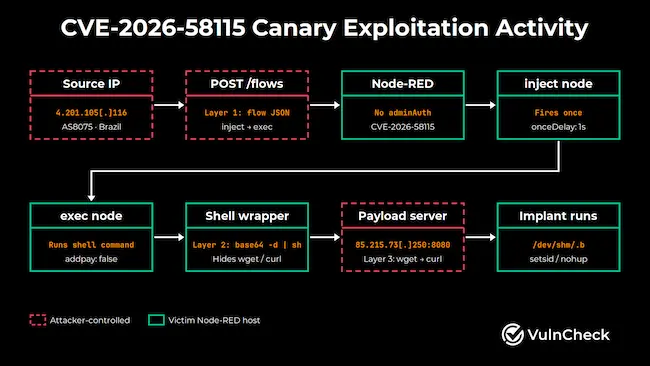
The exploitation activity (Source: VulnCheck)
Check your instances
VulnCheck added the flaw to its KEV catalog after spotting the in-the-wild attempt and noted that CISA had not listed it in its own KEV catalog at the time of writing.
“Node-RED instances without adminAuth are being found and exploited automatically,” Garrity warned.
“If you run Node-RED anywhere, including inside OT environments, check today whether it’s reachable from outside your network, apply updates where available and implement detections to reduce the risk of exploitation,” he added in a LinkedIn post.
The VulnCheck post lists indicators of compromise, including the IP addresses of the attack source and both payload servers.

Subscribe to our breaking news e-mail alert to never miss out on the latest breaches, vulnerabilities and cybersecurity threats. Subscribe here!
