AI agents inherit employee access, and nobody’s watching how they use it
AI agents that employees build inside project trackers, CRMs and automation tools often run on the credentials of the person who created them and carry that person’s access to company data, according to Nudge Security.
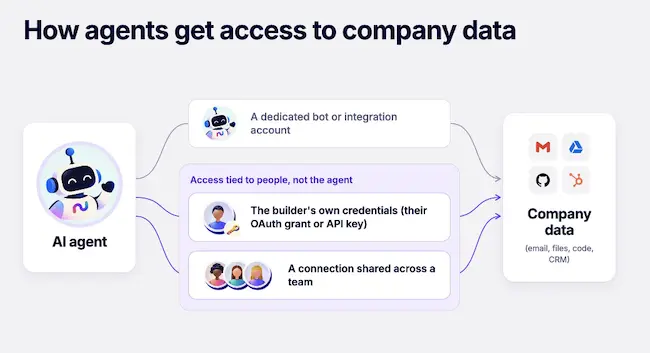
Source: Nudge Security
The AI Adoption in Practice 2026 report draws on anonymized, aggregated telemetry from Nudge Security customer environments. It tracks which AI tools show up in organizations, what those tools connect to, which agents are running and how employees use AI.
Agents that borrow their creator’s access
Among organizations with at least one AI agent, the median organization had seven, and about 44% had more than 10. The agents ran on 15 different platforms, and more than half of the organizations with agents had them on two or more. That means security teams have several admin consoles and permission models to check.
The agents commonly turned up in Atlassian’s Rovo Agents, Zapier Agents, Claude Managed Agents, Cursor Automations and ChatGPT Agents. Some platforms give an agent a dedicated bot or integration account. Often, though, the agent works off the OAuth grant or API key of the employee who set it up, or off a connection a team shares.
“In our view, that makes many agents an extension of the people who build them, carrying their access to company data,” the report states.
An agent a sales manager builds in a CRM can reach whatever that manager can reach. These agents run inside the platforms themselves and off company devices, so endpoint tools miss them, and when they don’t get an identity of their own, the identity provider has nothing new to manage.
That also muddies the audit trail. “Your logs show the employee, not the agent, so it’s hard to tell which actions a person took and which their agent took,” the company noted, adding that an agent’s access may stay the same when its creator changes roles.
“The platforms your teams use every day are becoming agent platforms, whether or not anyone decided they should be,” said Jaime Blasco, CTO of Nudge Security. “The project tracker, the CRM, the chat tool: each one now lets an employee build something that acts on their behalf, with their access, continuously. The question for security teams is no longer whether that’s allowed. It’s whether they know it’s happening.”
OAuth connections that bypass inspection
The company saw at least one Anthropic integration in 74% of organizations and an OpenAI integration in 67%. Google Workspace was the most common endpoint for both vendors. Anthropic’s integrations reached further into business systems, even though its adoption was slightly lower than OpenAI’s.
Most of these links are OAuth grants, created when an employee clicks “allow” so an AI tool can read their email, files, code or messages. Data then travels straight between cloud services and never crosses the corporate network, out of sight of AI gateways and data loss prevention tools.
Those grants stay in place until someone revokes them, often long after the employee stopped using the tool. The report recalls the 2025 Salesloft Drift breach, in which attackers stole OAuth tokens that customers had granted to Drift’s AI chat tool and used them to pull data from hundreds of companies’ Salesforce environments.
Two model providers in almost every company
OpenAI was present in 96.9% of the organizations Nudge Security observed and Anthropic in 94.5%, so at least 91% of organizations run both. “The core models have become infrastructure,” the report says, likening them to cloud providers that organizations mix and pick by use case.
Beyond the two big vendors, twelve different AI tools appeared in more than half of organizations. In total, the company identified 2,927 distinct AI vendors in the environments it monitors.
Company data goes into prompts every day
Pasted content or uploaded files showed up in 18% of all observed prompt activity. OpenAI accounted for 55% of observed prompts, and the rest went to other vendors with their own retention and training terms.
API keys and access tokens pose the most direct risk. “Once a working key leaves your environment, anyone who can see it can use it,” Nudge Security warned, advising organizations to rotate any key or token that ends up in a prompt.
Most of this sharing comes from routine work such as debugging code or summarizing a document, and the report doesn’t blame employees for it. “The data entering AI tools usually isn’t the result of someone breaking the rules. It’s a side effect of AI being useful,” it explains.
The company advises security teams to inventory agents inside the business platforms where they are built and find out whose access each one uses. It also recommends reviewing the OAuth grants employees have given AI tools and revoking the ones nobody needs anymore.
Blasco expects the problem to grow. “We expect this to get harder, not easier. Every platform your teams use is adding agent-building features, and each one makes it simpler to hand an agent a person’s access,” he said. “That means the gap between what an organization’s identity provider knows about and what’s actually acting on its data is going to keep widening.”