
Android 17 beta brings privacy, security, and performance changes
Google has released the first beta of Android 17, giving developers an early view of changes to core app behavior, platform tooling, performance, media handling, and connectivity.
The company plans to move quickly from this beta toward the Platform Stability milestone, targeted for March, where final APIs and behavior definitions for apps will be delivered.
After that, developers will have several months before the final stable release. The roadmap includes quarterly updates, with the Q2 release marked as the only one planned to introduce app behavior changes that affect compatibility, followed by a minor SDK release in Q4 that adds APIs and features.
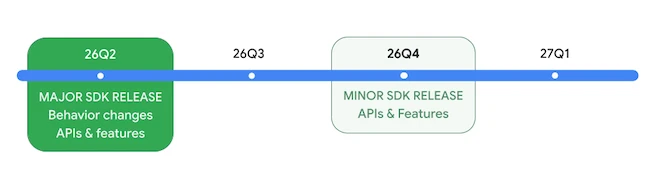
A year of releases (Source: Google)
The update removes the developer opt-out for orientation and resizability restrictions on large-screen devices, meaning apps must adapt to a wider range of layouts on foldables, tablets, and desktop-style windowing environments. Games are exempt from some of these requirements.
Android 17 beta privacy and security features
The beta also continues Android’s push on privacy and security. Android 17 deprecates the android:usesCleartextTraffic manifest attribute. Apps targeting Android 17 or higher that rely on usesCleartextTraffic=”true” without a Network Security Configuration will block cleartext traffic by default.
Users are encouraged to migrate to Network Security Configuration files to manage network traffic rules with more granular control.
A public Service Provider Interface for HPKE hybrid cryptography is also available, supporting secure communication using public key and symmetric encryption.
User preference controls are added for VoIP call history integration. These changes support caller and participant avatar URIs in the system dialer and allow users to manage how VoIP call logs appear and are shared.
Wi-Fi ranging is expanded with new proximity detection capabilities that support continuous ranging and secure peer-to-peer device discovery.
Runtime and media handling updates
A series of under-the-hood improvements target performance. The platform adds a lock-free message queue to reduce contention and missed frames, generational garbage collection to lower overall memory management cost, and enforcement of static final fields to enable more aggressive runtime optimization. New profiling triggers also support detailed performance analysis.
Media and camera support is expanded with tools aimed at professional-grade applications. A new API allows camera capture sessions to change output configurations without restarting the session, reducing visual glitches and simplifying transitions between modes.
“You can enroll any supported Pixel device to receive this and future Android beta updates over-the-air. If you don’t have a Pixel device, 64-bit system images are available through the Android Emulator in Android Studio,” Matthew McCullough, VP of Product Management for Android Developer, said.