
Security and complexity slow the next phase of enterprise AI agent adoption
Enterprise AI agents are embedded in routine business processes, particularly inside engineering and IT operations. Many organizations report active production deployments, and agent development ranks high on strategic agendas.
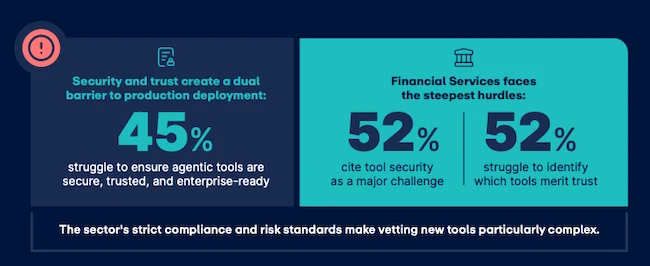
A new study from Docker, The State of Agentic AI Report, examines how enterprises are deploying agentic systems and the challenges emerging as deployments scale.
The data shows that 60% of organizations run AI agents in production environments. Nearly all describe building agents as a strategic priority.
Initial deployments focus on internal workflows. DevOps and Continuous Integration (CI) and Continuous Delivery (CD) optimization lead reported use cases, followed by security automation and general process automation. Code generation and review also rank prominently. These environments provide structured tasks and measurable outputs, giving teams room to evaluate performance and manage risk.
Industry adoption shows strong activity in telecommunications, financial services, and technology. Some organizations remain unfamiliar with the term agentic AI, signaling uneven awareness in the broader market.
Security remains the leading barrier
40% of respondents identify security and compliance as the primary obstacle to scaling agentic AI. Many report difficulty verifying that tools meet enterprise security standards.
Respondents describe issues at infrastructure, operational, and governance levels. Infrastructure teams emphasize runtime isolation and sandboxing. Operations leaders cite exposure introduced by coordinating models, APIs, and external systems. Governance stakeholders call for stronger audit mechanisms and consistent policy enforcement.
Prompt injection and tool poisoning appear frequently in responses about risk. Vulnerability detection and mitigation rank among the most pressing technical challenges. Credential management and access control in distributed agent systems also demand attention.
48% identify operational complexity from orchestrating multiple components as the primary challenge in building agents. Integrating models, connectors, and runtime environments increases monitoring requirements for security teams.
Multi model architectures raise operational demands
Agent systems rely on multiple models. Nearly all surveyed organizations use more than one model within their architectures, and almost half report using between four and six models.
61% combine cloud hosted and locally hosted models. Control, data privacy, and compliance drive decisions to execute models locally. Hybrid and multi cloud deployments are widespread, with most organizations operating agents in more than one infrastructure environment.
Technical complexity ranks among the top barriers to scale. Respondents describe orchestration tooling as immature for production settings. Security teams must account for interactions between models, data sources, and connected services in varied environments.
Model Context Protocol draws scrutiny
The Model Context Protocol, or MCP, enables agents to connect with external tools and enterprise data sources. Awareness among surveyed practitioners is high, and many report active use.
Organizations cite operational overhead in managing MCP servers and clients, along with installation and configuration burdens. Security and compliance concerns remain significant.
Prompt injection and tool poisoning emerge as primary risks in MCP enabled systems. Managing authentication, credentials, and access controls for MCP servers presents ongoing difficulty.
Enterprise scale deployment of MCP requires improvements in discovery, manageability, and security governance.
Distribution and vendor dependency concerns
Agent sharing practices remain fragmented. Commercial marketplaces and source code repositories serve as common distribution channels. Internal documentation and informal processes continue to support collaboration within teams.
Security represents the leading barrier to seamless sharing. Respondents call for signed and scannable agent packages, centralized registries, and built in policy enforcement. Version control and compatibility between environments add further operational demands.
76% of respondents report concern about lock in related to model hosting platforms, cloud providers, and monitoring layers. Organizations diversify models and infrastructure environments to reduce dependency, which increases coordination complexity.
Containers serve as a consistent operational foundation. A large majority of organizations use containers in agent development or production workflows. Most extend established cloud native pipelines and orchestration practices to support agent systems.
According to researchers “Agentic AI’s near-term value is already real in internal workflows; unlocking the next wave depends on standardizing how we secure, orchestrate, and ship agents. Teams that invest now in this trust layer, on top of the container foundations they already know, will be first to scale agents from local productivity to durable, enterprise-wide outcomes.”