
Claude Opus 5 sharpens coding and cybersecurity work on AWS
Claude Opus 5 went live on Amazon Bedrock and Claude Platform on AWS. Anthropic says the model improves on Claude Opus 4.8’s cyber capabilities, coding through cybersecurity.
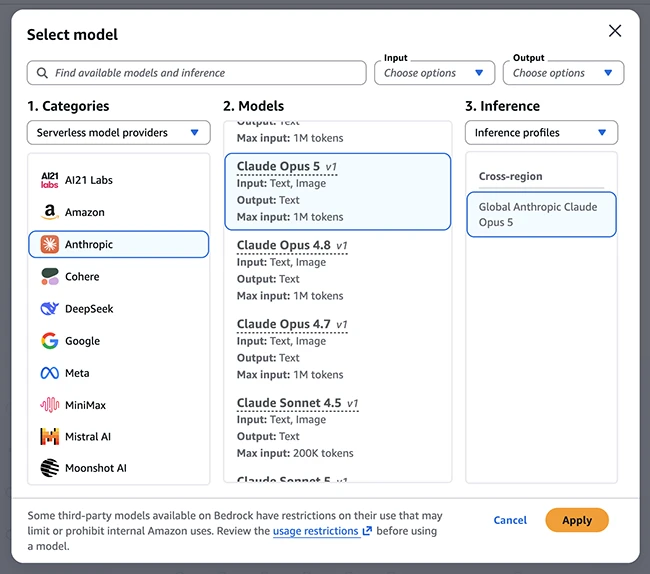
Anyone with an AWS account in a supported region can call it. On higher-risk requests, Opus 5 hands the job back to Opus 4.8, the older model. The user sees a notice when that happens. API customers can configure the fallback.
The guardrail that catches the riskiest requests ships with a setting the customer controls.
What the model does now
Opus 5 is a step up in coding, able to read a codebase like an experienced engineer and write production-quality code, adjusting its approach as it works. It runs agents that keep going for hours and overnight, routing around obstacles and recovering from errors. The company reports its largest accuracy gains on document-heavy enterprise work.
For agent automation, the model pushes back on flawed instructions and splits big jobs into sub-agents that need less oversight. It runs multi-day projects and produces professional-grade output.
Where the data goes
On Bedrock, Opus 5 runs with zero data retention by default and zero operator access. The same model reaches customers through Claude Platform on AWS, with zero data retention on request, billed and authenticated through AWS.
How engineers reach it
Engineers select Opus 5 in the Bedrock console playground or call it through the Anthropic Messages API and the Converse API. The model supports adding and removing tools mid-conversation through content blocks on system messages, replacing the re-send of the whole tools array.
Where it runs
Opus 5 is available on Bedrock in four regions at launch: US East (N. Virginia), Asia Pacific (Melbourne), Europe (Ireland), and Europe (Stockholm), with more listed in the documentation. On Claude Platform on AWS, it reaches North America, South America, Europe, and Asia Pacific.
Opus 5 lands with better cyber capabilities than Opus 4.8. The control over when it drops back to Opus 4.8 sits with the customer, in the API.
