
Parallels Desktop flaw hands any local user root on a Mac (CVE-2026-90894)
A newly disclosed vulnerability in Parallels Desktop, tracked as CVE-2026-90894 and dubbed “ParaShells,” can allow any local user on a Mac to gain root privileges on the host system.
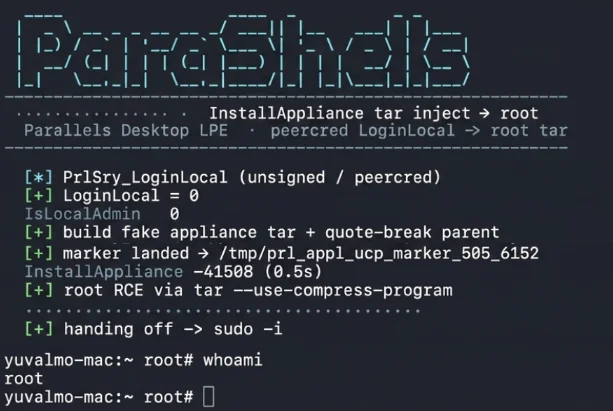
ParaShells PoC in action (Source: JFrog)
The danger is highest on developer laptops, where a single poisoned Homebrew formula or malicious npm preinstall script can go from local user to full control, and on shared university and corporate machines that have many local accounts, JFrog vulnerability research team lead Yuval Moravchick noted.
“From root, the attacker can replace system software, read other users’ data, and persist via launchd,” he added.
How the attack works
CVE-2026-90894 is an argument injection flaw that’s proven to affect Parallels Desktop for Mac v26.4.0, installed on macOS running on Apple’s own ARM-based processor. (Older builds might be vulnerable, but the researchers did not test them.)
Exploitation of ParaShells hinges on three things:
- A vulnerable version of the virtualization software being installed (but a virtual machine doesn’t have to be running)
- The prl_disp_service being active (its launch daemon starts it automatically on load, and it runs as root) and the /var/run/prl_disp_service.socket present, and
- The attacker being able to run code as any low-privileged local user.
“The exploit combines its world-writable Unix socket with weak local-client authentication and argument injection in the appliance extraction path,” Marvchick explained.
“The chain is short: A world-writable Unix socket, a login that trusts peer credentials rather than a Team ID, and an appliance unpack path that builds tar arguments using Qt string splitting. A quote in the parent path injects –use-compress-program=, and macOS tar runs the attacker’s script as uid 0 [i.e., root].”
JFrog researcher reported CVE-2026-90894 to Parallels maker Alludo, which fixed it in Parallels Desktop v27.0.0, released at the beginning of September 2026.
Two weeks later, they published the technical details, but not the one-liner proof-of-concept script they developed.
Moravchick advised organizations to pinpoint every Mac that is running Parallels Desktop, lock down local accounts running on these hosts, and upgrade to a fixed Parallels version (27.0.0 or higher).

Subscribe to our breaking news e-mail alert to never miss out on the latest breaches, vulnerabilities and cybersecurity threats. Subscribe here!
