
Nearly two-thirds of tested websites fail every bot test
Malicious bot activity increased 124% between July 2025 and June 2026, compared with 13.2% growth in human traffic. Traffic from AI agents and large language model crawlers rose 82.3% during the same period, according to DataDome’s State of Bot & Agent Security Report 2026.
Bot traffic grows nine times faster than human traffic
The company analyzed trillions of requests across more than 75,000 customer sites during the 12-month period. Bots and AI agents generated approximately 26.5% of all traffic in the dataset.
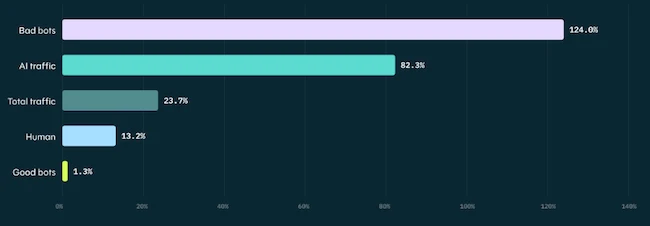
Percentage growth in traffic type over a 12-month period (Source: DataDome)
Human traffic’s share of requests declined, and bad bots accounted for most of the change. AI traffic also grew more than six times faster than human traffic.
Scraping, scalping, spamming and DDoS activity increased during the study period. Credential stuffing remained flat on an annual basis, with sharp drops and resurgences throughout the year.
Web scraping was the dominant attack type, accounting for 70.9% of bad bot traffic. The availability of scraping tools and demand for data at scale continue to drive these campaigns.
Credential-stuffing campaigns followed a recurring pattern. Attackers launched high-volume attacks, withdrew to refresh credential lists and rotate infrastructure, then returned at full scale.
In a 30-day sample of bad bot traffic, simple bots represented the largest share. They require little effort to operate and remain effective against websites with limited bot protection. Attackers use them for scanning, reconnaissance and attacks on easier targets.
Average-complexity bots are common in scraping, fake-account creation and credential-testing campaigns. They use browser automation frameworks that reproduce parts of a legitimate browsing session and make automated activity harder to identify.
Advanced operators tend to keep sophisticated tools separate from basic bots to avoid exposing a campaign through simple automation signals. Some campaigns combine simple and average techniques, starting with basic automation and switching to more convincing browser simulation when needed.
Browser-side signals cannot provide complete coverage. Attackers can suppress or imitate them, and requests targeting APIs, mobile endpoints or server-side services may never execute client-side code.
AI agents are entering sensitive areas
Monthly AI bot traffic to login pages increased more than eightfold during the first half of 2026. The increase shows the growing use of assistants that can perform tasks for users, including checking orders, retrieving account information and supporting purchases.
“Organizations are being asked to make more nuanced decisions with defenses that are still largely built around binary choices,” said Jerome Segura, VP of Threat Research at DataDome. “The ability to distinguish a legitimate AI assistant from a credential-testing bot or an automated account-abuse campaign will be critical to protecting customers without blocking beneficial activity.”
Login pages are also a target for bots testing stolen usernames and passwords. Shopping carts can be manipulated to reserve inventory or exploit promotions. Payment pages attract card-testing tools, and online forms remain targets for spam, false leads and automated data collection.
A single request may not reveal a visitor’s purpose. An authorized assistant checking an order can initially resemble a bot attempting to access a customer account. Security systems need to examine the sequence, speed, volume and context of each interaction.
Malicious software can copy the user-agent string of a recognized AI service and present itself as a trusted crawler. An unfamiliar bot can avoid rules created for known services.
Most websites miss automated threats
About 65.3% of the popular websites tested failed to detect any of the 10 simulated bots. Only 2.4% stopped or challenged every type.
The tests covered simple scripts, bots posing as recognized AI services, tools with forged browser fingerprints and automated versions of real browsers. Requests were sent through residential internet addresses in the United States, Canada and France.
Traffic volume offered little indication of protection. High-traffic websites performed at a similar level to sites with smaller audiences. Large organizations may have substantial security budgets, yet complex infrastructure, disconnected tools and legacy systems can leave gaps.
Testing focused on the homepages of 21,491 popular websites. Some protections may operate on login, account or payment pages and were outside the scope of the test.
Traffic classified as an attack represents an attempted action, not a successful attack, confirmed breach or financial loss.
