
Fake Claude Max giveaway tricks users into handing over their Google account credentials
A fake Claude Max giveaway uses a spoofed Google sign-in window to steal users’ login credentials, Malwarebytes researchers have found.
“Browser-in-the-browser” is not a new technique. Researchers have documented it since 2022, and in June Palo Alto Networks’ Unit 42 reported a campaign that used draggable fake browser windows to target Microsoft 365 users.
“Phishing follows whatever people want at the moment,” noted Stefan Dasic, the Malwarebytes researcher who analyzed the campaign.
“Claude’s paid plans start at $20 a month and cost considerably more for higher usage limits, while free accounts have stricter limits. That makes the promise of a free upgrade an attractive lure,” he said.
Microsoft reported in June that it had seen phishing, malicious advertising and search-based campaigns impersonating ChatGPT, Claude, DeepSeek and Copilot. Some of those claimed a payment had failed and sent victims to a fake checkout, while others offered app downloads that installed malware.
“The campaign we found takes a different approach. There is no form to collect card details and no download. Instead, it offers a free upgrade and asks you to sign in with your Google account,” added Dasic.
Fake giveaway creates urgency with a countdown and limited slots
The page copies Claude’s logo and colors. It displays invented star reviews, and its footer links to legitimate Anthropic pages. The site says Anthropic has passed 100 million users and is giving away 10,000 free one-month Claude Max subscriptions.
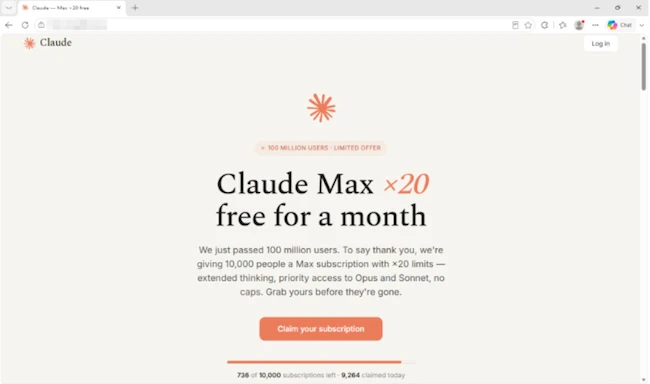
The fake giveaway (Source:Malwarebytes)
A counter claims fewer than 760 of the 10,000 slots remain and drops every few seconds. According to Dasic, the number is generated in the visitor’s browser and resets when the page is reloaded.
A FAQ section says no payment details are needed. “That part is true, which helps make the offer persuasive. Many people associate scams with requests for card details, and this page never asks for them,” Dasic explained.
The sign-in form shows several options, but only one works. The Apple button displays a message saying the method is temporarily unavailable, and the email box discards whatever the visitor types and triggers the Google button instead.
A compromised Google account gives attackers access to the victim’s email and documents, along with password reset messages for other services. The same account can also be used to sign into Claude.
A draggable browser window makes the phishing page look legitimate
Clicking the Google button does not open a Google sign-in window. The page draws a browser window within the existing tab, complete with a padlock and a correctly spelled Google sign-in address. The window can be dragged around the page.
It opens with a human verification step instead of a password field. Dasic said this may reassure visitors while helping to keep automated scanners away from the next stage.
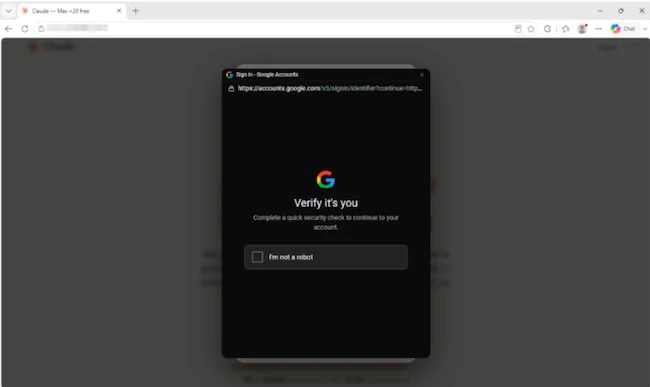
A fake Google verification window
What stands out in this sample is how little the operator had to build. The malicious functionality loads through a single line of code from an outside service, which presents itself as a reusable sign-in widget and includes installation instructions.
Comments in the code are written in Russian and refer to the target as the victim. One comment explains that dark-themed fake windows used to flash white while loading, so the widget fetches the correct color in advance.
“The code appears to be a maintained, reusable product rather than something built for this one campaign,” concluded Dasic.
