
Quantum random numbers can pass the tests and still leak clues to attackers
The European Telecommunications Standards Institute’s (ETSI) technical report, ETSI TR 104 171, offers guidance on building and evaluating quantum random number generators (QRNGs). It focuses on weaknesses in the devices and their supporting systems that could make the numbers they produce less secure.
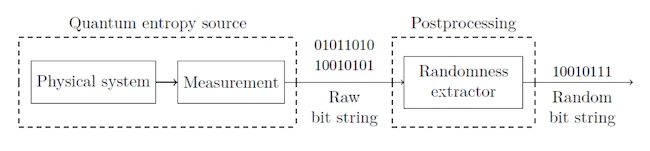
Components of a QRNG (Source: ETSI)
A QRNG measures a quantum process and turns the raw results into usable random numbers. Cryptographic systems rely on unpredictable numbers to generate keys and perform other security functions. If an attacker can predict those numbers, the protection those systems provide may be weakened.
“While quantum physics is adept at providing genuine unpredictability, secure randomness rests on the integrity of the entire implementation,” said Mark Pecen, Chair of ETSI TC Quantum. “These guidelines arrive at a critical moment as organizations need to understand how to validate the quantum source and ensure that entropy is properly extracted, monitored, protected and securely delivered to the applications that depend on it.”
The report follows the numbers from their source to the application that uses them. It explains how manufacturers can verify the source, process its raw output, and check for faults while a device runs. It also addresses physical tampering, information leaks, and the connections that carry the numbers to other systems.
One concern is that numbers can appear random in statistical tests while still giving an attacker clues about future output. Evaluating a QRNG therefore involves understanding how the device works, including the components surrounding its quantum source and the conditions under which it operates.
AI could expose weaknesses in QRNGs
AI could help an attacker spot patterns caused by a QRNG’s sensors, power supplies, or signal processors. These components can add noise to the output, and some of that noise may be predictable. An attacker could analyze a large amount of data, looking for patterns that offer clues about the numbers the device produces. The report says finding and exploiting those clues could take considerable time and effort.
A device may also reveal clues through changes in power use or electromagnetic signals. AI could help an attacker connect those signals to the numbers produced. The concern extends to other types of random number generators that use similar components.
The guidance recommends shielding sensitive hardware, using reliable methods to process raw output, and checking for unexpected patterns during operation. Monitoring can help operators detect a fault or possible interference before they continue using affected output.
Checks at every stage
For QRNGs used in regulated or high-security settings, the report recommends an approach called entropy zero trust. It calls for verifying the quantum source and monitoring the device throughout its operation. Hardware and software protections help guard against tampering, while secure connections protect the output on its way to an application.
The approach also covers systems shared by multiple users. Separate safeguards can help prevent a problem affecting one user’s output from spreading to another.
Devices should record when numbers were generated, which software was running, and information that traces the output to its source. Those records can help organizations investigate faults and show how a device was operating when it produced numbers used by a security system.
ETSI also calls for more consistent ways to compare QRNGs, including their security features, speed, power use, size, and ease of integration.
