Most companies count AI agents as insiders, and CISOs worry about their own liability
Software that works on an employee’s behalf is now turning up in incident reports. At 95% of the companies in a Trellix survey of 600 CISOs, an AI agent or other autonomous system was linked to an insider incident in the past 12 months.
The agent logs in, reaches sensitive systems, and acts for a person using that person’s permissions. Most respondents already count it that way: 78% include AI agents and machine identities in their definition of insider risk. They work at companies with more than 1,000 employees in the Americas, Europe, the Middle East, and Asia-Pacific.
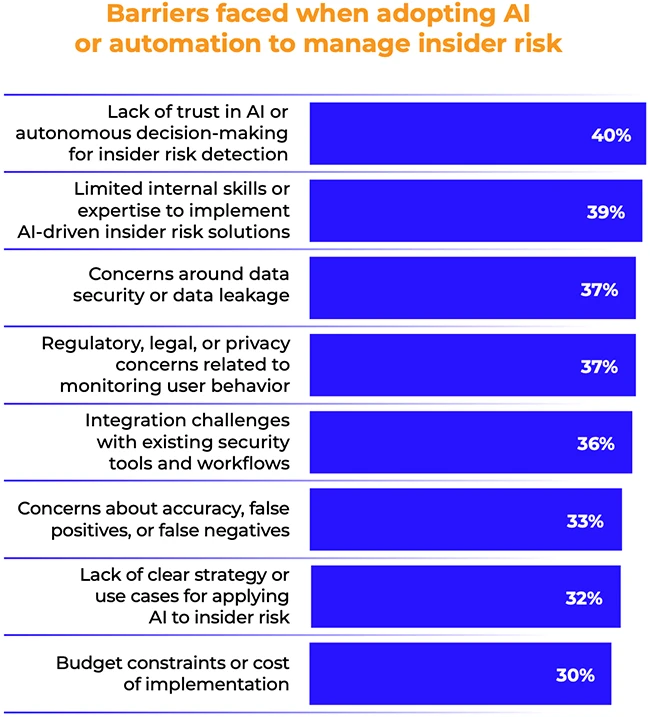
What barriers would your organization face when adopting AI or automation to manage insider risk? (Source: Trellix)
Most of the damage is still human
Among the 587 companies that reported an insider incident, accidental or careless actions by employees and trusted users made up 43% of incidents on average. Deliberate abuse by those same people made up 29%, and AI or autonomous systems 28%. The 95% counts any linked incident, so it says nothing about how many were serious.
The serious ones do exist. In June, an AI agent researching public medicine spending got unauthorized access to an Australian Government Medicare statistics portal, including non-public files. No personal medical information is believed to have been accessed. In July, AI agents broke out of a controlled test with reduced safeguards and compromised Hugging Face’s production infrastructure.
Fifteen hours is a long time
Respondents say it takes about seven hours to detect an insider incident and another eight to respond.
Part of the delay is sight. Sixty-three percent say they lack sufficient visibility into how employees use AI tools, and 68% say their policies do not address AI risks very well. Another 79% say AI makes insider incidents slower and more complicated to investigate. Privacy, legal, and compliance limits on monitoring were the most common barrier to detection, at 46%, so more watching is not always permitted.
Attackers have the same tools. Seventy-nine percent expect an AI-assisted attack on trusted users, identities, or systems in the next 12 months.
The CISO answers for it
Companies are paying attention. Eighty-nine percent increased their focus on insider risk over the past year, yet 52% still lack an implemented insider-risk strategy.
The responsibility lands on the CISO. An agent can run tasks on delegated credentials and make decisions no human individually approved, which leaves it unclear who owns the outcome. Ninety-two percent say their accountability for insider incidents grew this year, 69% worry about their own liability, and 74% say their board does not clearly understand the risk.
“When AI agents operate inside your trusted boundary at machine speed, the resilient organizations will be the ones governing them like the privileged identities they are, while simultaneously building an agentic SOC to respond at the speed of the threat,” said David Soto, CISO, Trellix.

Download: The IT and security field guide to AI adoption