
Tracking drones with the 5G tower down the street
Drone detection in cities is expensive. Dedicated radar installations are cost-prohibitive at scale, cameras have limited range and stop working well at night, and LiDAR systems have the same cost problem as radar. A group of researchers at the University of Science and Technology of China spent the past year working on a different approach: using 5G-Advanced base stations that are already in the ground to do the job instead.
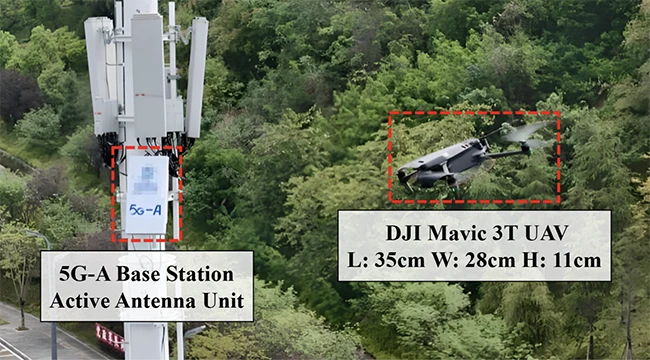
The 5G-A base station Active Antenna Unit (AAU) and the UAV deployed in the field experiments (Source: Research paper)
The result is BSense, a system tested on a live Huawei 5G-A base station in Shanghai. The base station operates at 4.9 GHz with a 100 MHz bandwidth and 128 antenna channels. It sits 23 meters off the ground and covers a sensing area up to 1,000 meters out, with a horizontal field of view of 130 degrees and a vertical field of view of 45 degrees. The surrounding area includes residential buildings, factories, overpasses, and a river.
The researchers ran a DJI Mavic 3T drone along 25 predefined flight paths over seven days, generating 54 test cases and roughly 155 minutes of data across more than 14,000 frames.
The noise problem
5G-A base stations with Integrated Sensing and Communication (ISAC) capability produce point clouds of the space around them, a byproduct of their signal processing pipeline. In theory, those point clouds contain everything the antenna can see, including drones. In practice, most of what they contain is noise.
The noise comes from three sources. Buildings, trees, and other stationary structures reflect signals back to the antenna, and small physical vibrations combined with a phenomenon called Doppler leakage can make those returns look like they are moving. Moving vehicles create multipath ghost signals when their reflections bounce off building facades. Sidelobe interference generates additional phantom detections at the wrong locations.
In a typical data frame, one point belongs to the drone. The other 174 are noise. More importantly, those noise points are not easy to discard. Their Doppler velocity, signal-to-noise ratio, signal power, and other measurable properties overlap substantially with the properties of a real drone return. Standard threshold-based filters cannot separate them.
Prior published work on UAV detection with 5G base stations was mostly limited to simulations. The one reported real-world deployment before BSense tracked maritime vessels in open water, where targets are much larger and background interference is minimal.
How BSense filters the noise
The system works in three stages, each one passing cleaner data to the next.
The first stage exploits the observation that background noise in a local volume of space tends to cluster around a consistent statistical signature. The system partitions the 3D sensing area into 40-meter cubes and models the noise inside each cube as a multivariate Gaussian distribution. Points that match their local noise signature closely are removed. The model needs about 10 minutes of noise-only data to initialize and updates automatically on a regular schedule.
The second stage applies motion-based checks. A real drone moves continuously, so it should have a corresponding position in the previous frame and its Doppler velocity should match the displacement computed between frames. Ghost points from vehicle multipath reflections often fail both checks. The system accumulates consistency scores over time to avoid being misled by single-frame measurement noise.
The third stage is a lightweight Transformer-based neural network called TrajFormer. It classifies entire trajectories by learning motion patterns across multiple frames. The network brings false detections down to near zero per frame. The whole pipeline runs well within the base station’s 640-millisecond frame interval on a standard desktop CPU.
What the tests showed
BSense tracked the drone accurately across all 25 flight paths, including figure-eights, star patterns, and straight-line passes at varying angles. Precision stayed above 96% across every path type. The mean localization error was 4.9 meters at ranges up to 1,000 meters.
In a separate test, two drones flew simultaneously in close proximity. BSense distinguished and tracked both without confusion. In a cross-site test at a different base station with no parameter retuning, performance held at roughly the same level.
The system also ran for 15 minutes with no drone in the air and produced almost no spurious detections.
The two comparison methods produced noticeable false positives and fragmented trajectories in the same cases where BSense tracked without interruption. A pipeline with no noise filtering at all was essentially unusable, which illustrates how much of the work the three suppression stages are doing.
Where it falls short
The system produces trajectory gaps for complex flight paths. On the infinity, M, and star-shaped routes, the drone occasionally disappears from the point cloud entirely for stretches of 50 to 100 meters. The researchers attribute this to signal occlusion by tall buildings and to flight directions that are tangential to the base station. Those gaps are not filtering errors; the drone simply produced no detectable return during those periods.
Localization error increases with range. At distances beyond 700 meters, mean error approaches 6.5 meters. The researchers note that this comes from measurement noise in the base station’s point cloud output rather than from the BSense algorithms, and that higher bandwidth or a larger antenna array would reduce it.
The test drones flew pre-planned routes at known altitudes and speeds. The paper does not evaluate how BSense performs against a drone operated to avoid detection. An operator who understands that the system relies on Doppler velocity consistency and spatial continuity could potentially exploit those assumptions, though no such test was conducted.
The wider picture
5G-A base stations with ISAC capability are being deployed at scale as part of the broader 5G-Advanced rollout. BSense demonstrates that the sensing data those stations already generate can support drone detection without additional hardware. The same base station infrastructure that delivers mobile connectivity becomes a passive sensor network covering the airspace above a city.
That has straightforward applications for airspace security around critical infrastructure, and it raises questions about what else the same infrastructure can detect and how those capabilities will be governed.
