
Gartner: 70% of SOCs will pilot AI agents. Only 15% will see results
In the Gartner report Validate the Promises of AI SOC Agents With These Key Questions, analysts Craig Lawson and Andrew Davies posit that “By 2028, 70% of large SOCs will pilot AI agents to augment Tier 1 and Tier 2 operations, but only 15% will achieve measurable improvements without structured evaluation.”
Just last year, Gartner placed AI SOC Agents at the Innovation Trigger stage with single-digit adoption. As of earlier this year, Gartner’s Hype Cycle for Security Operations, 2026 put them at the Peak of Inflated Expectations.
And according to Prophet Security’s State of AI in Security Operations 2026, 40% of security teams now use AI daily, 56% are currently evaluating or piloting within their environments, and only 4% have no plans to adopt it.
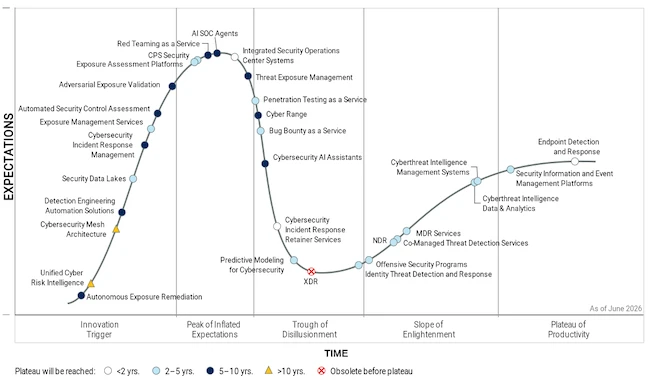
Hype cycle for security operations, 2026 (Source: Gartner)
There’s significant momentum for AI in the SOC, but structured evaluation is necessary if organizations expect to translate that into outcomes for their security programs.
To that end, Gartner offers a pragmatic set of questions to evaluate AI SOC agents, helping security professionals distinguish viable solutions from “AI washing” rampant in the market today and align deployments with measurable operational outcomes. Here are the key areas Gartner recommends evaluating and how that framework pairs with more recent survey data.
1. Is AI actually reducing your team’s workload?
The first set of questions from Gartner is meant to start from your bottlenecks rather than a vendor’s feature list. It’s worth mapping out what use cases would meaningfully reduce time spent on repetitive, monotonous work that can be automated rather than attempting to introduce automation for automation’s sake.
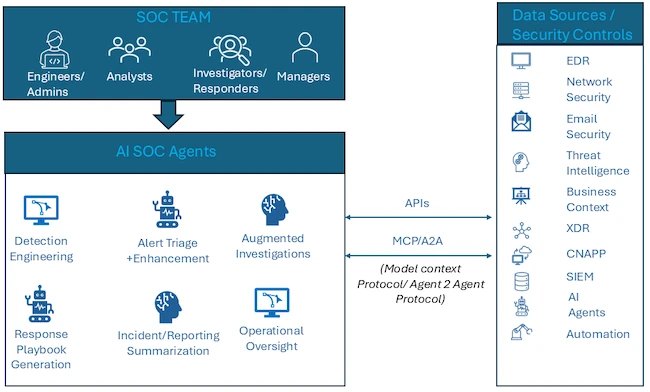
Usage of Al SOC agents (Source: Gartner)
However, it’s also worth re-evaluating your organization’s bottlenecks and prior controls put in place to cope with them.
The survey data consistently suggests most teams answer this question against an incomplete picture of their own workload. In the 2026 survey, respondents reported that 28% of alerts are never investigated, and up to 40% of organizations have turned off specific detection rules due to capacity constraints.
Tuning away a rule that has never produced an escalation is sound detection engineering, but switching one off because its output went unread is a coverage decision that tends to backfire. About 60% of respondents said an alert they missed or never investigated proved material, and for 34%, that happened three or more times in the past year.
When you scope a proof of value against current work, consider that some alerts that have been suppressed due to capacity limitations may be worth adding back for this exercise.
2. Which outcomes are meaningful?
Evaluation should go beyond alerts processed and center on TDIR outcomes: mean time to detect, mean time to respond, false positive reduction, and mean time to contain as the end goal, since containment is where risk is actually reduced.
A part of this section that most buying processes skip is asking for real-world benchmarks from environments similar to theirs and establishing whether those numbers came from a proof of concept or sustained production.
On speed, the survey data is encouraging; of the teams using AI, 72% reported cutting investigation time by at least 25%.
3. Is the vendor going to be around in 3 years?
Gartner recommends questions about general availability, customer base, funding, and how pricing behaves under load, while accepting that consolidation in this category is likely.
Most vendors in this space started providing solutions for the alert triage and investigation use cases since this is currently one of the major pain points of security operations teams. However, the introduction of a system that consistently records investigation outcomes and is capable of querying and interacting with multiple data sources is a strong enabler of additional capabilities to support adjacent use cases, such as detection engineering and threat hunting. It’s natural and expected to see vendors in the AI SOC space expanding their products in those directions.
The durability of the solution should be considered even when there is no vendor involved. The State of AI in Security Operations survey extends this question to the build vs. buy decision. 72% of AI users had tried building their own tooling. Those builds initially matched commercial results on the headline metric: 73% of teams that built reported investigation-time gains of at least a quarter, against 72% for AI users overall.
However, 46% were eventually abandoned, never reached production, or were replaced by a commercial product. What failed was maintenance: keeping pace as tools changed, absorbing new alert types, and holding accuracy stable as engineers who built it moved on.
4. Are analysts being elevated alongside your security outcomes?
Gartner includes a set of more nuanced questions around augmenting and upskilling analysts; a good solution should improve analyst expertise, foster continuous learning, and deliver measurable improvements in analyst effectiveness and satisfaction.
The survey data is promising; 57% expect AI to shift SOC roles without changing headcount over the next two years, and 9% expect headcount to grow. The expectation is reallocation; as AI absorbs tier-1 and tier-2 investigation, analysts move toward incident response, threat hunting, detection engineering, and adversary simulation.
Threat hunting is, indeed, a strong candidate for absorbing those resources, as it provides substantial risk reduction when performed frequently. Across all respondents, 38% have had a proactive hunt surface malicious activity their detection tools missed. Discovery climbs to 49% among those that hunt weekly or more, while dropping to 14% for those running hunts less than once a month.
5. Where do the boundaries of autonomy sit?
Gartner draws a distinction between “human in the loop” (where each action requires approval) from “human on the loop” (where oversight is strategic rather than tactical).
For now, practitioners have settled this fairly conservatively as they build trust with their chosen solutions.
Survey data indicates 57% still require a human to review every AI decision before an alert is closed. 44% percent allow AI to recommend actions that a human then executes, 30% auto-execute low-risk actions, 13% extend auto-execution to medium-risk actions, and 13% keep AI to read-only triage. No respondent grants full, unsupervised autonomy.
Autonomy granted per category of action, with human approval as the default and scope widening as a track record accumulates, matches both Gartner’s guidance and what teams actually do.
6. Will it actually work within your existing stack?
The goal here is interoperability.
Gartner’s integration category covers the expected ground of native SIEM, EDR, SOAR, and identity support, and asks an important architectural question: whether the solution requires data centralization or can operate across distributed environments.
According to Gartner and our own customer observations, AI SOC agents increasingly sit alongside other AI. Gartner asks how many existing LLMs a solution can work with, given that ITSM, XDR, SIEM, and exposure management tools now ship their own. Interoperability here means collaborating with AI-enabled tools rather than competing with them.
Integration claims are easy to make, hard to validate, and harder to build and maintain; this is a sticking point in favor of buying over building a solution internally. To that end, when evaluating what works within your stack, we’ve seen customers look for: depth of integration over breadth, bi-directional syncs, and the ease of adding new connectors.
7. Is the solution transparent, auditable, and aligned with enterprise risk expectations?
The transparency category asks how decisions are explained, whether human-readable audit trails exist for every automated action, which third-party LLM technologies are involved, where customer data goes, whether stronger data sovereignty options such as local hosting are available, and how analyst feedback on accuracy feeds back into tuning.
The survey data ranks those concerns at the top of the barrier list: data privacy and how models are trained was cited by 44% of respondents and explainability by 41%. Fortunately, both are testable during an evaluation rather than after signature.
An analyst should be able to see every question the system asked, every query it ran against every source, what came back, and how that evidence produced a verdict, then copy one of those queries and run it in the source tool to confirm the result. An investigation that cannot be reconstructed or rerun cannot be defended to an auditor or to whoever asks why an alert was closed.
The wider set of criteria, including case management, learning, and exit terms, is covered in this guide to evaluating an agentic SOC platform.
The key takeaway
For security leaders evaluating AI SOC agents, the key takeaway is that improving your security program requires a structured, outcomes-driven evaluation.
The value of Gartner’s framework is that it resists declaring winners in a category that’s rapidly changing, and it pushes buyers toward outcomes rather than feature lists. The survey data adds color a framework cannot supply: evidence that teams are adopting quickly, granting autonomy slowly, and seeing specific outcomes improve.
For organizations looking to apply Gartner’s evaluation framework to their own buying process or read the complete set of findings from this year’s State of AI in Security Operations, the full reports are available for download.
