AI slop is piling up highest on the biggest open-source projects
The maintainers of large open source projects are taking the worst of the AI slop. In a Linux Foundation survey of 234 open source contributors and maintainers, people running projects with more than 50 contributors estimated that close to a third of the code changes landing in their queue are low quality or AI-generated. Those maintainers now worry more about burning out than about the code itself.
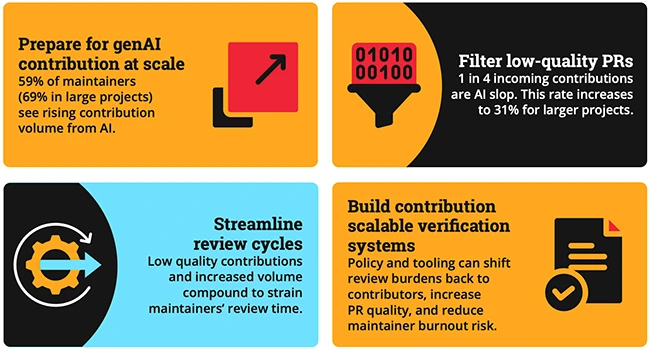
Across all projects, the estimate comes to about one in four. Each of those submissions, called a pull request, has to be read by a person before it gets merged or rejected. That person is a maintainer, and every piece of junk in the queue takes time away from the work that keeps the project running.
Bigger projects, bigger pile
You’d think a large project could spread the extra load across more reviewers. It doesn’t work out that way. Large projects reported the most slop, the fastest growth in submissions, and the most complaints about reviews dragging on.
Most maintainers say they’re getting more contributions since generative AI took off. Smaller projects still rank code quality as their main worry about AI-assisted work. On the big ones, burnout has moved to the top of the list.
Few projects have rules yet
About a third of projects have a formal policy that allows AI-assisted contributions, and one in ten bans them. The rest either have nothing written down or are still working on it. Where policies do exist, they mostly ask contributors to disclose AI use and to take responsibility for reviewing their own work.
Without rules, maintainers check AI-assisted code the old-fashioned way. They trust contributors they know, or they read the code themselves, and about a quarter have no check in place at all. Plenty are also fighting fire with fire. Three in four maintainers use AI tools to help vet what comes in, usually to summarize a change or hunt for logic bugs.
Contributors say they’re careful
The picture from the developer side is better than you might expect. Six in ten say they go through AI-generated code line by line and test it fully before submitting. Very few admit to sending it in unchecked.
Contributors are much less consistent about telling anyone AI was involved. About one in five never mention it. If you run a project and want a standard to point people to, the Linux kernel already asks for an “Assisted-by:” line in commit messages that names the AI tool and model used.
The time savings are real, up to a point
People who use AI say it roughly halves the time they spend writing code and cuts review time by more than 40%. Those savings shrink as the work gets harder. On the most complex tasks, about one in five developers say AI slows them down.
There’s a cost on the community side too. Most maintainers agree that AI makes it easier for newcomers to get involved. More than half say it hasn’t done anything for trust within their community. More of them say new contributors need extra mentoring than say they need less, and that mentoring falls on the same maintainers already handling the bigger queue.
The curl project shows that the problem can ease. In 2025, project lead Daniel Stenberg described curl as overwhelmed by AI slop in its vulnerability reports. By April 2026, he said the project had “stopped getting AI slop security reports” and was getting “an ever-increasing amount of really good security reports, almost all done with the help of AI.”

Download: The IT leader’s guide to AI code sprawl