Once a scam ends the victim blaming begins
Blaming people who fall for scams deepens the harm and teaches them to stay silent the next time, cyberpsychologist Dr. Nicola Fox Hamilton told the audience at IRISSCON 2026 in Dublin.
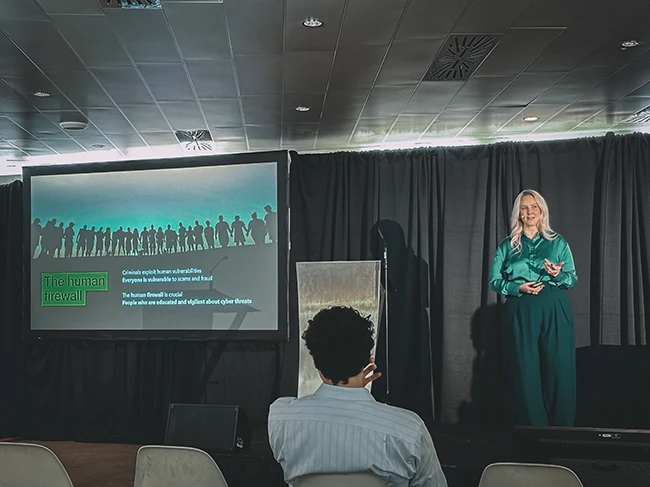
Dr. Nicola Fox Hamilton, cyberpsychology researcher and lecturer in IADT, talked about the psychology behind phishing and scams
Fox Hamilton, a cyberpsychology researcher and lecturer at IADT, talked about the lasting impact scams have on victims and made a point to note that nobody in the room was safe. “We are all potential victims of cybercrime at some point. It’s almost inevitable.”
What happens after the click matters just as much, she argued, whether the victim is someone who lost a pension pot to an investment scammer or an employee who typed a password into the wrong page, because shame keeps both of them quiet.
She admitted she learned this firsthand. While finishing her PhD during marking season at IADT, she got an email in her rarely checked university account telling her to update an old password. “I was like, grand, that makes sense,” she recalled. She clicked and entered her credentials, and “as soon as I hit the button, I knew what I’d done.”
The IT team was kind about it. Her own reaction was harsher. “I was like, I’m so stupid. But it’s not stupidity, it’s catching you in a moment of vulnerability, which everybody has at some point.”
Bad things happen to other people
Part of the problem lies in how people judge their own risk. Most of us carry an optimism bias, which she summed up as: “Bad things are much more likely to happen to other people than me. I’m not gonna get targeted. I’m not gonna fall for it. Other people will.” People who hold that belief strongly are much more likely to victim blame other people, she noted.
Overconfidence works the same way: assuming you’re safe leaves you more exposed. Her own click cured her of it.
A scammer who listens
Standard advice about romance scams tells people never to send money to someone they haven’t met. She argued that this misses how the scams work. Scammers spend months building a relationship before they ask for anything, and investment fraudsters do the same through a friendly “advisor.”
By that stage, the victim believes they are in a relationship. “And when somebody you’re in a relationship with asks you for money, that’s very socially normal,” she pointed out.
Scammers also cut victims off from the people who might warn them. When relatives question the relationship, the scammer tells the victim that the family doesn’t want them to be happy and is jealous. They let the victim do most of the talking, partly to gather information they can use and partly so they don’t have to keep track of their own lies. “Being listened to is very powerful,” she noted.
The emotional hit
When the scam falls apart, victims lose their money and the relationship they believed in, and the second loss often cuts deeper.
Victims feel deceived and powerless and turn the blame on themselves, which is why outside judgment does so much harm. “They feel powerless and engage in a lot of self blame, so they don’t need extra people victim blaming on top of that, which happens a lot,” she noted. Shame, fear, anxiety and depression are common, and in extreme cases romance and sextortion scams have led victims to suicidal thoughts or suicide.
The effects reach beyond individuals, she added, and cited a study from the Philippines that linked widespread phishing and cybercrime to lower trust in institutions, with people pulling away from one another and growing afraid of social media.
Shame at work
Organizations deal with the same dynamic on a smaller scale. Employees often assume phishing tests are there to catch them out, and Fox Hamilton urged security teams to explain that the tests look for gaps in training, and to respond to failures with support and education.
Fear of blame pushes people to hide mistakes, because we all wanna look good in front of other people, especially in front of those higher up the hierarchy. That instinct is dangerous when the mistake is a click on a phishing link, since every month of silence gives an attacker another month inside the network.
Blame and accountability are different things, she added. “If someone comes to you for the 50th time in a month and says I clicked on the thing, you’ve got another issue. But most people won’t be doing that.”
Her advice was to talk openly about incidents and near misses, starting with the people in charge. Admitting her own click in front of a room of security professionals was part of that. “That’s really helpful if you have done that to be able to be open about the fact that it is possible for anybody to do this. It doesn’t mean you’re stupid or not aware.”