Criminal marketplace sells infostealer logs with AI-written profiles of their owners
A criminal marketplace advertised on cybercrime forums is selling data stolen from computers infected with infostealer malware, along with AI-written profiles of their owners, Hudson Rock has discovered.
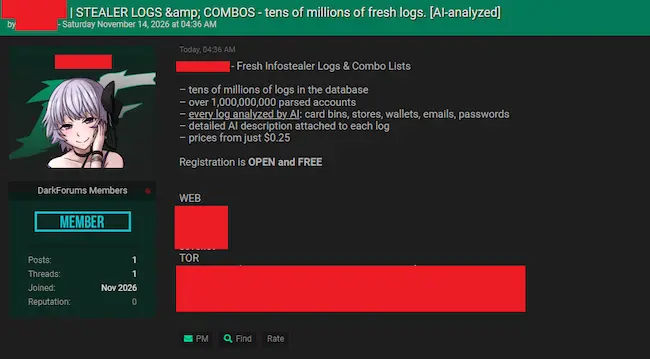
Marketplace advertisement (Source: Hudson Rock)
Each profile describes who appears to own the machine, where that person works and which of their accounts are worth buying. The service, which the security company does not name, lets buyers search these descriptions in plain language through a tab marked with AI labels, typing requests such as “citrix access to healthcare provider.”
“The surrounding filters include country, state, city, ISP, IP, ZIP code, stealer family, operating system, date, price, and vendor. Other tabs offer searches by domain, mask, email, cookies, and files. Geographic and technical filtering can therefore sit alongside the machine’s descriptive profile,” the researchers wrote.
The operator runs a separate catalog as well, selling individual logins, passwords and cookies by quantity. The stolen logs carry browser passwords, cookies and autofill data, and some include Citrix and VPN logins that could give a buyer a way into the victim’s workplace.
Searchable shops for stolen data aren’t new. Genesis Market, taken down in 2023, let buyers look up victims by location and account type. What this marketplace adds is a description of what each machine is used for.
“We see benefits for both less experienced and experienced buyers. A novice gets help recognizing potentially valuable material, while an experienced buyer can spend less time manually reviewing logs. The marketplace is packaging some of the analysis alongside the stolen data, making it easier to find and prioritize targets. Those descriptions still require validation, but they reduce the work involved in selecting what to investigate,” said Alon Gal, Hudson Rock’s CTO.
Fresh logs on sale
Hudson Rock matched several of the advertised logs to its own database, and some of them came from computers infected within the previous 24 hours, Gal told Help Net Security.
“Finding a log in our records does not make it old or recycled; freshly stolen data can circulate through several channels very quickly,” he said.
“These logs can remain highly actionable because many services do not properly monitor infostealer infections or promptly reset exposed credentials and revoke sessions. The fact that we have identified an infection does not mean the affected services have addressed it,” Gal explained.
The operator says the shop holds tens of millions of logs and more than a billion parsed accounts, with prices starting at $0.25. Buyers have to deposit at least $100 in cryptocurrency, and larger deposits earn bonuses.
“We have not verified the operator’s full inventory figures or established a percentage of fresh versus recycled data. We also have not independently confirmed completed purchases. The report establishes that real stolen material is being advertised, with pricing and payment functionality,” added Gal.
A clinic’s front desk for $10
One listing offered a workstation at an ophthalmology clinic in Canada for $10. The marketplace’s description said the computer was likely used for reception or front-desk work, and the log held 11 saved passwords and 574 cookies.
For $9, a buyer could get a computer from a defense contractor’s household, where corporate access was mixed with the family’s banking and personal accounts. The marketplace gave that listing a score of 100 out of 100.
“The listings also include tags and numerical scores. These labels can influence how buyers judge a machine, but the screenshots provide no methodology for the scores. A profile’s confidence or detail should not be mistaken for independently verified employment, access, or business impact,” Hudson Rock noted.
Another $10 listing described a family computer belonging to a government employee in Washington, D.C., with logins for government portals stored next to school and banking accounts.
A fourth came from an AI researcher in New Delhi, and the seller claimed it contained working session tokens for Anthropic’s Claude API. Hudson Rock could not establish what kind of tokens they were or whether they still worked.
Account searches on the site returned results for uber.com and fbi.gov, though that does not mean either organization was breached.
AI accounts are on the menu
Hudson Rock is finding AI credentials in stolen logs, and infostealers are going after AI development tools on purpose, Gal confirmed. In earlier research, the company documented stolen Claude Code and Codex CLI folders, including a Claude configuration file holding an API key and OAuth account details.
What a buyer can do with that depends on what was stolen. An API key can be used to run up charges on the victim’s account and can reach files uploaded to the API workspace it has access to, though, per Anthropic’s documentation, it does not open the victim’s Claude chat history.
“A valid, reusable browser session could expose the account’s conversations, uploads, and projects. Company information may be present in those materials or reachable through connected services, subject to their permissions,” Gal warned.
In a separate investigation involving OpenClaw, Hudson Rock found that infostealers had taken authentication material, a device private key and agent context files straight from the infected computer.
“That information can already be exposed before an attacker uses any stolen token,” Gal concluded.