Proxmox 9.3 adds production snapshots for SAN-backed VMs
Proxmox Virtual Environment 9.3 adds production support for snapshots on shared LVM storage over iSCSI and Fibre Channel SANs. The open-source virtualization platform also gives each guest an identity that survives migration, backup and restore.
If your VMs sit on a SAN, you can now snapshot them before a risky change in a setup the vendor supports for production. The snapshots work as volume chains on thick-provisioned LVM, the layer that carves SAN disks into guest storage. Admins turn it on in the advanced storage settings with the “Allow Snapshots as Volume-Chain” option.
The guest identity matters for backups. It stays the same even when a guest gets a new VMID or is restored to another cluster, so backup software and outside management tools can recognize the same machine across its life.
SAN setup moves into the web interface
Multipath means several network routes to the same storage LUN, and admins used to configure it node by node. A guided workflow now sets it up across cluster nodes for iSCSI, Fibre Channel and NVMe over Fabrics. A new Datacenter > SAN view shows LUN path state across all nodes in real time.
New logs and network isolation
The web interface gains a color-coded, filterable System Log, an API Access Log, and an APT History of past package transactions and changelogs. Simple SDN zones can use a dedicated VRF, a separate routing table, with custom static routes. WireGuard fabrics report interface and peer status.
Ceph key rotation is still a preview
Ceph Umbrella 21.2 ships as a technology preview, with a hardened default cipher for CephX authentication and online key rotation for daemons. Preview status means you test it before trusting it. Ceph Tentacle 20.2 is the stable version.
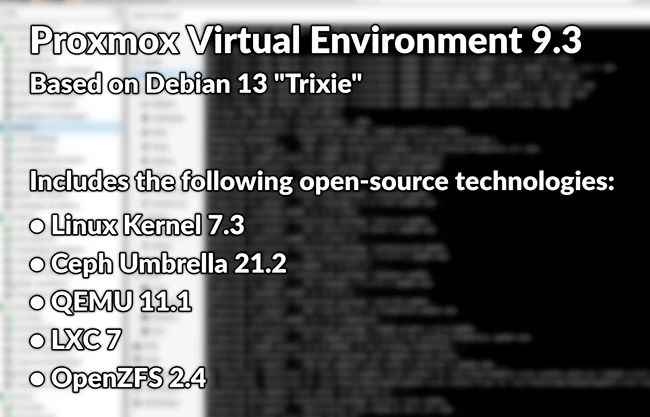
Underneath, 9.3 runs on Debian 13.8 with Linux kernel 7.0 as the default and kernel 7.3 as an opt-in. Upgrades from older versions run through APT, and a full ISO installs on bare metal.