
SecureClaw: Dual stack open-source security plugin and skill for OpenClaw
AI agent frameworks are being used to automate work that involves tools, files, and external services. That type of automation creates security questions around what an agent can access, what it can change, and how teams can detect risky behavior.
SecureClaw is an open-source project that adds security auditing and rule-based controls to OpenClaw agent environments. The tool is published by Adversa AI and is designed to work with OpenClaw and related agents such as Moltbot and Clawdbot.
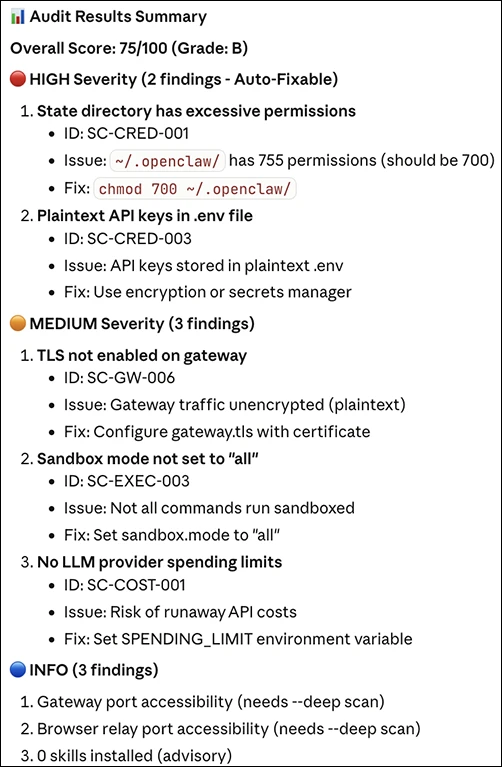
SecureClaw in action
Alex Polyakov, co-founder of Adversa AI, told Help Net Security the current ecosystem around OpenClaw security is fragmented.
“Most OpenClaw security tools I’ve seen solve one piece of the problem,” Polyakov said. “One tool validates skills for supply chain risks. Another does DLP. Another hardens tool permissions. They’re point solutions tackling individual threats in isolation.”
A plugin plus a skill
SecureClaw is structured as two components: a plugin and a skill.
The plugin is designed to integrate into OpenClaw’s plugin system and provides automated security auditing and hardening functions. The skill includes a set of rule definitions and scripts intended to run alongside an agent.
SecureClaw covers configuration-level checks and operational controls that apply during agent use. Polyakov said this two-part structure is meant to solve a weakness in many other approaches.
“The other critical difference is architecture. Most competing tools are skill-only, meaning the security logic lives inside the agent’s context window as natural language instructions,” he said. “The problem is that skills can be overridden by prompt injection: if an attacker can manipulate the agent’s input, they can tell it to ignore the security skill.”
Polyakov said SecureClaw is designed as a layered approach.
“SecureClaw uses a two-layer defense model: a code-level plugin that enforces hardening at the gateway and configuration level combined with a behavioral skill that gives the agent real-time awareness,” he said. “You need both layers.”
Automated auditing and hardening
SecureClaw includes 55 audit checks that evaluate an OpenClaw installation for security conditions. The project also includes hardening modules intended to apply changes based on audit findings.
The repository includes scripts for running audits and applying hardening actions through a command-line workflow.
Polyakov said the project was built to align systematically with agent security frameworks.
“SecureClaw is the first to address the full attack surface systematically, mapped to all 10 OWASP Agentic Security Initiative (ASI) Top,” he said. “That’s not a marketing checkbox; it means we designed protections for each documented threat class rather than patching whichever vulnerability made headlines that week.”
Behavioral rules and pattern matching
SecureClaw also includes 15 behavioral rules packaged in the skill component. These rules are designed to influence how an agent behaves when interacting with prompts, tools, and outputs.
The skill includes nine scripts and four JSON pattern databases used to support checks and detection logic.
Polyakov said performance constraints shaped how SecureClaw was designed, particularly around prompt length.
“Something I’m personally proud of is context window optimization. This is a technical detail that matters more than people realize,” Polyakov said. “It’s easy to write a massive security skill prompt that tries to filter everything, but in practice, large prompts fail for three reasons. First, LLMs lose focus on instructions that appeared early in a long context window, the agent literally forgets its security directives mid-conversation. Second, every token spent on security instructions is a token not available for the agent’s actual functionality. Third, longer prompts increase latency and API cost on every single interaction.”
“We optimized SecureClaw’s skill to approximately 1,150 tokens,” he added. “It directly impacts whether the security instructions actually get followed by the model, how much the user pays per interaction, and how much room the agent has to do its real job.”
Framework mapping
Polyakov said enterprise adoption of OpenClaw is expected to grow and SecureClaw is being positioned to meet those requirements.
“With the OpenAI acquisition, we expect OpenClaw adoption to accelerate significantly in enterprise environments,” he said. “We’ve already prepared for this: our latest update added formal mappings to MITRE ATLAS agentic AI attack techniques (CoSAI) guidance, along with threat modeling documentation, the kind of artifacts enterprise security teams need for compliance and risk assessment.”
He said future work will go beyond skill-level guardrails.
“Looking ahead, we have a substantial roadmap focused on infrastructure-level hardening and rigorous Red Teaming this solution with our AI Red Teaming platform,” Polyakov said.
SecureClaw is available for free on GitHub.

Must read:
- 40 open-source tools redefining how security teams secure the stack
- Firmware scanning time, cost, and where teams run EMBA

Subscribe to the Help Net Security ad-free monthly newsletter to stay informed on the essential open-source cybersecurity tools. Subscribe here!