
Microsoft signals breakthrough in data storage that can last for generations
Microsoft announced progress on Project Silica, its research initiative focused on developing durable, long-term quartz glass-based data storage technology.
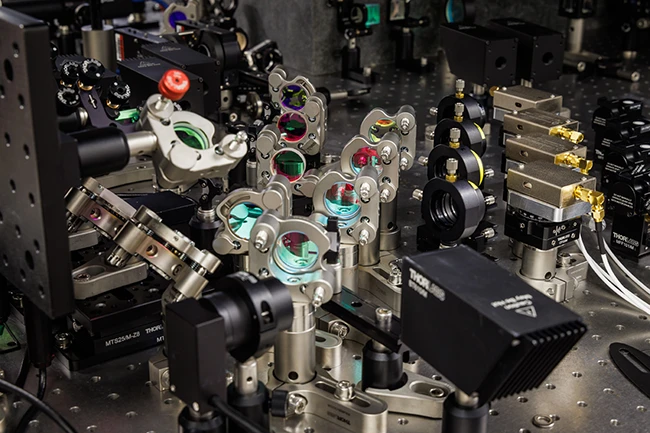
Close up of Writer showing high-speed multi-beam data encoding on laser pulses (Source: Microsoft)
Rising global data volumes increase the need for storage that can last for generations. Researchers believe this technology could preserve information for up to 10,000 years.
“We’re rethinking how large-scale storage systems are built to make use of the properties of glass media and create a sustainable and secure system to support archival storage for decades to come. We are co-designing the hardware and software stacks from scratch, from the media all the way up to the cloud user API. This includes a low-power design for the media library that reconsiders the robotics and mechanics of archival storage systems,” the company stated.
Richard Black, Partner Research Manager at Microsoft, said the new technique extends the technology beyond costly fused silica to borosilicate glass, a more affordable material widely used in kitchen cookware.
The system uses ultrafast femtosecond lasers to write data into the glass and polarization-sensitive microscopy with standard light to read it. This design creates a true air gap for the storage media, since the reading process does not generate enough power to alter the glass and overwrite data.
The mechanical structure of the media library also prevents storage media from returning to a writing unit, preserving the integrity of archived data throughout its lifespan.
According to Microsoft, Silica offers volumetric data densities higher than current magnetic tapes, with raw capacity exceeding 7TB in a square glass platter the size of a DVD.