
Cyber valuations climb as capital concentrates, AI security expands
Venture funding in cybersecurity continued to concentrate in large private rounds at the end of 2025, driving valuations higher across stages. Data from DataTribe shows total capital invested approached $150 billion for the year, with a disproportionate share flowing into fewer than 100 deals.
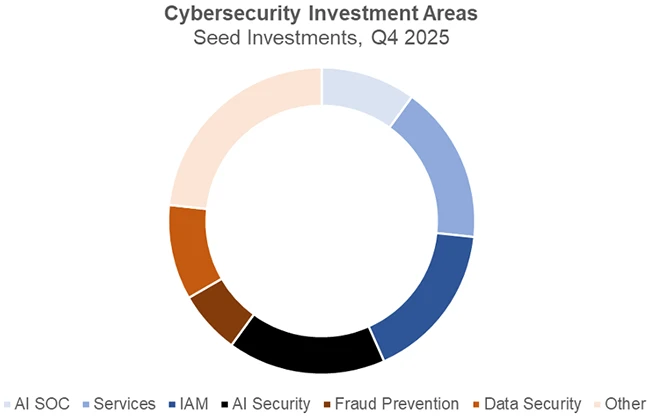
Cybersecurity investment areas (Source: PitchBook)
In Q4 alone, fewer than 100 transactions represented more than $34 billion in investment, and multiple financings surpassed the $1 billion mark. Companies continued to extend their time to exit, keeping significant capital in late stage private markets.
At the same time, IPO activity strengthened. The U.S. market recorded 110 offerings with more than $22 billion in proceeds in Q3 2025. Global IPO volume reached 387 offerings in Q4, the strongest quarter since late 2022. Continued momentum into 2026 could influence exit timing and capital recycling across the venture ecosystem.
Early stage activity improves, valuations climb
Seed and Series A deal activity increased during the quarter. Seed volume surpassed 1,000 deals for the first time since Q3 2023, representing a 41 percent increase from post pandemic lows in Q4 2024. Cybersecurity outperformed the broader venture market at both seed and Series A.
Median pre money valuations at Series A reached another record high across U.S. venture. In cybersecurity, Series A valuations approached the levels recorded in Q3 2023. Seed stage valuations in cyber also reached a new all time high, even as seed valuations in the broader market remained relatively flat.
Investor selectivity remained elevated at Series A. Down rounds persisted at higher levels, reflecting a funding environment in which companies that secure financing achieve valuation appreciation in line with pre pandemic norms. Capital remained highly concentrated at the top end of the market.
Capital flows shift across cyber categories
Several investment categories that softened earlier in the year returned to prominence in Q4. Services oriented companies accounted for more than 15 percent of deals during the quarter. This activity unfolded alongside continued growth in services delivered through software models.
AI security remained a focal point. Many companies shifted emphasis toward governance capabilities as enterprises prepare for more autonomous systems. Identity and access management represented more than 15 percent of deals, reflecting expanding machine identities across enterprise environments. Data security accounted for roughly 10 percent of transactions, including multiple companies focused on fully homomorphic encryption and its potential applicability to AI systems.
Startup focus tracks enterprise budget plans
Enterprise cyber budgets are expected to expand in 2026. In a survey of 3,887 business and technology executives conducted between May and July 2025, 78 percent indicated their organizations plan to increase cyber spending. Respondents spanned large and mid sized enterprises across 72 countries, with approximately 59 percent based in Western Europe and North America. 
A comparison of 98 cybersecurity startups that raised seed rounds in 2025 with enterprise budget priorities for 2026 shows broad alignment across categories. Artificial intelligence ranked highest in both startup formation and planned enterprise spending.
Within AI, two distinct segments emerged in seed activity. One group focused on protecting AI models, agents, and AI-enabled systems as a new attack surface. Another centered on AI driven automation and autonomous security operations, including SOC automation and continuous penetration testing. Both tracks map to enterprise interest in AI-related investment.
Cloud security and network security and zero trust ranked second and third among enterprise budget priorities for 2026. A smaller share of seed stage startups focused exclusively on those areas. Startup activity in 2025 concentrated heavily on red teaming, penetration testing, and AI enabled SOC automation. This distribution leaves room for additional innovation targeting cloud configuration challenges and network vulnerability management.
Cyber managed services and security awareness training also ranked high in enterprise spending plans. Venture backed seed activity in those categories remained limited. Managed security service providers typically operate as cash flow driven businesses in a competitive market. Security awareness continues to attract enterprise budget allocation, and many organizations report dissatisfaction with existing approaches.
Additional categories did not align neatly with enterprise budget taxonomy. Email security continued to generate seed stage activity. Blockchain security also appeared among startups, particularly as regulatory clarity improves and traditional finance continues to converge with decentralized finance infrastructure.
Market conditions heading into 2026
The fourth quarter reinforced trends seen throughout 2025. Valuations increased, capital concentrated in large private rounds, and AI remained central to investment strategy. Early stage volumes improved, accompanied by sustained investor selectivity at Series A.
If IPO momentum continues into 2026, public markets may provide additional exit opportunities. Venture capital flows indicate sustained interest in AI governance, identity expansion, data protection, and services delivered through software platforms. Cybersecurity startups are forming in areas that enterprises plan to fund, positioning the sector for continued activity in the year ahead.