
Tails 7.6 ships automatic Tor bridge retrieval and a new password manager
Tails 7.6 is out, and for users operating on networks that block Tor, the most consequential addition is built-in bridge retrieval. The Tor Connection assistant can now detect when a direct connection to Tor is restricted and automatically request bridges suited to the user’s region. The request goes through the Tor Project’s Moat API, and the connection to that API is disguised via domain fronting, making it appear as traffic to an ordinary website. Previously, users on censored networks had to obtain bridges manually and enter them by hand.
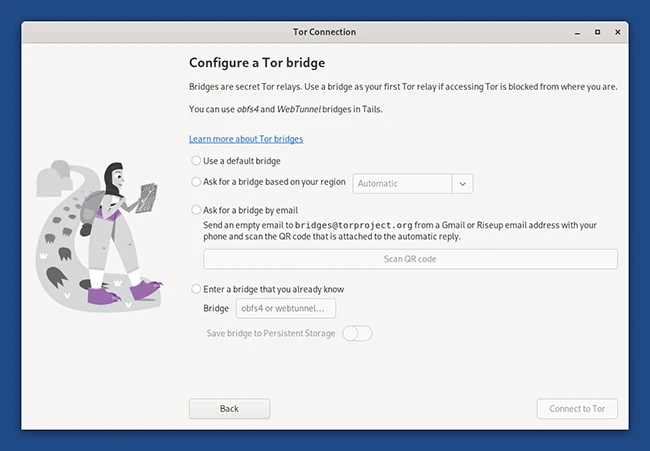
The feature closes a long-standing gap in Tails’ censorship-circumvention capability. Users who prefer to take action themselves can also select the option to request region-specific bridges directly from the connection assistant screen.
Password manager switches from KeePassXC to Secrets
Tails 7.6 replaces KeePassXC with the GNOME Secrets password manager as the default credential storage tool. Secrets has a simpler interface and integrates more tightly with the GNOME desktop environment. Accessibility features that were broken under KeePassXC, including the on-screen keyboard and cursor size adjustments, work again with Secrets. Existing KeePassXC database files are compatible with Secrets’ format, so stored credentials carry over without any conversion step. Users who depend on features specific to KeePassXC can still install it manually.
Component upgrades and Qt5 removal
The kernel moves to Linux 6.12.74. Tor Browser advances to 15.0.8, built on Firefox ESR 140.9. Thunderbird reaches 140.8.0esr. Electrum moves to 4.7.0, and that upgrade is tied directly to the removal of Qt5 from the distribution. The changelog confirms that Qt5 support packages have been stripped out entirely, and tests now verify that no Qt5 package ships with the build.
The base distribution advances to Debian 13.4 (Trixie). Firmware packages also receive an update: firmware-nonfree moves to version 20260110-1, improving hardware support for graphics cards and wireless adapters on newer machines.
The forge.js library, used in Tails’ web-facing components, upgrades to v1.3.3. The update includes a step to make it harder for external CDNs to target the project, and it brings the project’s license documentation into compliance with BSD 3-clause terms.
Bug fixes targeting localization and upgrade reliability
Three user-facing bugs are resolved in this release. Automated upgrades failed for users running Tails with the language set to Turkish; that problem is fixed. A broken link in the Thunderbird migration notification, the “Learn More” button that was supposed to point users to documentation, is restored. The confirmation dialog displayed when saving a language and keyboard layout to the USB stick in unencrypted form was not honoring available translations; it now renders in the user’s selected language.
Upgrading
Automatic upgrades are available for any installation running Tails 7.0 or later. The upgrade preserves data stored in Persistent Storage. Users whose automatic upgrade fails, or whose system does not start after an update, can follow the manual upgrade path available on the Tails documentation site.