
Multi-model AI is creating a routing headache for enterprises
Application teams are moving AI inference into production systems that support business operations. Enterprises are expanding traffic management, identity controls, observability, and routing systems for multiple AI models and environments.
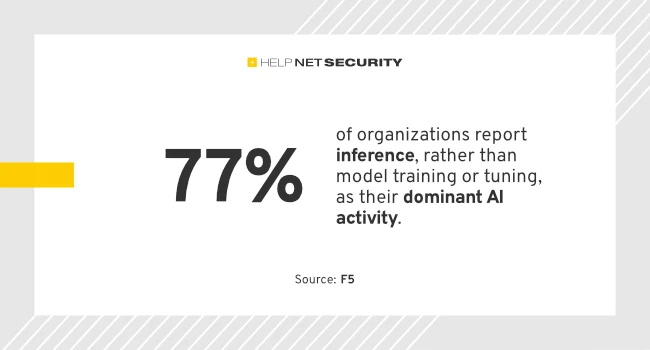
F5’s 2026 State of Application Strategy Report found that 78% of organizations operate their own inference services and 77% identify inference as their primary AI activity. They also operate or evaluate an average of seven AI models.
AI inference is the process of using a trained AI model to generate responses, predictions, or decisions from new data.
Inference moves into enterprise operations
AI inference falls into the same operational category as other enterprise application workloads. Teams run inference across public cloud platforms, colocation facilities, and on-premises infrastructure using many of the same controls tied to application delivery and security operations.
Multi-model AI inferencing introduces the same architectural and security challenges associated with distributed production workloads. Inference deployments are growing, and operational contro
“AI inference is becoming core to the business, which means AI delivery is now a traffic management challenge, and AI security is now a governance and control challenge. The companies that understand this shift early will be the ones that move faster and more safely,” said Kunal Anand, Chief Product Officer at F5.
New inference responsibilities are creating new teams with their own preferred tools, and the way firms manage the resulting complexity could shape the outcomes of their AI deployments.
Companies that underestimate infrastructure demands, complexity, and security risks tied to AI inference may encounter higher costs and operational strain.
Cross-model observability, centralized controls, and shared protection systems are becoming part of multi-model AI operations across enterprise environments.
AI workloads expand across hybrid multicloud operations
Most firms run hybrid multicloud environments across their own data centers, colocation facilities, and public cloud providers. They are integrating inference into business systems within hybrid multicloud environments.
Companies are also modifying external-facing applications to interact with AI agents. They are implementing identity-aware infrastructure to route and manage traffic based on machine or agent identity. Some are developing public-facing APIs that allow AI agents to access application data and functions, while others are adopting semantic data standards and data enrichment practices to support contextual understanding inside AI systems.
AI systems are becoming part of operational automation. AI now participates in decision-support functions and operational execution tasks tied to application environments. People continue to oversee application security, compliance, and business-risk decisions throughout enterprise systems.
Enterprises manage inference for multiple AI models
Organizations rely on multiple models, which challenges the idea that inference is a single endpoint. Instead, they operate a portfolio of models and services. This reflects the fact that no single model satisfies every workload, and teams continue to evaluate different models for different use cases. Different models introduce different costs, interfaces, and failure patterns under load.
Firms select AI models based on business and technical requirements that include cost optimization, compliance, resiliency, API compatibility, and model-specific capabilities.
Enterprises manage inference traffic across multiple models to support availability, preserve existing integrations, and control operational costs.
The shift toward multi-model AI is driven primarily by operational and business requirements. Models serve operational roles tied to workload requirements. Some are optimized for general tasks, while others are designed for specific workloads, cost efficiency, throughput, or accuracy.
Organizations are managing inference within distributed systems environments. They must determine which model should handle each request based on API compatibility, latency, availability, security, compliance, and cost.
Control planes become central to AI operations
AI systematization has direct implications for organizational architecture. When enterprises distill large models into smaller ones, combine them, or chain them dynamically, attention changes toward the control plane that determines where inference traffic goes, why it goes there, and how it is protected.
Orchestrating multiple models turns inference into a managed workload subject to delivery, security, cost control, and resilience requirements. Designing and managing systems that govern how inference traffic is routed, constrained, secured, and observed is becoming a major architectural priority for enterprises treating inference as a new application tier.
AI delivery and security converge around inference
Organizations are using AI to improve decision-making and automate operational tasks within defined limits. They are managing systems, policies, and controls connected to inference workloads
Many of them coordinate multiple AI models and inference services to support availability, compliance, and operational requirements. Investment is increasing around delivery and security controls tied to inference traffic and prompt handling.
