
Enterprises are rethinking where their AI applications run
Growing demand for compute capacity, power, cooling and low-latency connectivity is prompting organizations to reassess where AI applications run, according to CoreSite.
Public cloud continues to support experimentation and rapid deployment, while colocation is increasingly used for workloads that require predictable performance, dedicated infrastructure or close proximity to cloud services and enterprise data.
More than half of organizations have implemented or are upgrading AI technologies, an increase from the previous year. Generative AI, chatbots, predictive analytics and agentic AI have reached production environments at many organizations, indicating that AI deployments are moving beyond pilot projects.
Hybrid environments have become the preferred location for AI and machine learning workloads, while interest in on-premises deployments continues to decline. Colocation is emerging as a preferred environment for AI workloads that require additional power capacity and direct connections to cloud platforms.
“The levels of compute that AI requires are something new that enterprises are grappling with to manage effectively,” said Juan Font, President and CEO of CoreSite and SVP of American Tower.
“While the AI tools are effective, CIOs may not currently have accurate reporting on how widespread the usage is within their organizations. We’re seeing greater use of large language models, and the token usage, and therefore cost, is growing. So, when the actual invoices related to using these tools are shown to IT leaders, they start to rationalize and prioritize projects with higher ROI on AI spend.”
Colocation gains ground
Enterprises are expanding the role of colocation facilities within their infrastructure. They are deploying a broader range of applications in these environments, including web applications, human resources systems, security workloads and augmented AI applications.
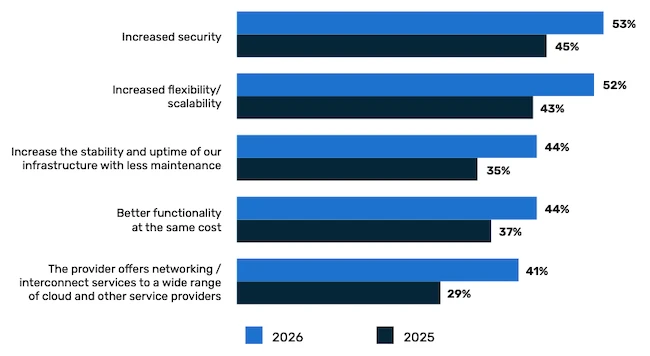
Top technical drivers for moving workloads to a colocation environment (Source: CoreSite)
Organizations increased public cloud deployments of mobile applications, websites, chatbots and content delivery services compared with the previous year. Some workloads moved away from public cloud as organizations reassessed workload placement based on performance, security and infrastructure requirements.
Organizations prioritize security, uptime and predictable performance when selecting colocation providers. Businesses value direct connections to cloud platforms, scalable infrastructure and support for the higher-density power and cooling requirements of AI systems.
Connectivity becomes a priority
Direct connectivity between enterprise infrastructure and major cloud providers has become an important requirement for hybrid deployments.
79% of IT leaders said native, direct cloud connections are a very important capability for colocation providers. These connections provide lower-latency access to cloud services, reduce reliance on the public internet and simplify data movement between enterprise environments and cloud platforms.
Organizations are increasingly evaluating provider ecosystems that combine cloud platforms, network carriers, AI services, security products and managed services to support workloads across multiple infrastructure environments.
