
Microsoft unveils MAI-Cyber-1-Flash, promises cybersecurity AI at half the cost
Microsoft has introduced MAI-Cyber-1-Flash, a security-focused AI model built into MDASH, the company’s multi-agent vulnerability identification and remediation system.
MAI-Cyber-1-Flash is Microsoft’s first model built specifically for cybersecurity work, and the company stated that it went through review by its AI Red Team, adversarial testing, and an assessment by an outside party.
Microsoft argues that advances in AI are giving attackers increasingly powerful capabilities to search large codebases for vulnerabilities, increasing the need for AI models designed to help identify software flaws.
“As the cost of finding a flaw collapses, the old model of security, where you scan occasionally and patch eventually, is now obsolete. If we’re to unlock the true benefits of AI, we must first build outstanding cyber models that help all of us harden the software the world runs on,” Microsoft wrote.
The company says MAI-Cyber-1-Flash was developed to identify challenging vulnerabilities in complex codebases and has been integrated into MDASH, where it works with multiple AI agents.
“Through MDASH, customers get enterprise-grade controls including role-based controls, tenant isolation, encryption, auditability, and sandboxed execution environments with no internet access,” the company added.
Microsoft says that MAI-Cyber-1-Flash inside MDASH outperformed Mythos, Gemini and GPT on the CyberGym benchmark, which it describes as a benchmark for evaluating how AI systems reason over large codebases to identify software vulnerabilities. According to Microsoft, it scored 12 points higher than Mythos.
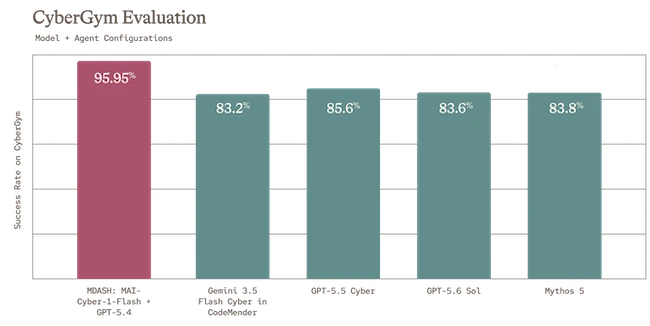
(Source: Microsoft)
“When combined with MDASH, it delivers world-class performance at 50 percent of the cost of leading models,” said Satya Nadella, CEO of Microsoft.
Project Perception
Microsoft also introduced Project Perception, an agentic security system built on MDASH.
“Project Perception brings together signals, context, models and specialized agents into a continuously learning system of defense. It can reason, prioritize and act at machine speed while keeping humans firmly in control and empowering them with powerful new workflows,” Hayete Gallot, EVP of Microsoft Security, said.
Microsoft noted that Project Perception enters public preview on August 3, 2026, and that the company plans to expand it with additional specialized security agents over time.
