
Companies push AI, sysadmins keep it on a short leash
In 2024, sysadmins expected AI to automate patch management optimization, vulnerability prioritization, infrastructure monitoring, and incident response within two years. Action1’s 2026 Survey Report: AI Impact on Sysadmins found that those expectations proved overly optimistic. The largest shortfalls appeared in high-impact operational and security functions, where AI needs to understand business context, system dependencies, risk, and the consequences of an incorrect action.
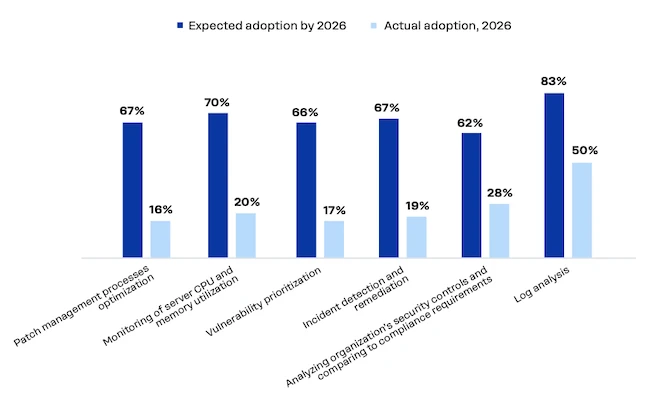
Areas with the widest expectation-reality gaps (Source: Action1)
Sysadmins view patch management and vulnerability prioritization as suitable for automation, but fewer than one in five currently use AI in either area.
Troubleshooting is the only area that has approached the level of automation predicted two years ago. Sysadmins use AI to generate hypotheses, identify possible causes, locate relevant information, and suggest commands or next steps. They still verify its findings, redirect investigations when AI follows the wrong path, and remain responsible for final diagnosis and resolution.
AI adoption varies across sysadmin workflows
AI adoption has not progressed evenly across sysadmin functions. To assess the relative maturity of different use cases, Action1 evaluated four factors: current adoption, growth since 2024, expectations for automation within the next two years, and the share of respondents who reported AI failures in each area.
Beyond serving as an assistant, AI adoption increased in analytical and advisory tasks, including compliance analysis, IT staff guidance, infrastructure monitoring, first-level end-user support, and post-incident reviews. Respondents continued to report outdated instructions, inaccurate recommendations, and difficulty handling user-specific or environment-specific issues.
Implementation changed little over the past two years in incident detection and remediation, vulnerability prioritization, and patch management optimization. These functions are candidates for AI because they involve large volumes of vulnerability, threat, and operational data. They require context that AI may not possess, including system criticality, maintenance windows, compensating controls, business impact, dependencies, and organizational risk tolerance.
Workflows that establish organizational rules or modify software environments have seen modest AI adoption.
Policy development requires AI to account for internal governance, compliance obligations, risk tolerance, ownership, existing procedures, and organization-specific exceptions. This context ensures recommendations align with organizational requirements.
Software installation and maintenance involve risks such as selecting incorrect versions, overlooking dependencies, using invalid installation paths, generating nonexistent commands, and producing instructions that do not match the target operating system or configuration. These errors can disrupt users, weaken security, and affect production systems.
The least adopted AI use cases, which also had the lowest expectations for future automation, include file management, user administration, and identity management. Respondents reported unsuccessful experiences, including incorrectly granted or revoked access, exposed credentials or sensitive company data, permissions assigned to the wrong user, and files that were misclassified, moved, or deleted. These errors could create security, privacy, and compliance consequences while leaving accountability for the resulting harm ambiguous.
Why sysadmins remain cautious about AI
Since 2023, the share of companies requiring sysadmins to implement AI has more than doubled. Understanding of how to apply AI has increased even faster.
Sysadmins remain cautious when using AI for production systems, security policies, access management, and remediation, relying heavily on human oversight. In 2026, 23% of respondents said they had never used AI professionally.
Data privacy, security risks, and uncertainty about AI accuracy and reliability remain sysadmins’ biggest concerns regarding AI adoption. More than half are concerned about losing control or visibility over AI-driven actions and decisions, as well as the cost of AI tools and ongoing adoption.
Concerns about job replacement and learning to use AI ranked lower. Respondents focused on the consequences of AI making incorrect decisions or accessing sensitive systems and data. They expressed concern that overreliance on AI could reduce hands-on learning and weaken long-term technical skills. Respondents want organizations to demonstrate operational value before deploying AI rather than adopting it simply because it is available.
Where sysadmins draw the line
Sysadmins are most willing to trust AI with prioritization and scheduling tasks. The highest level of trust was for assessing the severity and urgency of newly released patches. Nearly half trusted AI to schedule workstation patching, plan maintenance windows, and reduce unnecessary after-hours alerts.
They are less willing to let AI make decisions affecting production systems. Most want human approval for determining when to patch production servers, deciding which patches can be deferred, choosing rollback or remediation after failed patches, and creating pilot groups for staged deployments.
Trust drops sharply when AI is asked to act without oversight or override established policies. Fifty-three percent of respondents would not allow AI to deploy patches across production systems while they were away, and only 14% would allow it without supervision. Just 11% would let AI override existing patching policies, while 40% would not allow it under any circumstances.
