
Claude Opus 5.5 cuts costs and adds safeguards for autonomous AI
Claude Opus 5.5 is available across Anthropic’s platforms, Amazon Web Services, Google Cloud and Microsoft Azure. Developers can access it through the Claude Platform using the model name claude-opus-5-5. It includes watermarking measures designed to comply with the EU AI Act.
Built for long and complex tasks
Opus 5.5 is designed for codebase migrations, software audits, financial analysis, data collection and workflows involving several applications.
Early testers used the model for engineering tasks that ran for hours. In one test, Opus 5.5 audited and fixed a 200,000-line codebase in less than three hours. Opus 5 took more than 20 hours to complete the task and used 2.5 times as many tokens.
“I handed Claude Opus 5.5 a large engineering task across six of our repositories and let it run overnight, unattended. It stayed on task for over 18 hours defining how our services talk to each other and working out how each one should apply that. Compared with Opus 5, it hit milestones faster and required minimal reworking. Its code comments were short and useful instead of long and prose-heavy. I’m struggling to find anything negative to say,” Sean Heintz, staff software developer at Clio, said.
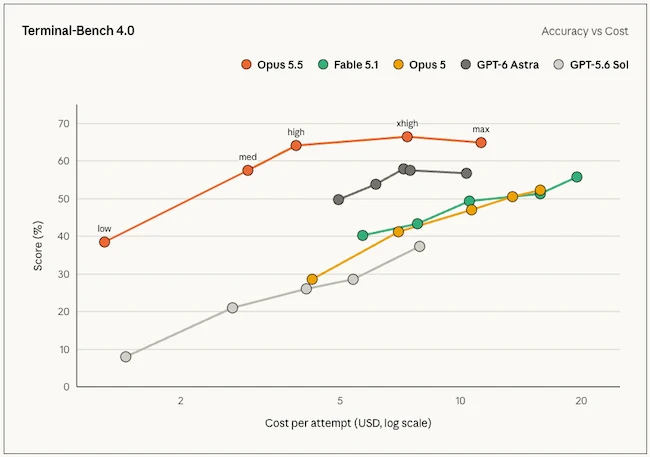
Terminal-Bench 4.0 measures how well a model can complete complex, multi-step professional tasks within a command line interface. (Source: Anthropic)
Early testers reported improvements in maintaining context, delegating work to other agents and checking results. Their accounts indicate that the model can reduce the prompts, tool calls and corrections needed to complete a task.
Anthropic reports gains in coding, computer use and professional knowledge work. Its benchmarks and customer tests indicate that Opus 5.5 can complete many tasks using fewer tokens than Opus 5. Performance may vary according to the task, tools and effort settings.
“Even at its lowest effort setting, Claude Opus 5.5 caught 72% of known bugs in our code reviews to Opus 5’s 56% at high effort, with fewer false alarms and a fraction of the output. On US consulting analysis, low thinking effort matched its higher thinking settings on half the output and passed our quality checks. When more lower thinking efforts are deployed in production, that’s client-ready work delivered efficiently,” said Carl Bennett, CIO at Deloitte Consulting.
Thinking mode stays on
Opus 5.5 cannot be used with “thinking” switched off. The model always uses a reasoning process, and developers can adjust the effort it applies to a task.
The release also includes preserved thinking, a safeguard designed to prevent API users from editing Claude’s prior context. Anthropic says the measure makes it harder to extract and copy the model’s capabilities through large-scale distillation attacks.
Preserved thinking applies to Opus 5.5 API accounts created on or after August 31, 2026.
Anthropic says Opus 5.5 is easier to understand, places key information earlier in responses and follows writing instructions more closely.
Additional controls for sensitive work
Anthropic CEO Dario Amodei said AI development should advance at a rate that allows safety practices to stay ahead of model capabilities. He described this approach as a way to manage risks, remain competitive with China and deliver benefits in fields such as biology and medicine.
Opus 5.5 includes safeguards covering cybersecurity, biology and attempts to copy the model. Most cybersecurity tasks are rerouted to Opus 4.8. Anthropic plans to expand its Cyber Verification Program to give verified cybersecurity professionals broader access to Opus 5.5.
Organizations whose biological research is impeded by the safeguards can apply to Anthropic’s Life Sciences Verification Program.
Anthropic has added a classifier that screens coding-agent actions before execution. The company has also introduced an open-source sandbox that security teams can audit and code-review features designed to catch vulnerabilities before changes are merged.
The model has stronger defences against prompt-injection attacks. In an evaluation of attempts to cross containment boundaries, the model tried to circumvent its assigned limits about 85% less often than Opus 5 or Claude Mythos 5.1. Anthropic said every attempt was low severity and self-reported.
External organizations, including METR and Frontier Design, evaluated the model before its release. Anthropic acknowledges that current evaluations cannot identify every potential failure before deployment.
Lower API prices and faster output
Claude Opus 5.5 costs $4 per million input tokens and $20 per million output tokens, down from $5 and $25 for Opus 5. Cached input reads cost $0.20 per million tokens, down from $0.50.
The lower cache price could benefit coding agents and other systems that consult the same instructions, files or conversation history repeatedly.
The model generates output more than 30% faster than Opus 5. A separate fast mode is available through Claude Code and the Claude Platform, offering up to 2.5 times the speed for $8 per million input tokens and $40 per million output tokens.
Anthropic is increasing five-hour usage limits for Pro, Max, Team and seat-based Enterprise customers. Subscription users will receive a rate-limit reset that they can save and use later.
