
Warp open sources its AI terminal client
Warp, the AI-centric terminal used by close to a million developers, has released the source code for its client on GitHub under the AGPL license, with OpenAI signed on as the founding sponsor of the repository.
An agent-first contribution model
Warp is steering contributions through Oz, its cloud agent orchestration platform. Agents handle the bulk of implementation work, including coding, planning, and testing, and human contributors focus on ideas, direction, and verification of agent output. The Warp team retains responsibility for guiding what gets built and when.
Contributors can use other coding agents to submit changes, with Oz set as the preferred path because it carries Warp’s rules, context, and verification loops. The agent workflows in the repository run on OpenAI’s GPT models.
“Open source has long been central to how developers learn, build, and push the field forward. We’re excited to support experiments that explore how AI can help maintainers and contributors collaborate more effectively at scale,” Thibault Sottiaux, Engineering Lead, OpenAI, explained.
Product changes shipping with the release
Warp paired the licensing change with three product updates. The first is wider support for open-source models, including Kimi, MiniMax, and Qwen, along with a new “auto (open)” routing option that selects an open model based on the task.
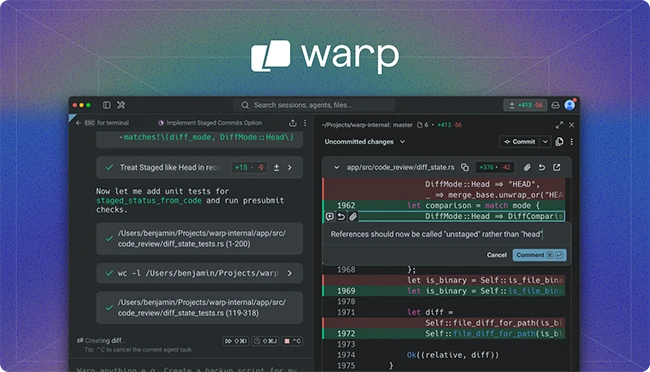
The second is a layered customization model for the application itself. Users can run Warp as a basic terminal, as a terminal with a small set of agentic features such as a diff view and file tree, or as a complete agentic development environment with built-in agents.
The third addition is a settings file, giving users and agents programmatic control over configuration and portability across machines.
Open roadmap and business rationale
Public GitHub issues will serve as the system of record for feature tracking going forward, and Warp plans to publish its roadmap for the agentic development environment and hold technical and product discussions in public.
Warp chief executive Zach Lloyd cited competitive pressure from well-funded closed-source rivals as a driver of the decision. Warp does not plan to compete on price or subsidize usage, and is betting that an active community paired with agent orchestration will let the company ship features faster than an internal team alone.
Warp is available for free on GitHub.

Must read:
- 25 open-source cybersecurity tools that don’t care about your budget
- GitHub CISO on security strategy and collaborating with the open-source community

Subscribe to the Help Net Security ad-free monthly newsletter to stay informed on the essential open-source cybersecurity tools. Subscribe here!
