
Finance phishing works because it sounds boringly normal
Finance departments process a constant stream of invoices, contracts, payment notices, and procurement emails, making email one of the most common initial access vectors for threat actors. According to Cofense, attackers exploit those workflows with phishing emails that resemble legitimate business correspondence rather than relying on urgency-based lures. Such phishing emails are also likely to bypass AI-based secure email gateways (SEGs) and other email security technologies.
Threat actors understand that employees in financial services organizations and finance departments routinely process repetitive administrative messages, making them more susceptible to phishing attacks.
Finance phishing mimics business workflows
Finance-themed campaigns account for the highest volume of phishing emails across all campaign categories. Email subject lines present the message as part of an ongoing business process. Operational themes appeared in 59% to 79% of phishing subject lines targeting financial organizations, while urgency-based messages accounted for 21% to 41%.
Subject lines that resemble routine business communication may avoid immediate suspicion because they match expected workflows. They may also perform better against users trained to recognize traditional phishing indicators but not routine administrative language.
Finance-themed campaigns center on new business opportunities, contracts in progress, and payments.
Business opportunities, contracts and payments
Attackers use fake business opportunities because unsolicited commercial messages are common in finance and procurement. These emails often pose as requests for proposals, tender invitations, supplier registrations, procurement notices, or bid invitations.
This approach works because such communications often originate from unfamiliar sender domains, include external attachments, and provide limited context. Recipients may not question unknown senders because vendor outreach and proposal exchanges frequently come from outside the organization.
Fake procurement opportunities reinforce the appearance of legitimate business communication and are less likely to trigger suspicion or additional verification.
Why contract and payment phishing works
Contract-related lures that appear to involve ongoing negotiations are successful because they create a sense of continuity. Rather than initiating a new conversation, attackers present the email as part of an existing exchange.
These campaigns differ from business email compromise (BEC) by relying on procedural realism. They simulate forgotten email threads, partial documentation, or incomplete negotiations.
Recipients may assume the message belongs to an existing conversation involving another department or colleague. As a result, they are more likely to open an attachment or click a link before questioning whether the email is legitimate.
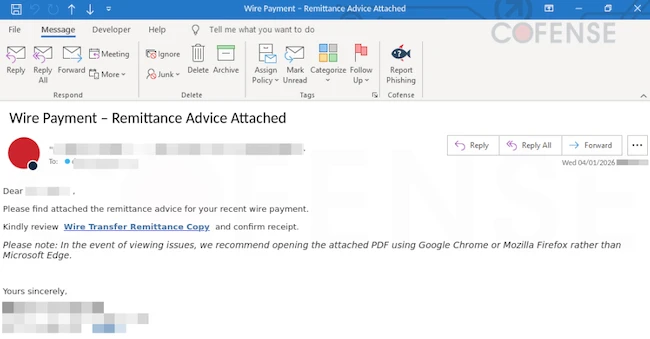
Example of a finance-themed credential phishing email leveraging an embedded malicious URL to facilitate credential phishing. (Source: Cofense)
Payment-related lures remain the strongest and most persistent finance-themed tactic because payment language carries built-in legitimacy in financial operations. Threat actors pretend to send or request money by using remittance advice, payment confirmations, or transfer notices. They also impersonate payment corrections, revised bank detail communications, and invoice issuance.
