
AI deployments are stretching enterprise security to its limits
CISOs and CTOs expect AI deployments to increase their organizations’ attack surface by an average of 14% over the next year. Nearly all lack visibility into AI deployments, and 90% are concerned about employees using unapproved AI tools outside formal oversight, according to NetFoundry’s 2026 State of Secure AI Access survey.
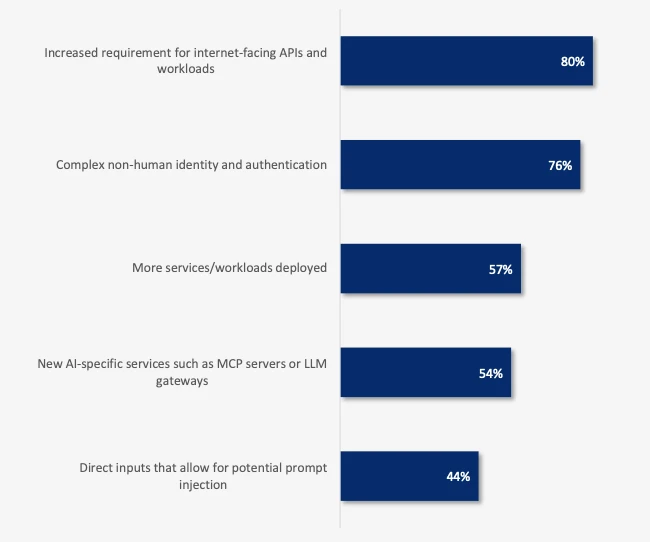
Key aspects of AI deployments contributing most to attack surface changes (Source: NetFoundry)
Organizations are under pressure to secure AI deployments, particularly in the retail and travel, healthcare and pharmaceuticals, and technology sectors. AI-related risks are now a top concern for security leaders. Only 15% of respondents said they were very confident their existing security tools could adequately protect AI deployments. Confidence was lower for CISOs.
Companies are also less confident securing AI systems and other machine workloads than protecting human users. Security investments over the past decade have focused primarily on people, leaving existing tools less suited to AI agents, APIs, and other machine-to-machine communications.
Software vulnerabilities have become the leading path for cybercriminals to gain initial access to organizations, and AI is helping attackers identify and exploit them faster. Vulnerability exploitation now accounts for about 31% of breaches, while the time between disclosure and active exploitation has shrunk from months to hours. Organizations are taking longer to remediate known exploited vulnerabilities, with the median time to patch increasing to 43 days.
Machine identities become a bigger concern
AI applications rely on models, APIs, cloud services, data sources, and partner platforms spread across multiple environments. Each new connection creates another potential entry point for attackers and expands the attack surface. Internet-facing APIs, distributed workloads, and non-human identities are the primary drivers of that expansion.
Static secrets, credentials, and service accounts give AI agents access to applications and data. These credentials often remain active for long periods, accumulate excessive permissions, and become harder to manage as AI deployments expand.
“For a decade we built security around human identity, but the fastest-growing risk today is machines connecting to machines — agents, models, MCP servers, APIs, and data moving across clouds, edges, and partners. Leaders know their VPN- and firewall-era tools weren’t designed for this, and they’re urgently looking for an identity-first approach that gives every workload a verifiable identity and eliminates the reachable attack surface entirely,” said Galeal Zino, CEO of NetFoundry.
Security teams are looking for better ways to identify, authenticate, and monitor AI agents without relying on long-lived credentials. Most organizations are evaluating new approaches to securing non-human identities.
Shadow AI reduces visibility
Infrastructure security ranked as a bigger concern for CTOs than CISOs, with 60% of CTOs identifying it as a key issue, compared with 41% of CISOs. Technology leaders responsible for building and operating AI environments are especially concerned about weaknesses in the underlying infrastructure.
More than one-third of respondents said they struggle to monitor AI agent activity, with the highest level of concern reported in the financial sector. Limited visibility makes it harder to detect problems, investigate incidents, and manage AI systems.
Ninety percent of respondents said they are concerned about employees using AI tools without the approval or oversight of IT and security teams. These tools can bypass existing security controls, reducing visibility into AI usage and the information those tools can access. Shadow AI is becoming a common byproduct of AI adoption as employees seek productivity gains.
Security reviews slow deployments
Securing AI deployments is extending implementation timelines. More than half of respondents said network changes, including firewall rule updates and access control modifications, add one to two weeks to AI deployments, with an average delay of eight days.
Every new AI model, API, or data connection requires security teams to review, approve, and implement changes before deployment. As AI environments expand and more applications and services are connected, these approval processes add time to projects. Deployment timelines are likely to increase further as AI adoption grows and security requirements become more complex.
Risk and compliance reviews are another major source of delays. More than half of respondents identified security reviews, compliance checks, and cross-team coordination as the biggest obstacles to making the network changes required for AI deployments. Organizations can expect additional security reviews and stricter oversight before new AI systems, APIs, and network connections are approved, especially as attackers continue to target software vulnerabilities.
