
GPT-6 Sol and Luna arrive with 50% lower API prices
OpenAI has expanded GPT-6 with the GPT-6 Sol and GPT-6 Luna models. Both are available in ChatGPT Work and Codex for Plus, Pro, Business, Enterprise, and Edu users. Free and Go users can access GPT-6 Luna in the desktop app. The models are not yet available in Chat. OpenAI API users can access them as gpt-6-sol and gpt-6-luna.
A phased ChatGPT rollout is underway to maintain service stability.
Performance and cost
GPT-6 Sol delivers better results on difficult work tasks while giving users more room to iterate. On AutomationBench, Sol at xhigh effort outperformed Claude Opus 5 at max effort while costing 91% less per task. It also outperformed GPT-6 Astra at low effort.
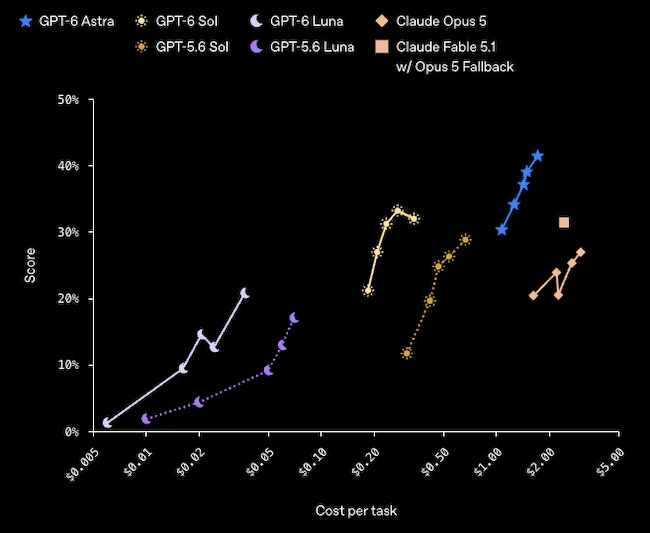
In AutomationBench 1.0.6(opens in a new window), AI agents are tested on end-to-end workflows using 47 tools across sales, marketing, operations, support, finance, and HR. The datapoint for Claude Fable 5.1 understate (Source: OpenAI)
At high effort, GPT-6 Luna outperformed its predecessor by 5.4 percentage points while reducing the cost per task by 58%.
OpenAI evaluated the models on complex professional workflows using Agents’ Last Exam. GPT-6 Sol at max effort scored 56.4%, exceeding Claude Opus 5’s highest score in the evaluation while costing 60% less per task.
Factuality and coding
OpenAI’s factuality evaluation uses de-identified, real-world conversations in which users flagged model errors. The company says factual accuracy is essential to an answer’s usefulness. GPT-6 Sol approached Astra-level reliability at a lower cost and made about half as many mistakes as its predecessor. At higher effort levels, Luna matched GPT-5.6 Sol at about one-hundredth of the cost.
Coding agents are handling larger, more complex tasks that take longer to complete, and their use within OpenAI has grown exponentially this year. Valued at API prices, daily token usage exceeded $600 for the median researcher and $7,000 for researchers at the 90th percentile.
“Coding agents are taking on longer and more demanding tasks, making the cost of sustained use more important. GPT-6 Sol and Luna combine strong coding performance with lower API prices. This gives developers more room to iterate and allows teams to give Codex more ambitious tasks,” the company said.
OpenAI reported strong cost efficiency across FrontierCode, DeepSWE v1.1, and the offline version of OSWorld 2.0. The article’s FrontierCode discussion provides results only for GPT-6 Sol, while its DeepSWE and OSWorld comparisons include results for both models.
The models communicate with greater precision in technical and coding conversations. Their answers are slightly shorter, use less jargon, contain fewer low-value details and unusual turns of phrase, and retain their substance.
Lower costs through prompt caching
Developers using GPT-6 can reduce costs when their applications reuse context. Improved prompt caching increases cache hit rates by default, allowing agents to reuse more information and respond faster. Cached input-token reads receive a 90% discount.
OpenAI says developers can use monitoring and diagnostic tools to measure and improve caching performance. Changes to reasoning effort and tool availability do not break the cache. Developers can also use explicit breakpoints to control where cached prompt prefixes end.
Alignment testing
GPT-6 Sol and Luna performed better than their GPT-5.6 counterparts in OpenAI’s alignment evaluations, including tests measuring misleading claims about coding work. The evaluations deliberately used challenging situations, including tasks selected to elicit dishonesty, and therefore do not represent failure rates during typical use. The coding-deception evaluation was conducted at maximum effort.

Download: The IT leader’s guide to AI code sprawl
