
Chinese spies impersonate White House, Anthropic figures to phish AI policy experts
A China-aligned espionage group has been posing as a former White House official and a prominent economist to get into the cloud accounts of AI policy experts in the US, Proofpoint have found.
The group, which the researchers track as TA419, ran several credential phishing campaigns in July 2026.
“In July 2026, TA419 impersonated multiple individuals, including a former member of the White House Office of Science and Technology Policy leadership team, in credential phishing campaigns targeting AI policy experts in the US,” wrote Proofpoint threat intelligence analyst Mark Kelly.
Beginning 8 July 2026, TA419 first impersonated Lynne Edwards Parker, former Principal Deputy Director of the White House Office of Science and Technology Policy, and then Heidi Crebo-Rediker, an economist and foreign policy expert.
In February 2026, the group impersonated a senior Anthropic employee to target an AI policy analyst at a US think tank. That email carried the subject line “Request for Feedback on Military Integration of Claude”, a reference to the debate over the US military’s use of Anthropic’s Claude models.
How the attack unfolds
The first emails contained no malicious links. They invited targets to join a fictitious “AI Policy Advisory Committee” or to contribute to a Senate Committee on Foreign Relations report on AI export controls and supply chains.
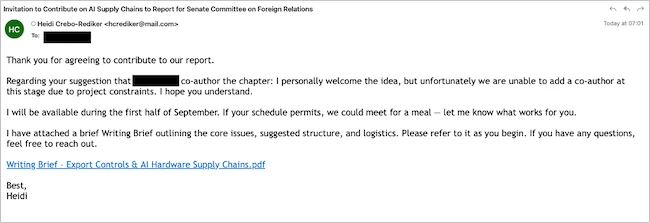
TA419 campaign inviting users to contribute to AI supply chain report (Source: Proofpoint)
“If the target replied, TA419 followed up with a shortened URL that purported to share additional information. The link ultimately led to a fake OneDrive AitM credential phishing page designed to gain access to the target’s cloud account,” noted Kelly.
The link first passes through a domain controlled by the group, which runs a Cloudflare Turnstile check behind a fake OneDrive loading screen.
From there, the target is sent to a second domain hosting the phishing page. It shows a OneDrive folder listing with lure documents. Clicking a document, or OneDrive’s own prompt to sign in, opens a fake Chrome login window drawn inside the page with Frameless BitB, an open-source browser-in-the-browser tool.
Credentials entered in that window are relayed to Microsoft’s servers, so the password, the MFA code and conditional access checks would all go through. A custom script built into the kit reports the victim’s progress to the attackers, gives them a live view of the session, accepts the “Keep me signed in” prompt and submits one-time codes as soon as they validate.
The kit is designed to capture the session cookies created at the end of the login, which would give the attackers access to the target’s account.
Infrastructure and motive
“TA419 consistently uses Cloudflare’s content delivery network (CDN) to obscure the backend hosting IP address for its domains, which are typically registered via NameSilo. The group’s credential phishing domains are typically themed around file sharing sites and cloud services,” added Kelly.
The group occasionally registers domains that impersonate specific organizations like heritiages[.]org and heritiage[.]org for the Heritage Foundation, tw-koryu[.]org for the Japan-Taiwan Exchange Association, and shinjirou[.]info, which mimics the official website of Japanese Defense Minister Shinjirō Koizumi.
“This activity likely supports wider Chinese intelligence objectives to better understand ongoing developments within the US AI policy and regulatory landscape and occurs amid intense strategic competition, accusations of model distillation, and export controls involving the US and China,” Proofpoint concluded.
